
Ants trailing up your money plant? Most advice tells you to kill the ants — but that’s treating the symptom, not the cause. (Hint: the real problem is hiding in the leaf joints.) Here’s how I actually break the mealybug cycle for good, not just for a week.
If you’ve spotted a trail of tiny ants marching up your money plant’s stem, don’t reach for the ant spray just yet. Ants rarely bother a healthy plant — they’re there because something sweet is already growing on it.
Nine times out of ten, that “something” is a mealybug colony, and the ants are simply farming them for the sugary honeydew they produce.
I’ve diagnosed this exact combination on dozens of balcony and living-room money plants across Mumbai, Pune, and Bangalore, and the pattern is almost always identical.
The good news: mealybugs on money plant are one of the most fixable pest problems in indoor gardening, provided you treat the actual cause instead of just the ants you can see.
Why Ants Suddenly Show Up on a Healthy-Looking Money Plant
Money plant (Epipremnum aureum, sold locally as paisa plant or golden pothos) is one of the most forgiving houseplants you can own, which is exactly why most owners don’t check it closely until ants appear. Ants aren’t attacking the plant.
They’re following a scent trail to a food source, and that food source is the sticky, sugar-rich waste called honeydew, excreted by sap-sucking insects. Common black garden ants and the smaller ghost ants found in Indian kitchens are both notorious honeydew foragers.
Here’s what most guides won’t tell you: ants actively protect the pests producing this honeydew.
They chase away ladybird beetles and lacewing larvae — the natural predators that would otherwise keep mealybug numbers in check — because killing off the mealybugs would mean losing their food supply.
This is why an ant trail on your plant is a warning sign, not the actual disease. Treating only the ants and the mealybug colony underneath will keep growing undisturbed, safer than ever from predators.
Mealybugs on Money Plant: How to Actually Identify Them
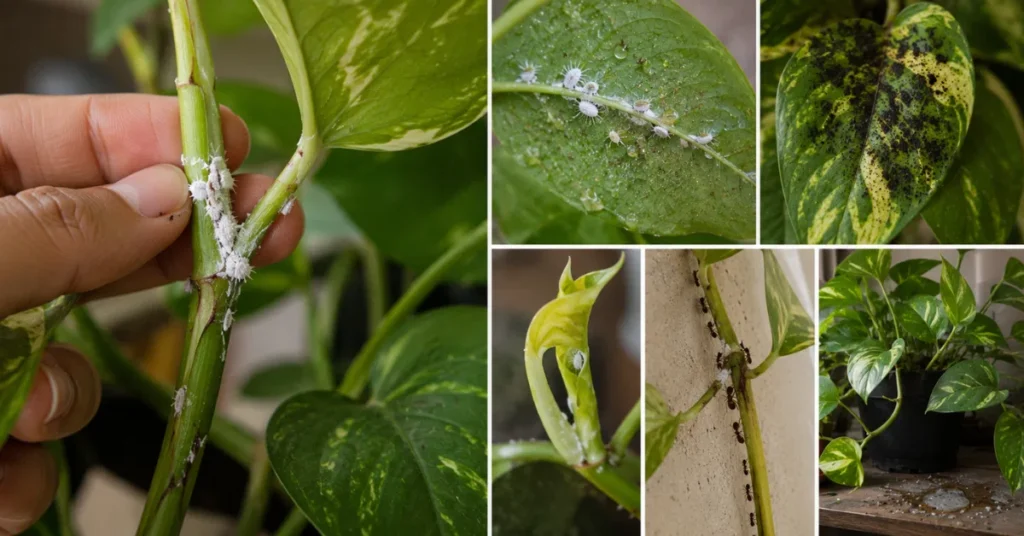
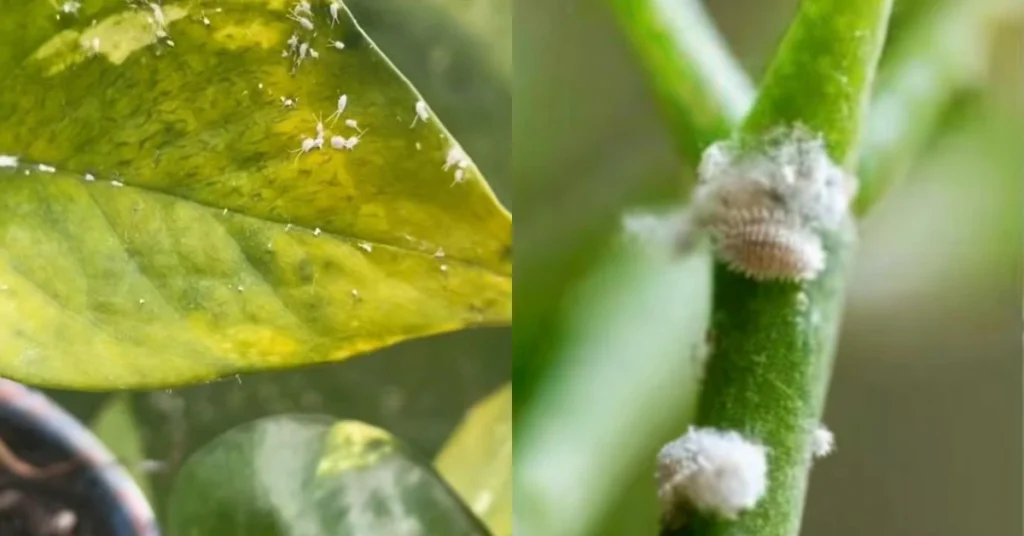
Mealybugs look like small tufts of white cotton wool, usually 2–4 mm long, clustered in leaf joints, along the underside of leaves near the midrib, and at the base of stems where they meet the soil — the warmest, most sheltered spots on the plant.
In the early stage, people often mistake them for fungus or mould because of the white, powdery coating. Run a finger over the patch: mealybugs will feel slightly waxy and, if disturbed, some may actually crawl.
A few field-tested identification pointers that separate mealybugs from other common money plant problems:
- Sticky residue on leaves or the floor/table beneath the pot — this is honeydew, and it’s the single most reliable early sign, often noticed before the insects themselves.
- A thin black, sooty film on leaf surfaces — this is sooty mould, a fungus that grows on old honeydew deposits. If you see this, assume mealybugs have been present for at least a few weeks.
- Curled or yellowing new growth, especially near the growing tip, where mealybugs prefer to feed on tender tissue.
- Ants move in a fixed path up and down the same stem repeatedly, rather than randomly foraging across the plant.
If your money plant is trailing along a shelf or wall, check every node where a leaf meets the stem — this is where mealybugs hide first, and where most people miss them until the population has already tripled.
Why This Combination Is So Common in Indian Homes
Money plant thrives in exactly the conditions that also favour mealybugs: warm temperatures, still air, and slightly dusty leaves that go unwiped for weeks.
Balconies with limited air circulation, north-facing rooms with AC running most of the day, and clustered indoor plant corners are the three most common infestation sites I come across during monsoon and post-monsoon months (July to October), when humidity stays high without matching airflow.
A second, less obvious cause is cross-contamination. Mealybugs travel easily on new nursery plants, on pruning scissors used across multiple pots, and even on clothing if you brush against an infested plant and then touch another one.
If you’ve recently brought home a new plant from a nursery — even one that looked perfectly clean — and started noticing ants a week or two later, that new plant is very likely the source.
Breaking the Mealybug Cycle: A Step-by-Step Treatment That Actually Works
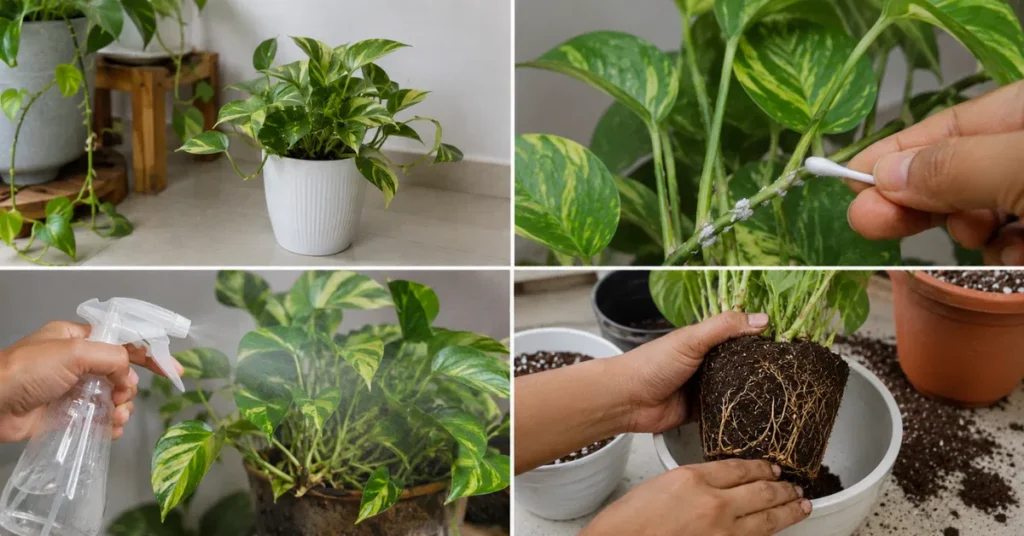
This is the part most articles rush through with a single line like “wipe with neem oil.” In practice, treating mealybugs on money plant needs a sequence, not a one-time spray, because mealybugs lay eggs in a waxy, water-resistant coating that survives a single wipe-down easily.
Step 1 — Isolate the Plant Immediately
Move the affected money plant away from all other plants, even if it means placing it in a bathroom or a separate room for two to three weeks.
This single step prevents 80% of the reinfestation cases I see. Mealybugs and their crawlers (the young, mobile stage) move to neighbouring pots via touching leaves, shared saucers, or even wind if pots are close together on a balcony rail.
Step 2 — Physical Removal Before Any Spray
Spraying directly onto a heavy infestation without removing the bulk of it first is one of the most common mistakes. Before any treatment:
- Dip a cotton bud or an old, soft toothbrush in 70% isopropyl alcohol (rubbing alcohol), easily available at any pharmacy in India, and dab it directly onto every visible mealybug cluster. The alcohol dissolves their waxy coating and kills on contact.
- For heavier infestations along the stem, wrap a piece of cotton soaked in alcohol around the stem and gently wipe downward.
- Rinse the whole plant under a gentle tap or shower afterward to physically knock off eggs and loosened insects. Tilt the pot so water drains away from the soil, not into it, if you’re worried about root rot.
Step 3 — Neem Oil Spray, Applied Correctly
Neem oil remains the most reliable, low-risk option for Indian households, but the concentration and frequency matter more than the product itself.
- Mix 5 ml cold-pressed neem oil with 2–3 drops of any mild liquid soap (not detergent) in 1 litre of water. The soap acts as an emulsifier so the oil doesn’t just float on top and actually coats the insects.
- Spray thoroughly on the undersides of leaves, stem joints, and the soil surface near the base — not just the top of the leaves, which is where most people spray and where mealybugs are rarely found.
- Repeat every 5–7 days for at least three to four cycles. Mealybug eggs hatch within this window, so a single spray only kills the adults you can see, not the next generation about to emerge.
- Spray in the early morning or evening, never in direct harsh sunlight, to avoid leaf burn.
- Adjust the concentration based on how bad the infestation actually is. A blanket “5 ml per litre” recommendation works for moderate cases, but a light, early-stage infestation doesn’t need the same strength as a plant that’s been struggling for weeks — and going too strong too soon can stress new growth. Here’s the breakdown I use on Indian money plants depending on severity:
| Infestation Severity | Visible Signs | Neem Oil Ratio (per litre of water) | Spray Frequency |
| Early / Mild | A few isolated white spots at 1–2 leaf joints, no honeydew yet | 3 ml neem oil + 2 drops liquid soap | Once every 10 days, 2 cycles |
| Moderate | Multiple joints affected, light sticky residue, occasional ants | 5 ml neem oil + 3 drops liquid soap | Once every 7 days, 3–4 cycles |
| Severe | Cottony clusters along most of the stem, sooty mould present, steady ant trail | 8–10 ml neem oil + 4 drops liquid soap | Once every 5 days, 4–5 cycles, combined with the alcohol wipe-down in Step 2 before every spray |
A quick note on the severe end: don’t be tempted to push the concentration higher than 10 ml per litre thinking it’ll work faster. Beyond this, neem oil starts to clog leaf pores rather than act as an insecticide, which can do more harm to the plant than the mealybugs themselves.
Step 4 — Check and Refresh the Soil
Mealybugs (specifically a soil-dwelling variety) can live at the root zone, completely hidden from view, which is why plants sometimes “relapse” a month after leaves look clean. If you notice a white, cottony residue when you gently dig near the roots, or the plant looks weak despite clean-looking leaves:
- Remove the plant from its pot and rinse the roots under running water to dislodge root mealybugs.
- Repot into a fresh potting mix — a blend of coco peat, perlite or sand, and compost in roughly a 2:1:1 ratio works well for money plant and drains far better than old, compacted nursery soil, which tends to stay damp and attracts pests.
- Discard the old soil entirely; don’t reuse it for other plants.
Now, Deal With the Ants
Once the mealybug population is under control, the ants will move on within a few days on their own, since their food source is gone. But if you want to speed this up or prevent them from returning while treatment is still ongoing:
- Wipe the pot’s outer surface, the tray beneath it, and the immediate floor or shelf area with a solution of soapy water to remove the scent trail ants use to navigate back to the same spot.
- Keep the pot slightly elevated or place it on a stand rather than directly on the floor, especially if you’ve had recurring ant issues in that room.
- Avoid broad-spectrum ant sprays directly on the plant — they don’t address the mealybugs and can stress the foliage unnecessarily. If ants are a persistent household issue beyond just this plant, a bait-style ant trap placed nearby (not on the plant itself) is safer and more effective long-term than a direct spray.
Preventing Reinfestation: What Actually Keeps Money Plant Pest-Free
Treatment is only half the story — the plants that stay mealybug-free long-term are the ones that get a small amount of routine care, not the ones sprayed once and left alone.
- Wipe leaves every 10–15 days with a damp cloth, especially the undersides. This single habit does more to prevent mealybugs than any spray, because it disrupts eggs and early crawlers before they establish.
- Inspect new plants for at least two weeks in a separate space before placing them near your existing collection, no matter how healthy they look at the nursery.
- Avoid overcrowding pots on balconies and window sills. Leaving even a few inches of gap between plants slows down insect movement significantly.
- Don’t over-fertilise. Excess nitrogen produces soft, sappy new growth that mealybugs and aphids are disproportionately drawn to. Feed money plant lightly, once a month during active growing months (March to October), rather than heavily and frequently.
- Improve airflow around indoor plant clusters — an inexpensive table fan on low speed for even an hour a day in a closed room noticeably reduces humidity-loving pest populations.
Mealybugs are just one of several issues money plant runs into indoors. If you’ve also noticed yellowing leaves, leggy growth, or slow roots alongside this, it’s worth reading through Indoor Money Plant Care: 10 Real Problems, Scientific Causes & Natural Solutions for the full picture, so you’re not treating one problem while missing another.
Quick Reference Checklist
Use this as a running checklist during and after treatment:
- [ ] Isolated the infested plant from all others
- [ ] Removed visible mealybugs with isopropyl alcohol on cotton buds
- [ ] Rinsed the plant to dislodge eggs and loosened pests
- [ ] Sprayed neem oil + soap solution on leaf undersides, joints, and soil
- [ ] Repeated neem oil spray every 5–7 days for 3–4 cycles
- [ ] Checked roots for soil-dwelling mealybugs; repotted if needed
- [ ] Cleaned the pot exterior, tray, and surrounding surface to remove ant trails
- [ ] Elevated the pot away from direct floor contact
- [ ] Set a recurring reminder to wipe leaves every 10–15 days
- [ ] Quarantined the plant for at least 2 weeks after treatment before reintroducing it to your collection
The Bottom Line
Ants on your money plant are a messenger, not the actual problem. The moment you see that trail, check the leaf joints and stem base for the tell-tale white, cottony clusters of mealybugs before doing anything else.
Treat the infestation with isolation, physical removal, and a properly timed neem oil routine, refresh the soil if root mealybugs are involved, and the ants will lose interest on their own.
Money plant is resilient enough to bounce back fully from this within a month of consistent care — I’ve seen heavily infested plants recover to full, glossy growth simply by sticking to this exact sequence rather than reaching for random fixes one after another.
