The Union Budget for Financial Year 2026-27, which was unveiled by Hon’ble Finance Minister Smt. Nirmala Sitharaman on 1st February 2026, is a significant milestone achieved in the economic journey towards development in India. The Budget, as a part of the theme of ‘Viksit Bharat 2047,’ aims at creating an appropriate balance between opportunities for investment and prudence.
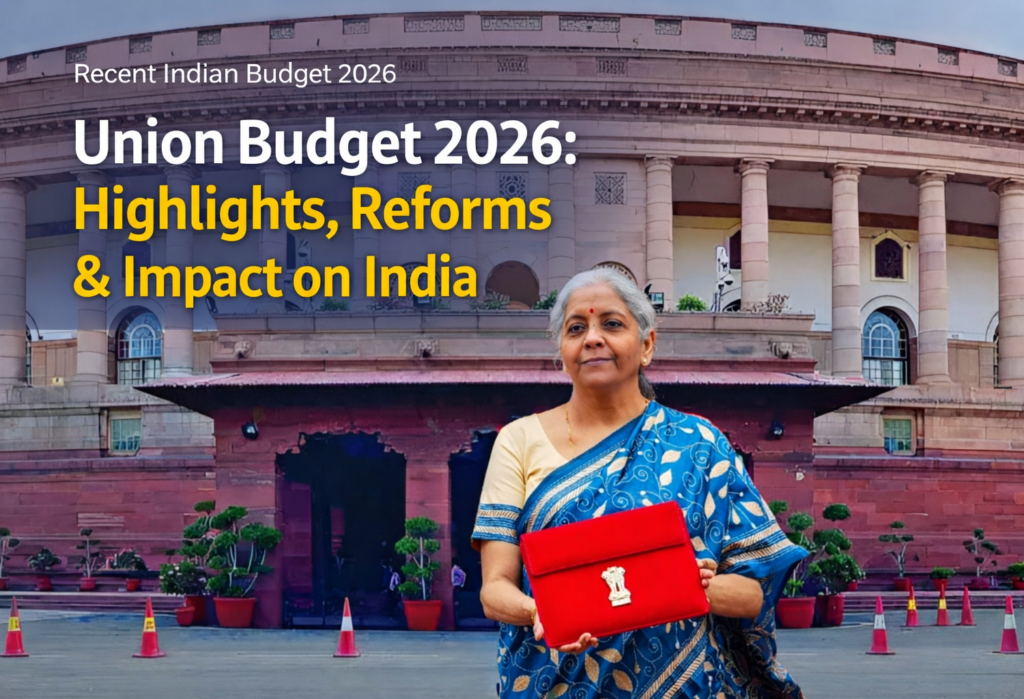
Budget 2026:The Big Picture and big vision
The Union Budget is basically the financial budget of the Government of India. It outlines the estimated revenue and expenditure to be incurred in the next financial year. With this budget, all fiscal policies are directed at influencing individual demand patterns, investments by companies, and so forth.
This year’s budget presentation is a historic one, as it is the first time that a budget is being presented on a Sunday, as well as marking the 9th consecutive budget being presented by Finance Minister Nirmala Sitharaman.
Fiscal and Macro Numbers
the key financial numbers announced in Budget 2026
- Total Expenditure: ₹53.5 lakh crore (new estimate)
- Net Tax Receipts: ₹28.7 lakh crore
- Total Receipts (Non-debt): ₹36.5 lakh crore
- Capital Expenditure (CapEx): ₹12.2 lakh crore, marking a strong push for infrastructure spending.
- Debt-to-GDP Ratio: Projected to ease to about 55.6%.
- Fiscal Deficit Target: Around 4.3% of GDP.
These figures indicate a sustained emphasis on growth driven capital investment, balanced with disciplined fiscal management.
1. Manufacturing and Key Strategic Sectors
This budget clearly signals the intent of India to become a powerhouse in global manufacturing. Targeted support is extended to strategic sectors from biopharmaceuticals to semiconductors and electronics manufacturing.
India Semiconductor Mission 2.0
Continuing with the previously announced India Semiconductor Mission, the 2026 budget implements ISM 2.0: a more general semiconductor and display ecosystem strategy for promoting domestic chip design and equipment manufacturing, as well as resilience in supply chains.The most direct official budget allocation is ₹1,000 crore for India Semiconductor Mission 2.0 in FY 2026-27.
Biopharma SHAKTI
The government launched the Biopharma SHAKTI program with an outlay of ₹10,000 crore over five years and aimed to make India a global leader in biopharma capacities.
Other Strategic Sector Boosts
Electronics component manufacturing outlay went up to ₹40,000 crore. Textile parks, container manufacturing pushes, and legacy industrial cluster rejuvenation are also supported.
2. Infrastructure and Connectivity: A Major Boost
This time, too, a lot of emphasis has been placed on infrastructure in the 2026 budget. The Central Government capex has been increased sharply to accelerate growth, reduce logistical bottlenecks, and improve connectivity across the country.
Shipping & Waterways
The budget also aims at doubling the share of coastal shipping and inland waterways from about 6% to 12% by 2047 with the Coastal Cargo Promotion Scheme.
High-Speed Rail & Transport
Of those, one of the big announcements is funding and plans for a bunch of different high-speed rail corridors, reducing travel times between major cities: Delhi-Varanasi, Mumbai-Pune, among others. City Economic Regions (CER) It has special allocations of ₹5,000 crore per City Economic Region for upgrading infrastructure and basic services in Tier-I and Tier-II cities to promote growth outside metropolitan hubs.
3. Tax Policies and Compliance
While there were no big changes in income tax rate reductions for individuals in the budget, there are some minor tax-related compliance issues.
Business tax tweaks
There is a change to the Securities Transaction Tax (STT) on futures.
Simplification of the classification process of manpower supply under the TDS rules seeks to minimize ambiguity with regard to compliance.
TCS & Customs Duty Adjustments
Tax collected at source (TCS) in overseas tour packages has been decreased considerably to a level of 2%.Duties on imported goods for personal use have been reduced from 20% to 10%.
Compliance Friendly Measures
New schemes have been put forward to simplify things for small taxpayers and to reduce litigation and penalties, which should also help the business environment.
4. Impact on Common Citizens
While Budget 2026 largely concentrates on broad economic reforms and long-term structural priorities, it also introduces a number of measures that directly affect everyday households. These initiatives are designed to ease financial pressure, improve access to essential services, and strengthen social security across income groups. From targeted tax relief and support for housing to enhanced spending on healthcare, education, and digital infrastructure, the budget aims to translate macroeconomic planning into tangible benefits at the family level. Together, these steps seek to balance fiscal responsibility with meaningful improvements in the quality of life for citizens.
Education & Skills
Investment in human capital development remains a priority with increased support for research fellowships and skills development programs that may enhance employability and innovativeness.
Healthcare Boost
Though insurance-related reforms remained in debate, allocations to health infrastructure, hospitals, and AYUSH facilities were increased, which could increase accessibility.
Urban & Rural Mobility
With an aim of introducing 4,000 new electric buses and enhancing public transport networks, commuting and connectivity can improve.
Agriculture & MSMEs
The increasing limits for short-term loans for farmers, fishermen, and dairy producers reflect the transfer payment policy.
What Analysts Are Saying
Experts and industry bodies have characterized Budget 2026 as investment-driven and growth-friendly rather than populist. It chiefly focuses on capital investment, job creation, scaling up manufacturing, and infrastructure assets that could recast the Indian economy in the medium term.By stepping up investment spending without compromise on discipline, this budget hopes to build the groundwork for high growth in the coming decade.
Final thoughts
Budget 2026 pairs fiscal realism with long-term ambition. It avoids headline grabbing freebies and instead bets on infrastructure, manufacturing capacity, technology and employment to drive growth. Whether you’re an investor sizing up opportunities, a student planning skills, an entrepreneur mapping expansion, or a policymaker weighing priorities, this budget sets directions that matter,and the coming months will show how well plans turn into action.



Thank you for this. It helped me gather knowledge about the recent union budget 2026
This is a real budget and it is absolutely going to make India improved. Thank you dear financial minister. Looking forward