
Stagnant water in your pot saucers isn’t just a gardening oversight — it’s prime breeding ground for dengue-carrying mosquitoes. After years of balcony gardening and society consultations across Thane and Navi Mumbai, here are the five hiding spots most people miss, and what actually fixes them.
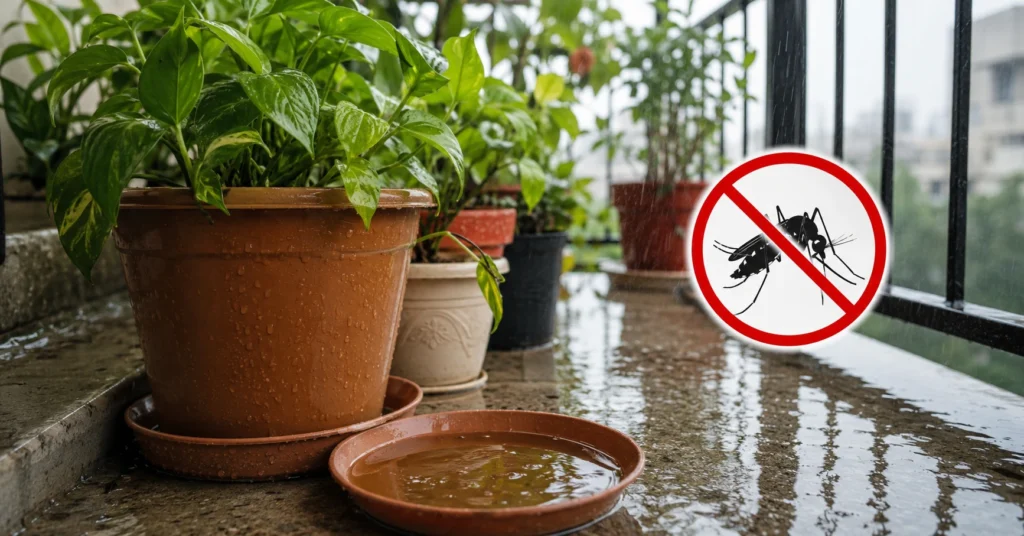
Dealing with mosquito breeding in pots is the primary reason I’ve lost count of how many neighbours have sprayed mosquito repellent, burned coils, and still ended up covered in bites. Almost every time, the source was obvious: stagnant water sitting in pot saucers.
This is a common mistake made with balcony-gardening. During the monsoon, water that sustains plants can sustain mosquito eggs for several days, and the problem moves indoors. The dengue and chikungunya mosquito, Aedes aegypti, breeds in small containers and generally remains within a few meters of where it emerged.
For more than eight years of balcony gardening and advising housing societies across Thane and Navi Mumbai, I hear the same complaint every monsoon: larvae in pots. There is no partial solution. Let one breeding spot be missed, and mosquitoes will find it.
Why Balcony Pots Can Be Worse Than Open Drains for Mosquito Breeding
This surprises most people, so let’s get the mechanism straight first.
Aedes mosquitoes — unlike the Culex species that breed in dirty drains and stagnant sewage — actually prefer clean, still water in small containers. Open drains, with their flow and organic muck, are more often Culex territory (the ones that cause filariasis and are just generally a nuisance). But the saucer under your money plant, the cap of an upturned bottle in the corner of your balcony, the depression on top of a polythene sheet covering your terrace garden setup — that’s five-star real estate for Aedes.
The reason is simple biology. The female mosquito needs water that won’t get washed away or contaminated for at least 7 to 10 days — that’s roughly the time it takes for an egg to go through the larval and pupal stages and emerge as an adult. A monsoon balcony, with its daily top-up of rain and the slow evaporation in between, gives her exactly that window. A flowing drain doesn’t.
So if you’ve been telling yourself “but my balcony is so clean, no garbage anywhere” — that’s actually part of the problem, not a reassurance. Clean stagnant water is what Aedes is looking for.
The Five Spots I Check First, In Every Single Balcony Garden
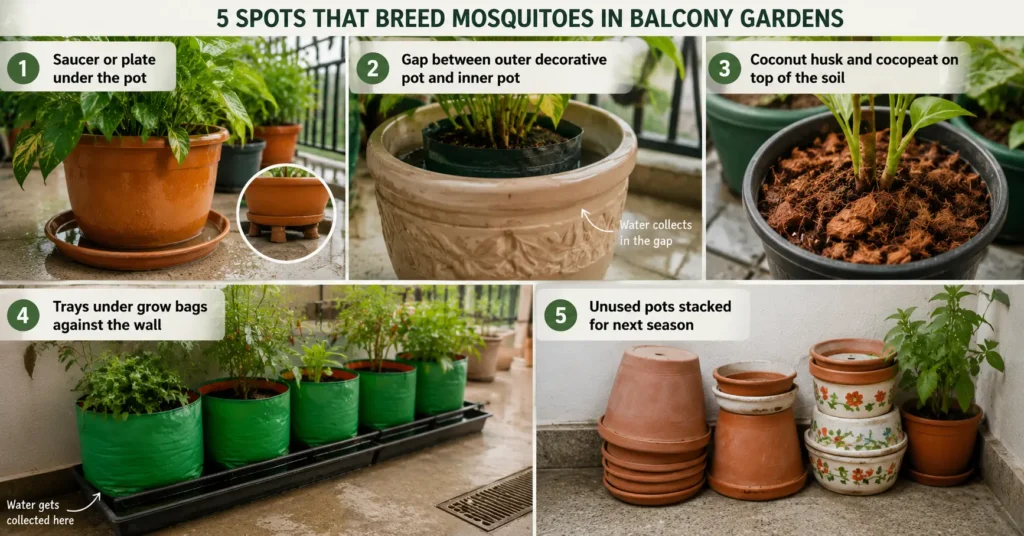
1. The saucer or plate under the pot
This is the number one source, hands down. We use saucers to stop water from staining the floor tiles or dripping onto the neighbour’s balcony below — completely sensible, but during monsoon, that saucer fills up with rainwater on top of whatever drains out from the pot. In a city like Pune or Bengaluru where it can rain on and off for a week straight, that saucer never gets a chance to dry.
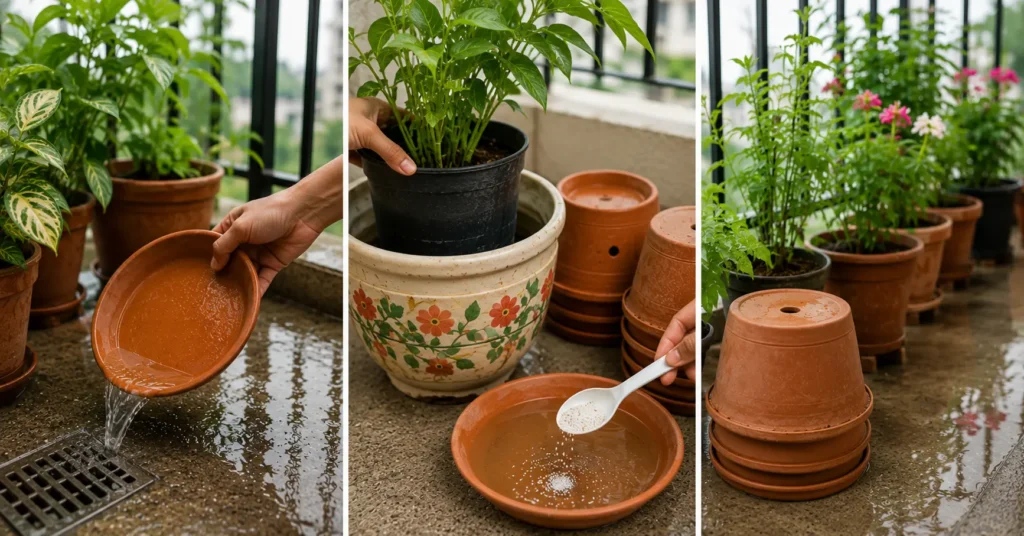
The fix: Don’t just empty it occasionally — change how the pot sits. Place small stones, broken pieces of brick (khadi), or pot-risers (sold cheaply at any nursery as “pot feet”) under the pot so it sits raised above the saucer. This lets excess water drain through without pooling against the base, and air gets underneath to dry the saucer faster.
If you’re someone who travels for work and can’t check pots every alternate day, skip the saucer altogether in monsoon and let the balcony floor have a slight slope toward the drain — most Indian balconies are built with this slope anyway.
This same waterlogging problem is actually why so many people can’t keep mint alive on their balcony past two weeks — the saucer that’s breeding mosquitoes is very often the same saucer that’s drowning the roots.
2. The gap between the pot’s outer decorative cover and the actual grow bag/pot inside
This is the one even experienced gardeners miss. A lot of us use a terracotta or ceramic outer pot purely for looks, with the actual plant sitting inside in a plastic grow bag or a cheaper plastic pot. Water seeps out of the inner pot’s drainage holes and collects in the gap between the two — completely invisible unless you lift the plant out.
The fix: Either drill a drainage hole in the bottom of the decorative outer pot too (a 6mm masonry bit does this in under a minute), or do a monthly “lift and check” — physically pull the inner pot out and tip out any standing water in the cavity.
3. Coconut husk and cocopeat-based potting mixes that haven’t been amended
This one’s specific to how we garden in India. We use a LOT of cocopeat and coconut husk chunks (often as a cheap, locally available substitute for perlite) for drainage. But raw, unwashed coconut husk pieces — the kind you get from a roadside coconut-seller’s waste, not the treated cocopeat blocks — hold water in their fibrous gaps almost like a sponge with air pockets, and in monsoon those pockets become breeding pockets if the husk pieces are sitting loose on the surface rather than mixed in.
The fix: Keep husk chunks at the bottom third of the pot as drainage material only, never scattered loosely on the topsoil surface where rain can pool inside them directly.
4. Saucers and trays under your kitchen-garden grow bags lined up against the parapet wall
If you’re growing tomatoes, chillies, or methi in a row of grow bags — a very common setup on Indian balconies now — people often place a single long plastic tray or an old aluminium sheet underneath the entire row to catch runoff and protect the floor. This becomes one continuous breeding trough instead of five separate small problems, which actually makes it worse, not better, because it holds a far larger volume of standing water.
The fix: Punch 3-4 small drainage holes at one end of that tray, angled toward your floor drain, with a slight tilt in the tray itself (a thin strip of wood or tile piece under one end works). Don’t seal it completely; you want water passing through, not pooling.
5. The unused pot stacked in the corner “for next season”
Almost every balcony gardener has 2-3 empty pots stacked somewhere, waiting to be used for the next sowing. These get ignored completely during inspection because nobody thinks of an empty pot as a “plant” problem. But an empty pot left right-side-up collects rain for days, completely undisturbed.
The fix: Stack empty pots upside down, always. It takes five seconds and it’s the single easiest win on this entire list.
What Actually Kills Mosquito Larvae Without Killing Your Plants
Once you’ve fixed the structural issues above, you’ll still have water sitting in plant trays sometimes — that’s unavoidable with daily watering. Here’s what I actually use, ranked by what works versus what’s just marketing.
Temephos (Abate) sand granules — This is what BMC and most municipal corporations use themselves in water tanks and coolers, and it’s sold cheaply at most pesticide/agri shops. A pinch in the saucer water is enough; it’s larvicidal, not adulticidal, so it won’t harm your plant roots or beneficial soil organisms at the small doses needed for a saucer. This is genuinely the most effective thing for a working household, because you don’t need to remember to do anything daily — one application lasts roughly a week to ten days even with water changes.
Used tea leaves and neem oil mix — I’ll be honest, this is more of a supportive measure than a standalone solution, but it does work as a mild larvicide and most of us already have both lying around. A few drops of neem oil in standing water disrupts the larvae’s ability to breathe at the surface. Don’t expect it to outperform Temephos, but it’s useful for the saucers you genuinely cannot empty regularly, like ones under heavy ceramic pots you can’t lift alone.
Guppy fish in larger water-storage containers — If you keep a bigger open container for harvesting rainwater for your garden (a lot of serious terrace gardeners do this, it’s genuinely good practice for water-stressed cities), drop in 2-3 guppies. They’re cheap, available at most aquarium shops, breed on their own, and eat larvae continuously. This isn’t practical for a small saucer, but for a 20-30 litre drum collecting rainwater, it’s the best long-term solution I’ve seen.
What doesn’t really work: Mosquito coils and sprays near the pots address adult mosquitoes flying around, not the larvae sitting in the water — so they’re treating a completely different stage of the problem.
If you’re spraying your balcony every evening but still finding larvae in the saucer the next morning, that’s exactly why; you’ve been fighting the wrong battle stage. Camphor in water is popular as a home remedy in many WhatsApp forwards, but in my experience and from what entomologists at NCDC have publicly stated in interviews, it has very limited, short-lived effect compared to Temephos.
A Weekly Monsoon Garden Care Routine That Works in Real Life
Most gardening advice assumes you have unlimited time, which doesn’t match how most working Indians actually manage balcony plants. So here’s what I tell clients who have a 9-to-6 job and maybe twenty minutes on a Sunday.
Every 3-4 days, not daily: Tip out saucers. You genuinely don’t need to do this every single day — the mosquito life cycle from egg to adult takes about a week in our climate, so a 3-4 day cycle of checking breaks that cycle before it completes, and it’s a far more sustainable habit than something that demands daily attention and inevitably gets skipped.
Once a week: Do the “lift and check” on decorative outer pots, check the unused stacked pots are still upside down, and add a pinch of Temephos sand to any saucer you know you won’t be able to empty that week (because of travel, rain making the balcony slippery, etc).
Once a month: Reassess your pot placement. If you notice a pot that’s consistently collecting more water than others — maybe it’s positioned where the rain directly lashes in, or the parapet’s slope is funnelling water toward it — move it, or add risers.
Why This Matters Beyond Just Your Own Health
Something I always tell my housing-society clients: your balcony isn’t a closed system. Aedes mosquitoes have a flight range of roughly 400 metres in their lifetime. That means the larvae breeding in your 14th-floor balcony pot isn’t just your problem — it’s a risk for every flat in that line, especially in monsoon when BMC, PMC, and other municipal teams run active dengue-chikungunya surveillance and can issue notices (and in repeat cases, fines) to individual flats found with breeding sites during their fortnightly checks.
I’ve personally seen a society in Thane get a collective notice because three balconies on the same wing all had the same saucer problem.
So fixing your pots isn’t just gardening hygiene. During June to September, it’s something closer to a civic responsibility, the same way segregating wet and dry waste is.
The Bigger Picture for Your Garden’s Health
Here’s something I’ve noticed that most articles on this topic miss entirely: a balcony garden that’s properly managed for mosquito control is also a healthier garden.
Waterlogged saucers don’t just breed larvae — they cause root rot, especially in plants like tulsi, mint, and most flowering ornamentals that genuinely dislike “wet feet.”
So the pot-riser trick, the drainage-hole drilling, the discipline of not letting water sit — every single fix on this list is something a good urban gardener should be doing anyway for plant health. The mosquito problem and the root-rot problem share the exact same solution. You’re not choosing between a thriving garden and a mosquito-free balcony. Getting one right gets you the other for free.
If there’s one thing I’d want every Indian balcony gardener to take from this monsoon, it’s this: check your saucers before you check your phone weather app for rain alerts. The rain is coming regardless. What you do with the water once it lands in your pots — that’s the only part actually in your control.
Conclusion
None of this requires a pest-control budget or a weekend overhaul. It’s five minutes here, a pot-riser there, and the discipline to check saucers before you check anything else when it rains.
What I’ve found, after enough monsoons doing this for my own balcony and for clients across Thane and Navi Mumbai, is that the people who stay ahead of this problem aren’t the ones with fancier solutions — they’re the ones who made it a habit early and stuck with it.
Your garden will thank you for the same fixes too. Better drainage, drier roots, fewer larvae — it’s really one problem wearing two different hats.
So before the next spell of rain hits, walk your balcony and look at it the way a mosquito would. You’ll probably spot the gaps faster than you think.
FAQs
How do I know if there are actually mosquito larvae in my pot saucer, or am I just imagining it?
Observe the water on a sunny morning when the water is calmer; larvae appear as small comma-shaped wrigglers that make an erratic up-and-down motion near the surface, then dive when disturbed, so if you have seen this type of movement when the water has been sitting more than 4-5 days, that is your confirmation. A trick I share with clients: Tap the side of the saucer gently; larvae respond immediately and dart down, while debris or dirt will not move.
Can mosquito eggs survive in dry soil and hatch later once it rains?
Indeed, and that is truly underappreciated. Aedes lay their eggs in damp soil just above the waterline or on the inner walls of a pot, and the eggs can remain dormant for weeks, sometimes months, even during dry spells; they hatch within hours after rain refills that spot, which is why you might see larvae in a pot that appeared dry and “safe” for most of the summer.
Is it safe to use Temephos in pots growing vegetables like tomatoes or methi that I’ll eat?
At the low concentration used for a household saucer (a pinch per liter), Temephos is deemed safe enough that municipal corporations apply it to water tanks for drinking water, but still, I would not allow it to touch the soil or root zone directly, limit it to the standing water in the saucer, and wash harvested leafy greens thoroughly as you would any other produce.
How long does it actually take for a mosquito to go from egg to a flying adult during monsoon?
Under ideal Indian monsoon conditions (warm and humid), the entire egg to adult life cycle takes approximately 7 to 10 days, with the number of days decreasing to 5 days at higher temperatures. This is precisely why checking saucers every 3-4 days is a control measure: you are interrupting the life cycle before it can even begin, not trying to clean up after the mosquitoes have already hatched.
Do mosquito-repellent plants like citronella or lemongrass actually keep mosquitoes off a balcony garden?
In reality, less than most articles suggest. The repellent compounds that these plants release are only released when the leaves are crushed or rubbed, and not when simply sitting in a pot, so they are at best a minor deterrent on an open balcony. Treat them as a nice bonus to your garden rather than a serious mosquito-reduction method: the saucer and drainage fixes above always do more heavy lifting than any plant alone.