How to Recover Website Traffic After the Google March 2026 Core Update: 7 Practical SEO Fixes
 Anjali Bhardwaj
If the Google March 2026 Core Update resulted in a significant drop in website traffic, you are not alone. Many bloggers and website owners saw changes in their ranks during the rollout. Google’s fundamental updates frequently review the quality and applicability of material on the internet, which might lead to sudden increases for some websites and sharp decreases for others. 32% of websites experience significant traffic changes after algorithm updates.
The most important thing to remember is that a core upgrade is not a penalty. It just shows that Google has changed how it evaluates content. Websites with more user value usually move up or not at all, while weaker pages slip down the results. In this guide, I want to share seven practical SEO fixes that many website owners are using right now to recover their lost traffic.
Many bloggers noticed traffic drops after the Google March 2026 Core Update. Understanding how core updates work is important. You can also read our guide on how Google core updates affect website rankings.
Read: Google March 2026 Core Update: Early Impact on Indian Websites
1. Start With Google Search Console Data
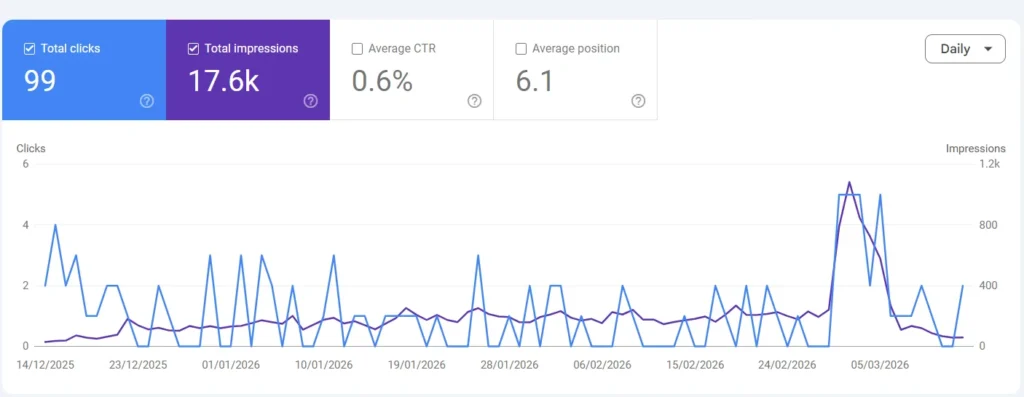
Before changing anything, open your Google Search Console dashboard and carefully review your traffic trends.
Link of Google Search Console
Before changing anything, ask yourself:
- Which pages lost the most clicks?
- Did impressions drop or just rankings?
- Are only a few keywords affected, or entire categories?
This simple investigation often reveals the real problem. For example, you might see that solely informational blog postings saw a drop in traffic, even though news content is still doing well. That tells you just where to focus. Making all the modifications at once without knowing the reason is a common mistake made by many SEO experts. Instead, make use of data before taking action.
This is the real data from my website Inbriefly last 3 months
2. Improve Content Depth and Value
One of the biggest signals strengthened in recent updates is helpful content. Google now prioritizes articles that provide real value rather than shallow summaries. If your article is only 400 or 500 words and repeats information available everywhere, it may struggle to rank.
Instead, try this approach:
- Include examples or case studies
- Add detailed explanations
- Update statistics and references
- Answer common reader questions
Many SEO experts noticed that thin content pages are not visible after the last updates, while long and informative guides are ranking. So, in some cases, the solution to the problem is to make average content the best on the topic.
3. Strengthen E-E-A-T Signals
Google increasingly evaluates content based on Experience, Expertise, Authoritativeness, and Trust (E-E-A-T). This means your website should clearly show who created the content and why readers should trust it. In recent updates, Google has placed more focus on the credibility behind an article, not just the keywords used in it. Adding an author bio, mentioning credentials, and linking to reliable sources can help show that your content is written by someone knowledgeable. Recent SEO studies also suggest that these quality signals now apply across almost all niches, not just sensitive topics like health or finance.
In simple terms, Google wants readers to feel confident about the person or team behind the information they are reading.
This means your site should clearly show:
- Who wrote the article
- Why they are qualified
- Where the information comes from
4. Fix Technical SEO and Core Web Vitals
Even the best content can struggle to rank if the overall website experience is poor. A slow website, heavy images, or broken navigation can negatively affect rankings because Google now pays close attention to user experience signals. If visitors find your pages slow or difficult to use, they are more likely to leave quickly, which can reduce your chances of ranking well. Improving technical SEO helps search engines crawl your site more efficiently while also making it easier and faster for users to browse.
Research also shows that websites with slow loading times often lose significant traffic after major updates because competitors offer a smoother browsing experience. In simple terms, making your site faster and more user-friendly can greatly support your SEO performance.
Some quick improvements include:
- Compress images using WebP format
- Reduce heavy JavaScript files
- Enable lazy loading for images
- Improve mobile page speed
5. Update Old Content Regularly
Over time, content becomes outdated, which causes a lot of traffic drops. Information that was true a year or two ago might not be true today, particularly when it comes to rapidly evolving subjects like finance, technology, or SEO. For instance, some of the tactics discussed in a 2023 article about SEO trends might not be entirely applicable today. In addition to keeping your content current and helpful for readers, updating older articles demonstrates to search engines that your website is being actively maintained. Refreshing existing content is frequently one of the quickest ways to recover lost rankings, and Google itself advises concentrating on significant improvements rather than quick SEO tricks when recovering from a core update.
So you need to:
- Refresh statistics
- Add new sections
- Improve headings and structure
- Include current examples
6. Build Topical Authority
Another common reason for ranking loss is weak topical authority. If your site publishes random topics, Google may struggle to understand your expertise. Instead, build clusters around a main subject.
For example:
- SEO updates
- Digital marketing strategies
- Google algorithm changes
7. Avoid Panic Changes
Lastly, the most important tip is not to panic if you see a drop in traffic after a core update. Many website owners start deleting pages, changing URLs, and even rewriting large sections of their site within a short time after the update. However, this is usually not the best way to handle the problem. It is important to remember that Google needs time to crawl and understand the changes you make to your website. Recovery does not happen instantly. SEO is a long-term strategy, not a short-term solution. Instead of panicking and making drastic changes, focus on gradually improving the overall quality of your website.

 Shubham Thakur
Thank you for this update. It helped me lot ♥️😊