
Pet-safe plant lists? Most are useless for Indian homes. They’re written for foreign climates, ignore monsoon humidity, and skip the narrow railings our balconies actually have. Here’s how I design real pet-friendly gardens for Indian dogs and cats — the layouts, safety fixes, and plants that genuinely survive.
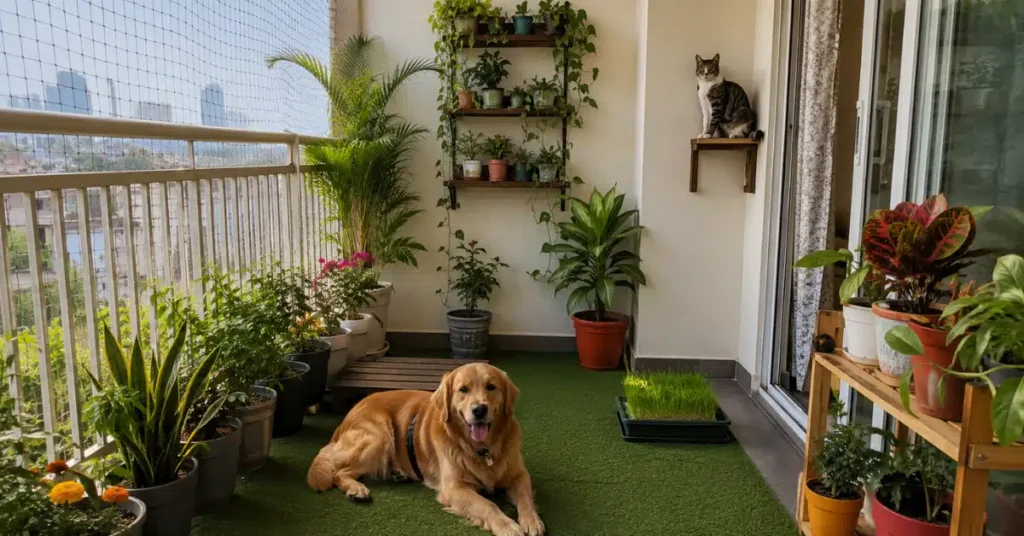
Three years ago, a reader from Pune sent me a photo of her Labrador’s swollen lip after he chewed on a Money Plant she’d hung on her balcony railing.
That message is the reason this guide exists. Most “pet-friendly garden” articles online are recycled American plant lists with zero relevance to Indian balconies, monsoon humidity, or the specific breeds we keep as pets here.
This one isn’t. Everything below comes from actually building and troubleshooting pet-friendly garden setups in Indian apartments — the railing gaps, the terrace heat, the neighbour’s cat that jumps the parapet, all of it.
If you own a dog or cat and want real green space without a vet emergency, read on.
Why Most Pet-Friendly Garden Advice Doesn’t Work in Indian Homes
Search “pet-friendly garden” and you’ll find dozens of lists naming daylilies, snapdragons, and coral bells. None of these are commonly sold at your local Sunday nursery in Delhi, Bengaluru, or Ahmedabad.
A genuinely useful pet-friendly garden guide for India has to solve three problems that Western content ignores completely.
First, our balconies are small — often 3×6 feet — and shared with drying clothes, a washing machine, or an AC compressor.
Second, Indian apartment railings are frequently open-baluster or grille-style, which is a fall risk that barely exists in the suburban homes those foreign articles are written for.
Third, our climate swings between brutal summer heat, a three-month monsoon, and short dry winters, which most imported plant lists never account for.
A real pet-friendly garden in India has to be designed around these three realities before a single pot goes down. That’s the difference between a pet-friendly garden that survives August and one that collapses by July.
Step 1: Audit Your Balcony or Terrace Before Buying Anything
Every pet-friendly garden project I’ve helped set up starts with a 20-minute audit, not a nursery visit. Skip this and you’ll be redoing your pet-friendly garden within a month.
Check the railing gap. Measure the space between balusters or grille bars. If your cat can fit its head through, it can fit its whole body through. As a rule, gaps wider than 4 inches (10 cm) are unsafe for cats and small/toy-breed dogs (Shih Tzus, Pomeranians, Beagle puppies) in a pet-friendly garden setup.
Check the floor load and drainage slope. Older Indian buildings, especially those built before 2005, weren’t always designed for heavy container gardens. A cluster of filled ceramic pots can weigh over 200 kg. Confirm with your building’s facility manager or a structural engineer if you’re planning more than 15–20 medium pots, especially on a cantilevered balcony rather than a load-bearing terrace.
Check direct sun hours. Stand on the balcony at 8 am, 12 pm, and 4 pm for two days and note the sun. This decides both your plant choices and where your pet will actually want to sit — pets avoid harsh afternoon sun in a pet-friendly garden just like we do.
Check for existing toxic plants. Before adding anything, go through what’s already there. Money Plant (Pothos), Peace Lily, Aloe vera, Croton, and Adenium (Desert Rose) are extremely common in Indian homes and all are toxic to cats and dogs. A pet-friendly garden audit isn’t complete until these are relocated indoors out of pet reach or removed entirely.
Step 2: Zone Your Pet-Friendly Garden — Dogs and Cats Need Different Layouts
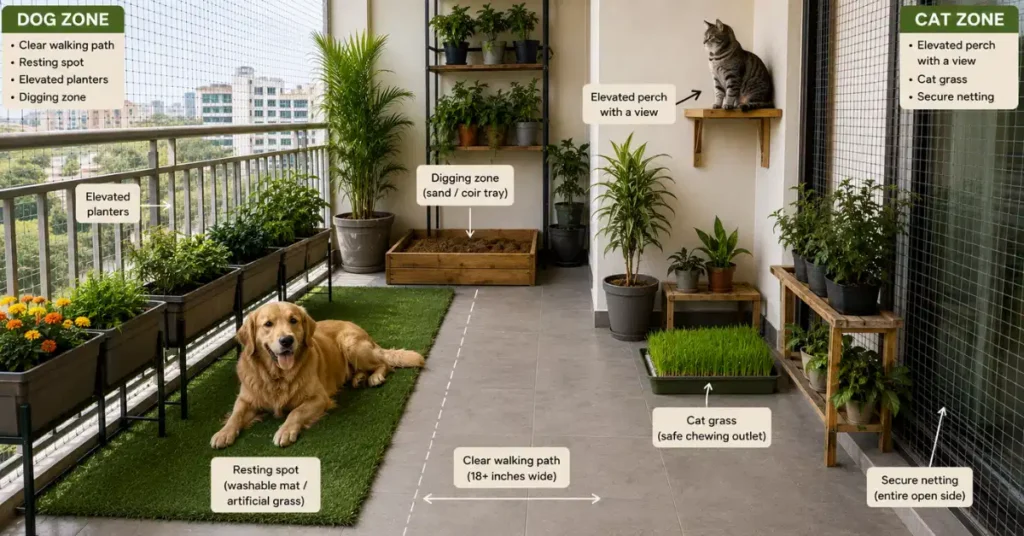
This is the part every generic list skips, and it’s the actual design work of a pet-friendly garden.
For dog owners
Dogs use a balcony or terrace to patrol, sniff, and occasionally dig. A pet-friendly garden for a dog needs:
- A clear walking path of at least 18 inches, free of trailing wires or loose pot edges
- One low-traffic corner with a washable mat or artificial grass patch — this becomes their default resting spot
- Elevated planters (on stands, 2+ feet high) for anything you don’t want investigated by nose or paw
- A dedicated digging zone if you have a Beagle, Dachshund, or Indie mix with digging instincts — a deep tray of pet-safe sand or coir stops them from excavating your actual pots
For cat owners
Cats use vertical space, not floor space. A pet-friendly garden for a cat should include:
- At least one elevated perch with a view outward — a cat that can watch the street below is a calmer cat
- Cat grass (Cynodon dactylon or wheatgrass, grown in a shallow tray) placed at floor level as a safe chewing outlet — this single addition reduces cats nibbling your ornamental plants by a large margin in my experience
- Secure netting on the entire open side if your terrace or balcony has any drop, regardless of railing height — cats misjudge jumps more often than owners expect
If you keep both a dog and a cat, zone the space rather than mixing everything — a shared open area plus one raised cat-only shelf works better than one flat layout for both.
Step 3: Pet-Safe Plants That Actually Thrive in Indian Conditions
Here is where most pet-friendly garden content fails Indian readers — the plants recommended simply don’t survive our heat or humidity. Below is a climate-sorted list I’ve personally grown or supervised in pet households across three Indian cities.
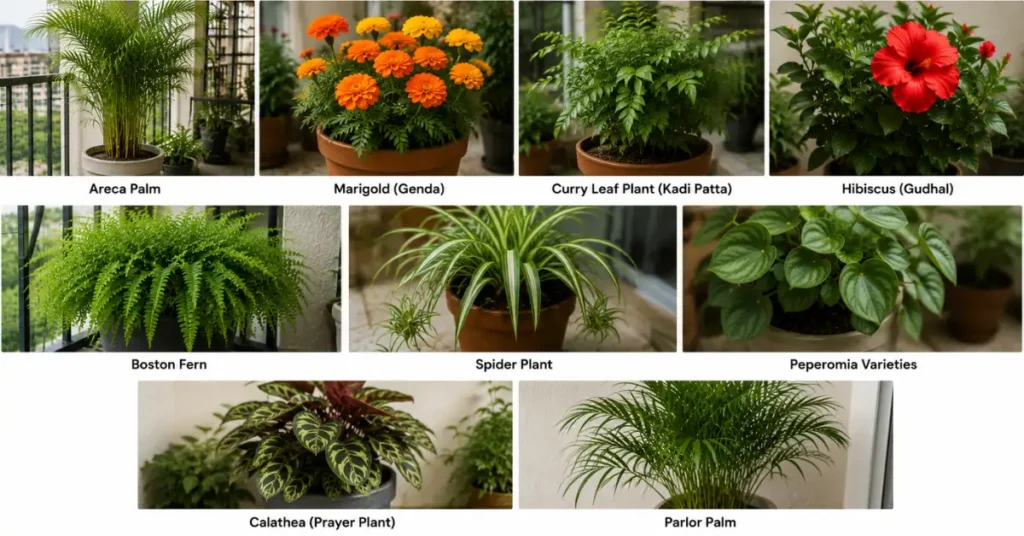
For hot, high-sun balconies (Delhi, Jaipur, Nagpur, Ahmedabad summers)
- Areca Palm — non-toxic, handles direct sun once established, and doubles as a privacy screen
- Marigold (Genda) — completely pet-safe, blooms through summer, and is genuinely easy for beginners
- Curry Leaf Plant (Kadi Patta) — non-toxic to pets, useful in the kitchen, and tolerates heat well
- Hibiscus (Gudhal) — non-toxic to dogs and cats, though heavy bloom-drop can attract ants, so keep pots slightly away from pet resting zones
For humid, coastal balconies (Mumbai, Chennai, Kochi, Kolkata)
- Boston Fern — loves humidity, non-toxic, but needs afternoon shade
- Spider Plant — one of the most forgiving pet-friendly garden plants for humid climates, and cats particularly enjoy chewing its leaf tips without harm
- Peperomia varieties — compact, humidity-loving, and safe if nibbled
For low-light, shaded balconies (ground-floor flats, deep-set terraces)
- Calathea (Prayer Plant) — non-toxic, thrives without direct sun, though it needs consistent watering
- Parlor Palm — one of the few palms that genuinely tolerates low light and is fully pet-safe
Herbs worth growing in every pet-friendly garden
Basil (Tulsi’s cousin, sweet basil), coriander, and dill are all safe if pets nibble them, and they give your pet-friendly garden a working, useful character rather than being purely ornamental.
Plants to Remove Immediately From an Indian Pet-Friendly Garden
This list matters more than the safe list, because these are the plants I see most often in Indian homes, sold at every neighbourhood nursery without any toxicity warning.
| Common Name | Local/Hindi Name | Risk to Pets |
| Money Plant | Paisa Paudha | Oral irritation, drooling, vomiting |
| Peace Lily | Shanti Lily | Severe oral swelling, breathing difficulty |
| Aloe Vera | Ghritkumari | Vomiting, diarrhoea, lethargy |
| Croton | Patharchur | Vomiting, skin irritation |
| Adenium (Desert Rose) | — | Cardiac toxicity, very dangerous if chewed |
| Caladium | — | Severe mouth and throat swelling |
| Oleander (Kaner) | Kaner | Extremely toxic, can be fatal to dogs |
| Snake Plant | — | Mild to moderate gastrointestinal upset |
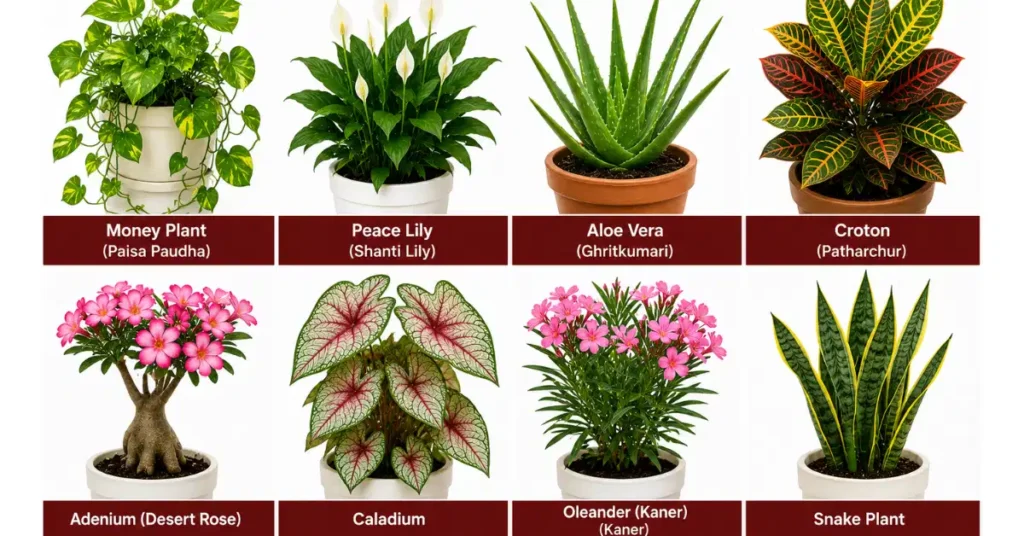
If any of these are already growing on your terrace, don’t panic and throw them out overnight — instead, move them to a hanging position at least 3 feet above where your pet can reach, or relocate them to a room your pet doesn’t access. A true pet-friendly garden isn’t about zero risk plants only; it’s about controlling access to the risky ones you want to keep.
Soil, Mulch, and Fertiliser: The Overlooked Part of a Pet-Friendly Garden
Nobody talks about this, but soil additives cause more emergency vet visits than the plants themselves in a badly set up pet-friendly garden.
Cocopeat over garden soil. Cocopeat is lightweight, drains well, and is non-toxic if a curious pet takes a mouthful. Regular red garden soil often contains sharp organic debris and occasionally chemical fertiliser residue from nursery bags.
Avoid cocoa shell mulch entirely. It’s rare in India but increasingly sold online as premium mulch — it’s genuinely toxic to dogs (same compound as chocolate) and has no place in a pet-friendly garden. Use dried neem leaf mulch or coco-coir mulch instead.
Skip chemical pesticides on any plant your pet can reach. Use a neem oil and water spray (1 tsp neem oil, few drops of liquid soap, 1 litre water) for pest control in your pet-friendly garden — it’s effective against mealybugs and aphids and safe once dry.
Go easy on bone meal fertiliser. Dogs are drawn to its smell and will dig up pots to get at it. If you use bone meal in your pet-friendly garden, mix it deep into the soil, not on the surface.
Physical Safety: Making the Space Actually Escape-Proof
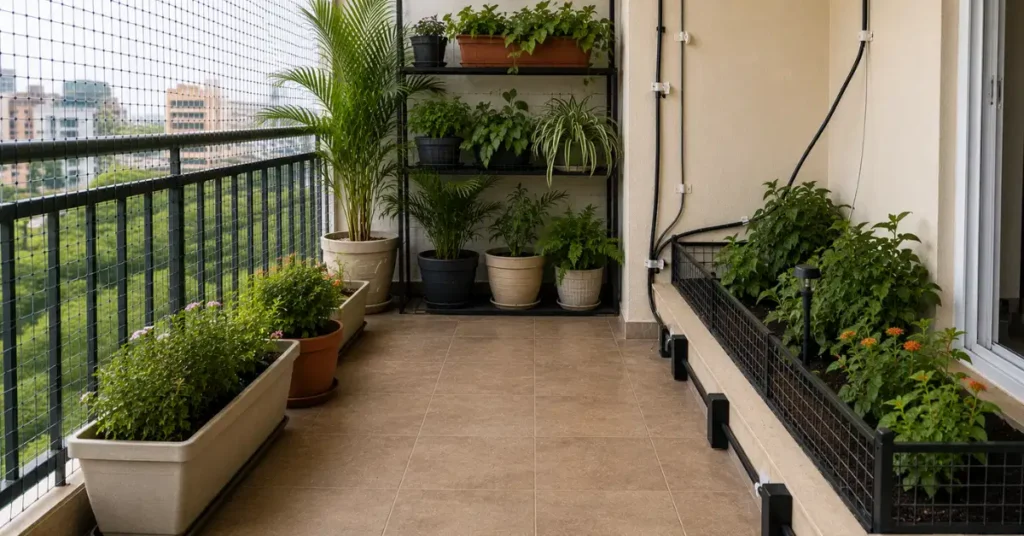
A plant list means nothing if your pet-friendly garden isn’t physically secure. This is the step Indian pet parents skip most often, usually because it costs more than a trip to the nursery.
Install UV-stabilised nylon netting across open railings — costs roughly ₹15–25 per sq. ft. installed, and is the single highest-impact safety upgrade for a pet-friendly garden with cats or small dogs.
Use heavy, wide-based pots. Terracotta pots below 10 inches in diameter tip over easily when a dog brushes past. Go for a wider base-to-height ratio, or use fibre-reinforced plastic (FRP) pots which are lighter but more stable when properly filled.
Secure trailing wires and drip irrigation lines. Chewed wires are one of the most common pet-friendly garden injuries I hear about — route them along walls with cable clips rather than across open floors.
Add a low physical barrier around any raised bed edge or ledge, even indoor-facing ones, if you have a jumpy breed like a Cocker Spaniel or an adolescent cat.
Solving the Mosquito Problem in a Pet-Friendly Garden (Without Toxic Sprays)
This is a genuine Indian problem that almost no pet-friendly garden article addresses: standing water in saucers breeds mosquitoes, and most mosquito repellent sprays and coils are unsafe around pets.
- Empty and wipe saucers under pots every 3 days without fail during monsoon — this alone prevents most breeding
- Add a thin layer of coarse sand on top of saucer water if you can’t check daily
- Grow lemongrass (Citronella-adjacent, genuinely pet-safe) in at least two pots — it’s a natural deterrent and a useful addition to any Indian pet-friendly garden
- Avoid mosquito coils and chemical vaporisers on the balcony itself; use physical mesh screening instead
Standing water in pot saucers is one of the most overlooked triggers here — if you want the full breakdown of why this happens and how to stop it for good, I’ve covered it in detail in Your Balcony Pots Could Be Breeding Mosquitoes This Monsoon, which pairs well with everything above for keeping your pet-friendly garden monsoon-safe.
Weekly Pet-Friendly Garden Care Checklist
Print this or save it — this is the actual routine that keeps a pet-friendly garden alive and safe month after month.
- Check and empty all pot saucers (every 2–3 days, daily in monsoon)
- Inspect railing netting and mesh for tears or gaps
- Wipe down any pet resting mat or artificial grass patch
- Check soil surface for exposed fertiliser or bone meal after watering
- Trim any overgrown branches extending into your pet’s walking path
- Refresh cat grass tray (reseed every 2–3 weeks for continuous growth)
- Look for pest infestations before they require chemical treatment
- Confirm no new plant has been added without a toxicity check
- Water early morning or early evening — avoid midday watering, which stresses both plants and pets on hot terraces
What to Do If Your Pet Eats a Toxic Plant
Even a well-designed pet-friendly garden can have a slip-up, so know the steps in advance.
Stay calm and identify the plant your pet ate, ideally with a photo. Do not induce vomiting unless your vet specifically instructs you to — some plants cause more damage coming back up.
Call your vet or the nearest 24-hour pet hospital immediately and describe symptoms (drooling, vomiting, lethargy, swelling).
Keep a small piece of the plant to show the vet if possible. Most urban centres in India now have at least one 24-hour pet emergency clinic — save that number in your phone before you need it, not after.
Beyond your personal vet, it’s worth knowing that India has dedicated animal welfare organizations that can guide you in a crisis or connect you with emergency care if your regular vet is unavailable.
Blue Cross of India, the country’s oldest and largest animal welfare organization, runs hospitals, ambulance services, and emergency support for pet owners — the kind of backup resource every pet-friendly garden owner should have saved, not searched for, in the middle of an emergency.
Cat-Specific vs Dog-Specific Pet-Friendly Garden Considerations
It’s worth repeating because it’s the most common mistake I see: owners design one generic pet-friendly garden and expect it to work equally for both species.
Dogs generally respond well to a pet-friendly garden with texture variety — grass patches, gravel, and a dig zone. They’re less interested in height and more interested in ground-level exploration and smell.
Cats almost always prefer vertical territory. A pet-friendly garden that only offers floor-level features will get far less use from a cat than one with even a single secure elevated shelf or window perch.
If budget or space is tight, prioritise netting and one elevated perch for cat households, and prioritise a washable rest zone plus secure wide pots for dog households.
Seasonal Pet-Friendly Garden Care Across Indian Weather
A pet-friendly garden that looks great in February can be a health hazard by June. Seasonal changes affect pets differently than they affect plants, and a proper pet-friendly garden plan accounts for both.
Summer (March to June)
Terracotta and metal pots heat up fast in direct sun, and a dog or cat walking barefoot across a hot terrace floor can burn paw pads within minutes between 12 pm and 4 pm. In a well-run pet-friendly garden, this window is simply blocked off — move outdoor time to early morning or after 6 pm.
- Lay a jute mat or interlocking rubber tile path across the hottest stretch of floor so paws never touch bare concrete or tile
- Group pots together to create shade pockets; isolated pots in full sun stress both the plant roots and any pet resting nearby
- Increase watering frequency for Areca Palm and Boston Fern, but always check the saucer isn’t collecting standing water, since summer pre-monsoon showers can quickly turn a dry pet-friendly garden into a mosquito breeding ground
- Keep a shallow, shaded water bowl permanently on the terrace — heatstroke in pets is a real risk on exposed terraces, and a pet-friendly garden should never be a heat trap
Monsoon (June to September)
This is genuinely the hardest season to manage a pet-friendly garden in most of India, because humidity, waterlogging, and fungal growth all spike together.
- Reposition pots so none sit directly under a water outflow point or AC drip line
- Check for root rot weekly in Calathea and Parlor Palm, both of which are pet-safe but sensitive to overwatering
- Increase saucer-emptying frequency to daily; this single habit prevents the majority of monsoon mosquito problems in a pet-friendly garden
- Watch for mould on wooden furniture or matting pets rest on — replace jute mats with a washable synthetic alternative for these three months
- Slugs and snails appear heavily during monsoon and are mildly toxic if a curious dog eats one; a quick evening check of the pot rims keeps this in check
Winter (October to February)
The easiest season for a pet-friendly garden in most of India, though North Indian cities need a few adjustments.
- Move the most cold-sensitive plants like Boston Fern slightly away from open railing edges in Delhi and North Indian winters
- This is the best season to repot, refresh soil, and expand your pet-friendly garden, since both plants and pets tolerate the mild temperatures well
- Sunlight angle changes in winter, so recheck your sun-hour audit from Step 1 — a spot that was shaded in June may get direct winter sun by December
Common Mistakes Indian Pet Owners Make While Building a Pet-Friendly Garden
I’ve corrected these same five mistakes across dozens of pet-friendly garden setups, so it’s worth listing them directly rather than letting you discover them the hard way.
Mistake 1: Buying plants first, auditing later. The single most common error. People fall in love with a plant at the nursery, bring it home, and only check toxicity after their pet has already had access to it for a week.
Mistake 2: Assuming “outdoor plant” means “safe.” Owners often assume a plant is only risky if kept indoors. Toxicity has nothing to do with indoor or outdoor placement — Oleander and Adenium are outdoor plants and are among the most dangerous on this entire list.
Mistake 3: Ignoring the netting until after an incident. Netting is treated as optional or purely decorative in most pet-friendly garden builds I’ve seen, when it should be step one, not an afterthought.
Mistake 4: Overcrowding a small balcony. A cramped pet-friendly garden with too many pots leaves no clear walking path, which increases the chance of a pet knocking over a pot or getting cornered by furniture and greenery at the same time.
Mistake 5: Forgetting that puppies and kittens explore differently than adult pets. A pet-friendly garden that was safe for your adult Labrador may not be safe for a new puppy who chews everything within reach. Reassess your setup every time a new or young pet joins the household.
A Real Example: Building a Pet-Friendly Garden on a Ground-Floor Flat in Bengaluru
To make this practical, here’s how one actual setup came together for a reader with a ground-floor flat and a mixed-breed Indie dog plus one indoor cat.
The balcony was roughly 4×7 feet, partially shaded by the building above, with an open MS grille railing with 5-inch gaps — too wide for the cat. Step one was installing UV-stabilised netting across the entire open side, which cost about ₹1,400 for the full width. Next, every existing plant was audited: two Money Plant vines and one Aloe vera pot were relocated indoors to a high shelf out of both pets’ reach.
The new pet-friendly garden layout used Areca Palm in two large FRP pots as a privacy screen along one wall, a shallow tray of cat grass at floor level near the door for the cat, a jute-free rubber mat as a dog resting zone in the shadiest corner, and hanging Spider Plant baskets kept above 3 feet.
Total cost for the full pet-friendly garden conversion, including netting, pots, cocopeat soil, and plants, came to just under ₹6,000 — and two years later, it’s still the dog’s favourite spot in the house.
Choosing the Right Pots and Containers for a Pet-Friendly Garden
Pot choice is rarely discussed in pet-friendly garden content, but it directly affects both plant health and pet safety.
Avoid glazed ceramic pots below 8 inches in any pet-friendly garden with an active dog — they chip easily and shatter if knocked, creating sharp edges.
Fibre-reinforced plastic (FRP) pots are the best all-round choice for a pet-friendly garden: lightweight enough to move for seasonal repositioning, sturdy enough to resist tipping, and widely available in Indian nurseries and online at reasonable prices.
Raised wooden or metal plant stands work well for creating the elevation dogs and cats both benefit from — dogs get investigation-proof storage for riskier plants, and cats get the vertical perches they naturally seek in any good pet-friendly garden.
Self-watering pots are worth the extra cost for anyone travelling frequently, since they reduce the standing-water-in-saucers problem that both stresses plants and breeds mosquitoes in an unattended pet-friendly garden.
Quick Reference: Best Pet-Friendly Garden Plants by Purpose
Bookmark this table — it’s the fastest way to shortlist plants for your own pet-friendly garden without re-reading the full guide every time you visit a nursery.
| Purpose | Plant | Pet Safety | Best For |
| Privacy screen | Areca Palm | Safe | Sunny balconies, all climates |
| Cat chewing outlet | Cat Grass | Safe | Any pet-friendly garden with cats |
| Low light corner | Calathea | Safe | Shaded terraces, ground floors |
| Hanging basket | Spider Plant | Safe | Humid coastal cities |
| Flowering colour | Marigold | Safe | Hot, sunny North Indian balconies |
| Kitchen herb | Curry Leaf | Safe | Any pet-friendly garden with sun |
| Mosquito deterrent | Lemongrass | Safe | Monsoon-heavy regions |
| Avoid entirely | Oleander (Kaner) | Toxic | — |
| Avoid entirely | Money Plant | Toxic | — |
| Avoid entirely | Peace Lily | Toxic | — |
Final Thoughts
A pet-friendly garden isn’t a plant list you copy once — it’s an ongoing relationship between your space, your climate, and the specific pet you’re designing for.
Start with the audit, fix the physical safety gaps first, choose plants that actually survive your city’s weather, and build the weekly checklist into your routine. Do that, and your balcony or terrace becomes what it should be: a space your dog or cat genuinely enjoys, without a single trip to the emergency vet.
If you’ve built a pet-friendly garden of your own, I’d love to hear what worked and what didn’t in your specific city and climate — drop it in the comments below.

FAQs
Can I use artificial grass instead of real plants in a pet-friendly garden?
Yes, and many Indian pet owners do exactly this for the dog’s main resting patch. Artificial turf designed for pets (with drainage holes) is washable, doesn’t stain paws, and pairs well with real plants kept in surrounding pots — it’s a practical hybrid approach for a low-maintenance pet-friendly garden.
Is it safe to let my cat sit directly on soil in a pet-friendly garden pot?
Not ideal. Cats sometimes use loose soil as a litter substitute, which isn’t hygienic for either the plant or the cat. Top-dress pots with decorative pebbles or coco-coir chips to discourage this in your pet-friendly garden.
How do I stop my dog from digging up every new plant I add?
Give the digging instinct somewhere else to go. A dedicated sand or soil tray, refreshed weekly, redirects most digging behaviour away from your actual pet-friendly garden pots within a couple of weeks of consistent redirection.
Are there any pet-friendly garden plants that also repel pests naturally?
Yes — lemongrass, marigold, and basil all have natural pest-deterrent properties and are completely safe for pets, making them some of the most useful multi-purpose additions to any Indian pet-friendly garden.
Does a rented flat make a pet-friendly garden harder to build?
Not really. Almost everything in this guide — netting, FRP pots, raised stands, mats — is fully portable and installed without drilling or permanent changes, which makes a pet-friendly garden entirely renter-friendly if you choose clip-on or free-standing fittings over screwed-in ones.