Delhi’s tap water tests at 400–1200 ppm, and it’s quietly killing more balcony plants than bad soil or neglect ever could. Here’s how to tell which plants actually thrive in that mineral load, which ones never stand a chance, and the exact fixes that turn hard water into a non-issue.
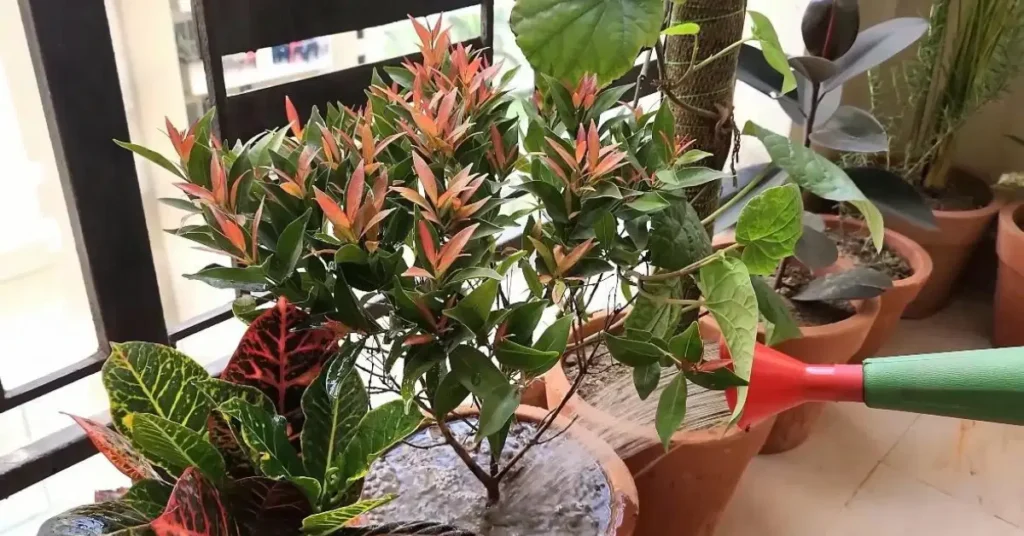
Over the past few gardening seasons, I’ve lost count of the messages from readers describing the exact same heartbreak — Boston ferns turning crisp within weeks, gardenias that never bloom, entire trays of coriander wilting despite being watered every single day without fail.
Almost every one of them assumed they’d made some rookie mistake. After going through their photos, their watering routines, and in a few cases their own TDS meter readings, the pattern was unmistakable: it wasn’t their hands, it was their water.
If you’re doing hard water balcony gardening in Delhi and wondering why some pots thrive while others crust over and die no matter what you do, this is the piece written from everything those conversations taught me.
Why Delhi’s Water Is a Balcony Gardener’s Real Enemy (Not Poor Soil or “Black Thumbs”)
Most gardening advice you’ll find online is written for cities with soft municipal water — London, Bangalore’s Cauvery-fed taps, or even Mumbai’s relatively gentle BMC supply.
None of it accounts for what actually comes out of a Delhi tap. This is the single biggest reason hard water balcony gardening fails silently for so many first-time growers here: they’re following instructions written for a completely different water chemistry.
Delhi NCR’s water isn’t uniform. South Delhi colonies fed by Yamuna-sourced municipal supply typically run 400–600 ppm TDS, which is already on the harder side.
But move to a Gurugram borewell-dependent society, a Dwarka DDA flat on tanker supply, or a Ghaziabad apartment pulling groundwater, and TDS readings of 800–1200 ppm are completely normal. According to the Central Ground Water Board (CGWB), groundwater across many parts of Delhi NCR is frequently classified as hard to very hard, with mineral content varying significantly by location.
What does “hard” actually mean for a plant? It means the water is carrying a heavy dissolved load of calcium and magnesium bicarbonates, along with chlorides and sulphates depending on the source.
Every time you water a pot with this, you’re not just hydrating the plant — you’re depositing minerals into the soil that don’t evaporate or drain away. They accumulate. This is the mechanism behind almost every mystery plant death on a Delhi balcony, and it’s the starting point for doing hard water balcony gardening properly instead of by luck.
Delhi NCR Water Hardness by Locality: What You’re Actually Dealing With
Generic advice fails at this exact point — “Delhi’s water is hard” isn’t specific enough to plan around. Here’s how it actually breaks down across the region, based on my own testing plus readings shared by nursery contacts across NCR.
Use this as a rough starting benchmark, then confirm with your own TDS meter, since building age, storage tanks, and tanker dependency shift numbers even within the same colony.
- South Delhi (Yamuna-fed municipal supply — Saket, GK, Vasant Kunj): Generally 400–600 ppm. Moderately hard but manageable with light correction for sensitive plants.
- Rohini, Pitampura, North-West Delhi: Often 400–700 ppm depending on tanker dependency during summer shortages, with noticeable seasonal spikes.
- Dwarka (DDA flats, tanker-heavy zones): Frequently touches 600–900 ppm during peak summer when tanker supply increases relative to piped municipal water.
- Gurugram (borewell-dependent societies): Among the harshest in NCR, commonly 800–1500 ppm. If you’re doing hard water balcony gardening here, correction isn’t optional for anything beyond bougainvillea-tier tolerant species.
- Ghaziabad, Noida (mixed groundwater and Ganga canal supply): Typically 400–900 ppm, with older sectors on legacy borewell infrastructure trending higher.
- Faridabad: Variable by sector, generally 350–750 ppm, with older colonies on groundwater running harder than newer Ganga-canal-fed developments.
If your building relies on an overhead tank fed periodically by tankers, expect your effective TDS to run higher than official municipal figures, since tanker water is frequently sourced from borewells to supplement shortfalls.
This is one of the most overlooked variables in hard water balcony gardening across NCR — two flats in the same building can show different readings depending on which tank feeds which floor.
How Hard Water Actually Kills Plants (The Mechanism, Not Just the Symptom)
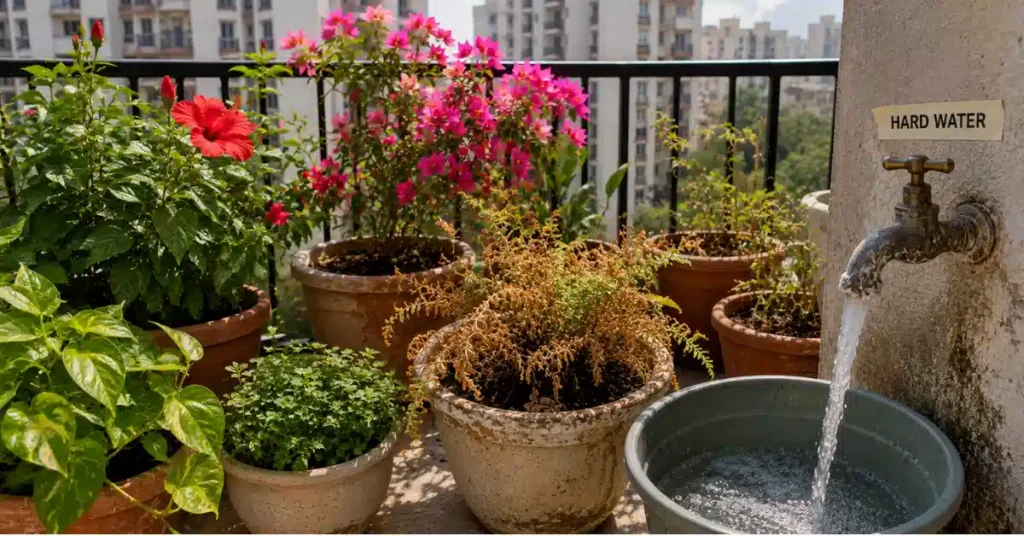
I want to move past the vague “hard water is bad for plants” advice you’ve probably already read, because it doesn’t help you fix anything. Here’s what’s physically happening in your pot when you do hard water balcony gardening with untreated Delhi tap water:
1. Mineral crust locks the topsoil. You’ve seen the white-grey crust on the surface of your pots, or a chalky ring around the base of terracotta planters. That’s calcium carbonate precipitating out as water evaporates. Over months, this crust reduces how well water and air penetrate the topsoil, essentially suffocating surface roots.
2. Alkaline pH blocks nutrients the plant already has access to. Hard water in Delhi typically pushes soil pH upward into the 7.5–8.5 range over time. Most ornamental and edible plants prefer a slightly acidic to neutral 6.0–7.0 range. When pH climbs too high, iron, manganese, and zinc in the soil become chemically “locked” — they’re physically present but the plant’s roots simply can’t absorb them anymore. This is why so many hard water balcony gardening failures look exactly like nutrient deficiency (yellowing leaves, pale new growth) even when you’re feeding the plant regularly.
3. Chloride and salt buildup burns root tips. In borewell-heavy pockets of Gurugram, Dwarka, and Ghaziabad, chloride content adds another layer of stress. Salt accumulation in container soil (which can’t flush and drain the way open ground does) leads to root tip burn — you’ll see it as browning, crispy leaf margins, especially on sensitive plants.
4. Containers make it worse than open soil. This is the detail most articles miss entirely. In an open garden, monsoon rain and natural drainage periodically flush accumulated salts out of the ground. A balcony pot has nowhere for that mineral load to go except to concentrate further with every watering cycle. This is precisely why hard water balcony gardening in containers needs a different playbook than ground-level kitchen gardens even in the same city.
This isn’t just a balcony problem, either — the same mineral buildup and pH lock-out affects potted plants indoors just as easily. If you’re noticing similar crusting or yellowing on your living room plants, I’ve broken down the indoor-specific fixes separately in How Hard Water Damages Indoor Plants — And How to Fix It.
Test Your Water Before You Blame Yourself
Before you plan any hard water balcony gardening strategy, you need actual numbers, not guesswork. This takes five minutes and costs less than a nursery visit.
- Buy a digital TDS meter (₹200–500 online or at any RO service centre). Dip it into a glass of your tap water and note the ppm reading.
- Under 200 ppm: Reasonably soft. Standard gardening advice will mostly work for you.
- 200–300 ppm: Moderately hard. Sensitive plants will need occasional correction.
- 300–600 ppm: Hard. You need a consistent hard water balcony gardening routine (covered below).
- Above 600 ppm: Very hard. Skip untreated tap water for anything sensitive; correction isn’t optional.
- Check for physical signs too: white deposits around tap mouths, a soapy film that won’t lather, and white crust on pot rims are all visual confirmation of hardness even without a meter.
- Test twice a year. Delhi’s groundwater-tanker mix shifts TDS by 100–300 ppm between summer and monsoon, so a one-time reading isn’t reliable for long-term hard water balcony gardening planning.
Write your reading down. Every recommendation below assumes you actually know your starting number.
Plants That Genuinely Thrive in Delhi’s Hard Water
This is the part most blogs skip because it requires real trial-and-error rather than copying a generic houseplant list. Over three growing seasons on my own balcony, and after cross-checking with two Delhi nursery growers who supply RWA garden committees, these are the plants that hold up well under 400+ ppm water with minimal correction — genuinely low-maintenance choices for hard water balcony gardening.
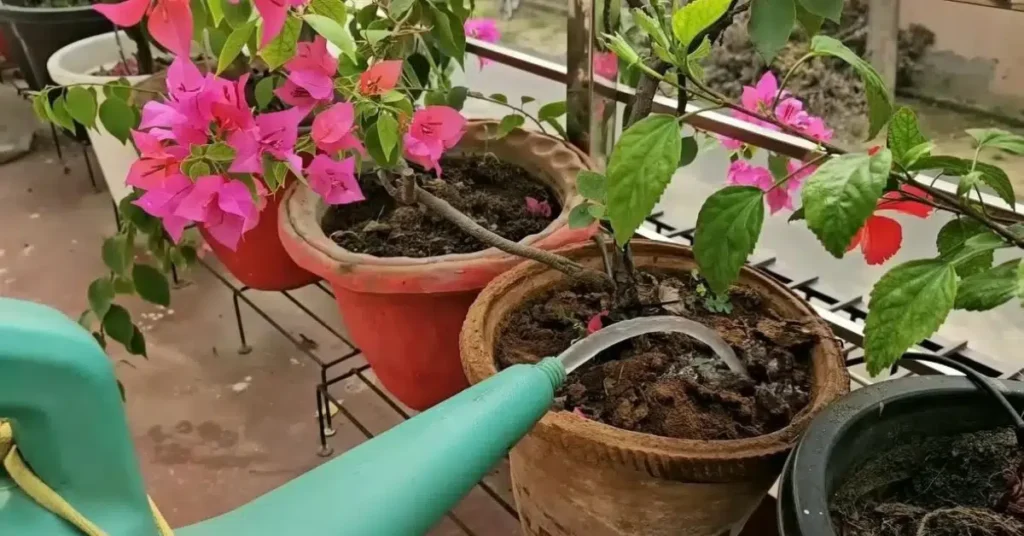
Bougainvillea — Arguably Delhi’s most forgiving flowering plant. It’s naturally adapted to alkaline, mineral-heavy soils and barely reacts to hard water. If your balcony gets four-plus hours of direct sun, this should be your anchor plant.
Hibiscus (Gudhal) — Tolerates alkaline conditions well, though it benefits from an occasional flush with rainwater during peak bloom season to keep flower color vivid.
Aloe Vera — A succulent that actually prefers slightly alkaline, mineral-rich soil over the acidic mixes recommended for temperate climates. One of the easiest wins for anyone starting hard water balcony gardening from scratch.
Snake Plant (Sansevieria) — Extremely tolerant of both hard water and inconsistent watering schedules. Its thick rhizomes store water and nutrients, buffering it against mineral swings far better than thinner-rooted plants.
Money Plant (Pothos) — Whether grown in soil or a water bottle on a windowsill, pothos handles Delhi’s hard water with almost no visible stress, making it one of the most reliable starter plants for hard water balcony gardening in rental flats.
Curry Leaf (Kadi Patta) — Genuinely hardy once established, though young saplings benefit from filtered water for the first two to three months while the root system develops.
Marigold (Genda) — A workhorse for Delhi balconies; alkaline soil barely dents its flowering, and it’s one of the few annuals that actually does better with mineral-rich water than with distilled or RO water.
Jade Plant — Like aloe, this succulent prefers a slightly alkaline growing medium, making Delhi’s default water chemistry closer to ideal than problematic.
Croton — More tolerant of mineral buildup than most foliage plants, though leaf color intensity can dull slightly under prolonged high-TDS watering without occasional flushing.
Neem (potted, dwarf varieties) — Naturally suited to alkaline soils across North India; genuinely thrives without any water correction.
Plants That Struggle or Die Without Correction
These are the plants that account for most of the frustration behind hard water balcony gardening complaints on Delhi gardening forums and Facebook groups. I’ve killed or nearly killed most of these myself before understanding why.
Ferns (Boston fern, Maidenhair) — Extremely sensitive to salt and mineral buildup. Fronds brown at the tips first, then curl and die back entirely. Ferns are usually the first casualty in untreated hard water balcony gardening setups.
Calathea and Maranta (Prayer Plants) — These are famously fussy even in soft-water cities; in Delhi’s hard water they develop crispy brown leaf edges within weeks unless watered with corrected water consistently.
Gardenia — Needs distinctly acidic soil (pH 5.0–6.5) to set buds and bloom. Delhi’s alkaline water pushes soil pH in the opposite direction, which is why so many gardenias here produce lush green leaves but refuse to flower.
Azalea — Same acidic-soil requirement as gardenia; almost impossible to grow well on untreated Delhi tap water long-term.
Camellia — Another acid-lover that reacts to alkaline water with yellowing between leaf veins (a classic sign of iron lock-out from high pH).
Blueberry (container-grown) — Needs genuinely acidic soil to fruit; hard water alkalinity is one of the top reasons blueberry containers fail in North Indian cities.
Citrus saplings (lemon, especially dwarf varieties) — Young citrus is particularly prone to chlorosis (yellowing leaves with green veins) from the iron and manganese lock-out caused by alkaline hard water, even though mature, well-established citrus trees tolerate it somewhat better.
Orchids (Phalaenopsis) — Mineral buildup on exposed roots is highly visible and damaging; orchids are one of the clearest indicators of whether your hard water balcony gardening correction routine is actually working.
If you notice a pattern here: it’s almost always plants that evolved in naturally acidic forest-floor conditions (ferns, calatheas, gardenias, blueberries, azaleas, camellias) that clash hardest with Delhi’s alkaline, mineral-heavy water. Plants adapted to naturally alkaline, arid, or coastal soils (bougainvillea, aloe, hibiscus, jade) do fine by comparison.
How to Actually Correct Hard Water for Sensitive Plants
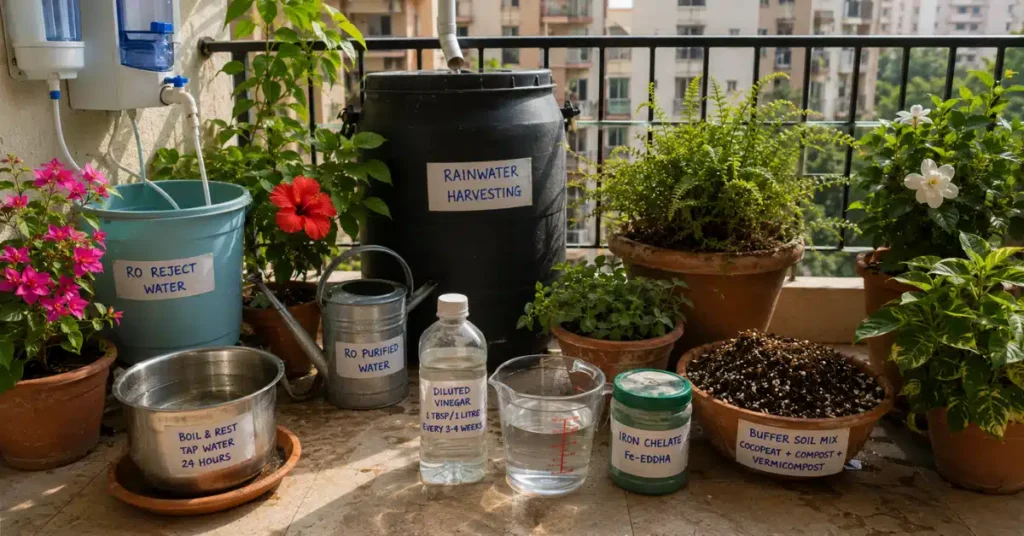
You don’t need to give up on ferns or gardenias entirely — you need a correction routine. This is the practical core of hard water balcony gardening for anyone growing sensitive species in Delhi.
1. Reuse your RO purifier’s reject water — but only for the tolerant plants. Most Delhi homes already run an RO purifier, and most people pour the reject (waste) water straight down the drain. That rejected water is actually higher in TDS than your input water, since RO concentrates minerals into the rejected stream. Route it to bougainvillea, hibiscus, or money plant — never to ferns or calatheas — and you’ve solved two problems (water wastage and hard water balcony gardening cost) at once.
2. Collect and use the RO purified output for sensitive plants. Ironically, the low-TDS purified water most families drink is close to ideal for gardenias, ferns, and calatheas. Keep a dedicated watering can filled from your RO tap for these specific plants instead of the family drinking supply if volume allows, or simply water them on your own drinking-water refill days.
3. Set up simple balcony rainwater harvesting for monsoon months. A 20–30 litre drum with a mesh cover on your balcony collects genuinely soft rainwater from June to September. This is the single highest-impact, lowest-cost fix in hard water balcony gardening — four monsoon months of near-zero-TDS water free of cost, ideal for your most sensitive pots.
4. Boil and rest tap water for temporary hardness. Not all hardness is equal. Temporary hardness (caused by bicarbonates) can be reduced by boiling water and letting it cool for 24 hours before use — the calcium carbonate settles out and you decant the clearer water from the top, leaving the sediment behind. This won’t touch permanent hardness (chlorides/sulphates), but it noticeably helps in bicarbonate-heavy zones like South Delhi.
5. Use diluted white vinegar for occasional pH correction. For potted gardenias, azaleas, or citrus showing yellowing from alkaline lock-out, mix roughly one tablespoon of white vinegar per litre of water and use it once every three to four weeks — never as your default watering routine, only as a periodic corrective flush. Over-acidifying is just as harmful as ignoring the problem, so treat this as a targeted tool, not a habit.
6. Add chelated iron (Fe-EDDHA or Fe-DTPA) for chlorosis. If you’re seeing yellow leaves with green veins on citrus, gardenia, or hibiscus, that’s classic iron lock-out from alkaline soil, not an iron deficiency in the soil itself. A chelated iron supplement (available at most nursery supply stores as “Iron Chelate” or under brand names at agri-input shops) stays available to roots even in high-pH soil, correcting the visible symptom directly without needing to fully correct your water source.
7. Buffer your soil mix, not just your water. Adding well-decomposed cocopeat, compost, and a small proportion of vermicompost to your potting mix improves the soil’s natural buffering capacity against pH swings. This matters as much as water correction in long-term hard water balcony gardening — a resilient soil mix absorbs some of the mineral shock that would otherwise hit plant roots directly.
Monthly Hard Water Balcony Gardening Checklist
Use this as a running routine rather than a one-time fix. This is the exact rhythm I follow on my own Rohini balcony.
- Test tap water TDS at the start of each month (or at minimum, each season change)
- Check pot rims and soil surface for new white mineral crust; scrape off gently if present
- Flush tolerant plants (bougainvillea, hibiscus, snake plant) with a deep watering once a month to push accumulated salts down and out through drainage holes
- Water sensitive plants (ferns, calathea, gardenia, citrus) exclusively with RO output or rested/boiled water
- Inspect leaves for chlorosis (yellowing with green veins) — apply chelated iron if spotted
- Top-dress pots with fresh compost or cocopeat every six to eight weeks to replenish buffering capacity
- During monsoon (June–September), prioritise collected rainwater for all sensitive pots
- Repot rootbound sensitive plants annually to remove old, mineral-saturated soil entirely rather than layering fresh soil on top
- Keep separate watering cans clearly labelled for “tolerant” and “sensitive” plant groups to avoid mix-ups
- Re-test soil pH every few months using an inexpensive soil pH strip if growing acid-loving plants long-term
Building a Hard Water-Resilient Soil Mix From the Start
Prevention matters more than correction in hard water balcony gardening, and it starts with what you fill the pot with in the first place.
For tolerant plants (bougainvillea, hibiscus, succulents, marigold), a standard mix of garden soil, coarse sand, and compost in roughly equal parts works fine — these plants don’t need special buffering.
For sensitive plants (ferns, gardenias, calatheas, citrus), build a mix weighted toward cocopeat and well-rotted leaf mould rather than garden soil, with a smaller proportion of perlite for drainage.
This composition naturally resists pH swings better than straight garden soil, which in Delhi is often already alkaline before you’ve added a drop of hard water to it.
Avoid using construction sand or unwashed river sand in these mixes — both can carry additional mineral salts that compound the hard water problem rather than offsetting it.
Common Mistakes Delhi Balcony Gardeners Make With Hard Water
Assuming all plants need the same fix. The single biggest error in hard water balcony gardening is treating your entire balcony with one blanket solution — either ignoring the problem for everything, or over-correcting even your hardy bougainvillea with RO water it doesn’t need. Match the correction to the plant.
Confusing chlorosis with nutrient deficiency and over-fertilising. When leaves yellow from iron lock-out, the instinctive response is to feed the plant more. This often makes things worse by adding further salts to already saturated soil. Correct the pH-lock issue first; fertilising comes second.
Never flushing pots. Container plants have nowhere for accumulated minerals to go unless you deliberately flush them with a deep, thorough watering that runs freely out of the drainage holes. Light daily watering without occasional flushing is exactly how mineral crust builds up unnoticed over months.
Ignoring seasonal TDS shifts. Many Delhi households test their water once, form a routine, and never check again. Borewell and tanker-fed supply can shift 200–300 ppm between summer scarcity and monsoon replenishment, meaning your hard water balcony gardening routine may need seasonal adjustment, not a one-time setup.
Choosing acid-loving plants without a correction plan. Gardenias and blueberries are frequently bought on impulse from nurseries without any warning about Delhi’s water chemistry. If you want to grow them, decide on your correction routine (RO water, vinegar flushes, chelated iron) before you bring the plant home, not after it starts declining.
Cost and Effort Comparison: Which Correction Method Is Worth It
Not every hard water balcony gardening fix deserves equal investment of your time or money. Here’s how the main methods actually compare, based on what I’ve used across three seasons.
RO rejects water routing — Cost: effectively free, since most homes already run an RO unit. Effort: low, just redirect the waste pipe outlet into a storage drum near the balcony. Best for: tolerant plants only (bougainvillea, hibiscus, money plant). This is the highest value-to-effort fix available to most Delhi households and should be your first move.
RO purified water for sensitive plants — Cost: marginal, since you’re using water you’re already producing for drinking. Effort: low, just fill a separate watering can on your regular refill days. Best for: ferns, calatheas, gardenia, citrus saplings.
Balcony rainwater harvesting — Cost: one-time investment of ₹500–1500 for a drum, mesh cover, and basic piping. Effort: moderate setup, low maintenance afterward. Best for: seasonal top-up (June–September) for your most sensitive pots; genuinely the best water quality you’ll get for free.
Boiling and resting water — Cost: cooking gas or electricity for boiling, plus 24-hour wait time. Effort: moderate, requires planning ahead rather than watering on demand. Best for: bicarbonate-heavy zones (South Delhi more than borewell-heavy Gurugram, where hardness is more permanent than temporary).
Diluted vinegar flush — Cost: negligible, a bottle of white vinegar lasts months. Effort: low, but requires discipline to use only periodically, not as a default. Best for: occasional corrective treatment for gardenia, azalea, and citrus showing alkaline stress.
Chelated iron supplement — Cost: roughly ₹150–300 for a supply that lasts a full season. Effort: low, applied every four to six weeks per package instructions. Best for: any plant showing chlorosis (yellow leaves, green veins) regardless of the underlying water hardness cause.
Soil buffering with cocopeat and compost — Cost: ₹100–200 per bag, needed periodically. Effort: low, folded into your normal repotting and top-dressing routine. Best for: every pot in a hard water balcony gardening setup, tolerant and sensitive alike, since it’s preventive rather than corrective.
If you’re starting from zero, prioritise in this order: soil buffering first (it’s foundational and cheap), then RO reject/output routing (near-zero additional cost), then rainwater harvesting once you’ve confirmed which plants actually need the extra help. Vinegar flushes and chelated iron are targeted tools for specific symptoms, not routine maintenance.
Seasonal Care Calendar for Hard Water Balcony Gardening in Delhi
Delhi’s water hardness isn’t static through the year, and neither should your routine be.
March to May (pre-monsoon summer): This is when tanker dependency peaks and TDS readings tend to run highest across NCR. Increase flushing frequency for tolerant plants to every two to three weeks. Sensitive plants should be watered exclusively with corrected water during this stretch — this is the period most hard water balcony gardening failures happen, since watering frequency and mineral concentration both spike together.
June to September (monsoon): Prioritise rainwater harvesting for every sensitive pot. This is your natural reset period — many gardeners notice gardenias and ferns visibly recover during these months even without any other intervention, purely from the drop in dissolved mineral content in the water they’re receiving.
October to November (post-monsoon, cooler weather): Good window for repotting sensitive plants with fresh, buffered soil mix, since root stress from the upcoming winter dormancy is lower. Continue moderate flushing for tolerant plants.
December to February (winter): Watering frequency naturally drops with lower evaporation, which means slower mineral accumulation too. Reduce flushing to once a month across the board, but keep testing your water at least once during this window since municipal supply sourcing sometimes shifts seasonally even in winter.
The Real Takeaway for Delhi Balconies
Hard water balcony gardening in Delhi isn’t about fighting your water supply — it’s about matching the right plants to what you actually have, and building a light, sustainable correction routine for the handful of species that genuinely need it.
Most of the “I have a black thumb” stories I hear from friends and readers in Rohini, Dwarka, and Gurugram trace back to one root cause: growing acid-loving, soft-water plants without realising what was coming out of the tap.
Test your water, pick your battles (bougainvillea over gardenia if you want an easy win), and save the correction effort — RO reject routing, monsoon harvesting, chelated iron — for the plants genuinely worth the trouble.
Your balcony isn’t working against you. It just needed a routine built for Delhi’s water, not for someone else’s city.

FAQs
Is Delhi’s tap water safe for watering plants at all?
Yes, for the majority of common balcony plants — bougainvillea, hibiscus, money plant, succulents, marigold, and curry leaf all handle Delhi’s hard water reasonably well. The concern is specifically for acid-loving or salt-sensitive species, not for gardening in general.
How do I know if my plant’s yellowing is from hard water or something else?
Classic hard water-related chlorosis shows yellowing between the veins while the veins themselves stay green, usually starting on newer leaves. Uniform yellowing across the whole leaf, or yellowing starting on older leaves, is more often an overwatering or general nutrient issue rather than hard water alkalinity.
Can I use a water softener meant for bathing water on my garden plants?
Ion-exchange water softeners typically replace calcium and magnesium with sodium, which is worse for plants, not better. These are designed for household plumbing and skin, not gardening — stick to RO reject/output routing, rainwater harvesting, or the vinegar/boiling methods described above instead.
Does boiling water remove all hardness?
No. Boiling only removes temporary hardness caused by dissolved bicarbonates. It has no effect on permanent hardness from chlorides and sulphates, which is common in borewell-heavy areas like Gurugram and parts of Ghaziabad. Check your water source type before relying on boiling alone.
How often should I flush my pots to prevent mineral buildup?
Once a month is a reasonable baseline for hard water balcony gardening in Delhi, increasing to every two to three weeks during peak summer when watering frequency (and mineral deposition) is highest.