If your newspaper seed pots keep turning moldy in humid weather, the problem isn’t your watering — it’s the paper itself. This guide breaks down exactly why newsprint fails in Indian humidity, plus a simple turmeric-lime treatment that keeps pots mold-free right through germination and transplant.
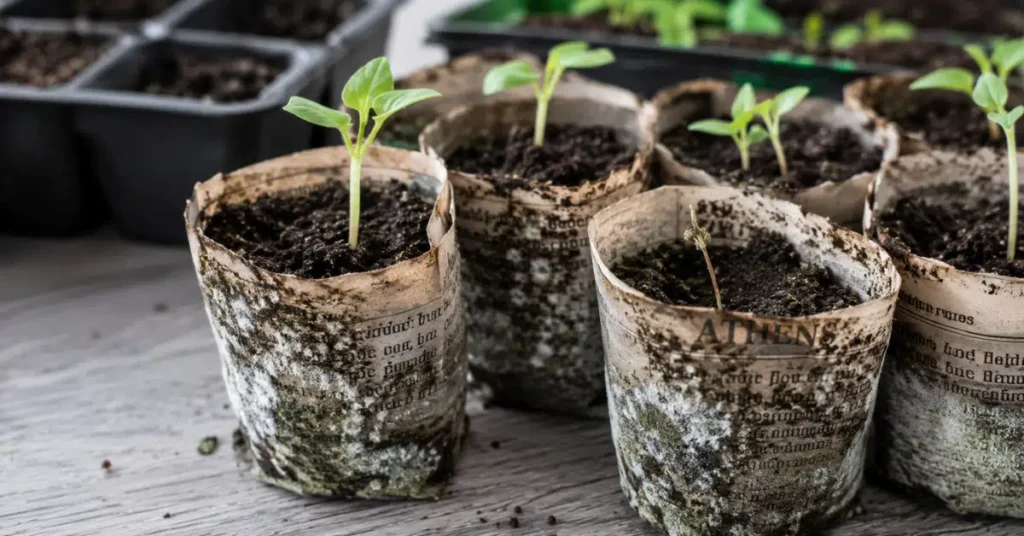
If your newspaper seed pots turned fuzzy white or greenish within four days of sowing, you are not doing anything “wrong” in the way most gardening blogs suggest.
It is not overwatering alone, and it is definitely not bad luck. In coastal and monsoon-affected Indian cities, ordinary newsprint simply cannot survive 75%+ relative humidity without breaking down biologically — and almost every gardening guide skips the one variable that actually causes it: the paper’s own moisture-holding structure combined with print ink residue.
I have grown seedlings in newspaper pots across three different Indian humidity zones for over a decade, and once I understood what was actually happening at the fibre level, mold stopped being a mystery. Here is the real reason, and the fix that finally works.
The Real Reason Newspaper Seed Pots Go Moldy (It’s Not What Most Guides Say)
Most articles blame mold on “too much water” and tell you to water less. That advice is incomplete, and if you follow it strictly, your seedlings dry out and stop germinating instead. The actual problem with newspaper seed pots in Indian conditions is a combination of three things happening at once, and almost no guide separates them out.
First, newsprint is mechanically pulped, not chemically pulped. Unlike kraft paper or coir liners, ordinary newspaper is made from short, loosely bonded wood fibres. These fibres absorb moisture fast but release it very slowly. In a place like Kochi, Chennai, Mumbai, or Kolkata during monsoon, ambient humidity regularly sits above 80%. Your newspaper seed pots are absorbing atmospheric moisture even when you’re not watering them at all. This is the part every generic guide misses — the mold isn’t only coming from your watering can, it’s coming from the air.
Second, the folded layers trap a microclimate. A newspaper seed pot is folded in multiple overlapping layers to make the base sturdy. Between those layers sits a pocket of still, damp air with zero airflow — exactly the environment fungal spores need to germinate within 48–72 hours. This is why the mold in newspaper seed pots almost always starts at the base fold first, not at the rim, and by the time you see it on the outside, it has usually been growing between the layers for two or three days already.
Third, and this is the one nobody talks about — print ink and glossy inserts. Regular black-and-white newsprint from broadsheet Indian dailies uses soy or mineral-based ink, which is relatively low-risk. But the coloured supplement pages, glossy inserts, and advertisement pullouts common in Sunday editions use a different coating. That coating changes how the paper absorbs and releases moisture, and in my experience, seed pots made from those glossy sections mold noticeably faster than pots made from plain classified-ads pages. If you’ve ever wondered why one batch of newspaper seed pots molded and another batch from the same week didn’t, this is very likely why.
Quick Humidity Test: Is Your Region High-Risk for Newspaper Seed Pot Mold?
Before jumping into fixes, run this two-minute test. It tells you whether your city’s ambient humidity alone is enough to cause newspaper seed pot mold, independent of your watering habits.
The Palm Test: Take a dry sheet of newspaper, fold it into quarters, and leave it flat on an open shelf (not in direct sun) for six hours. Then press your palm on it. If it feels cool and slightly damp, your local humidity is already high enough to threaten unprotected newspaper seed pots, and you need the reinforced method described below — not the basic fold.
| Indian Region | Typical Monsoon RH% | Newspaper Pot Mold Risk | Recommended Method |
| Mumbai, Kochi, Mangalore, Goa | 80–95% | Very High | Reinforced (Turmeric-Lime Dip) mandatory |
| Chennai, Vizag, Kolkata | 75–88% | High | Reinforced method strongly recommended |
| Bengaluru, Pune, Hyderabad | 60–75% | Moderate | Reinforced method recommended June–Sept |
| Delhi NCR, Jaipur, Lucknow | 45–65% (varies by season) | Low–Moderate (spikes in July–Aug) | Basic fold works Oct–May; reinforce during monsoon |
| Ahmedabad, Nagpur, indoor AC balconies | 35–55% | Low | Basic fold usually sufficient |
If you’re in the “Very High” or “High” row, please don’t skip the reinforcement step further down. I’ve had readers from Kochi write to me saying they lost three consecutive sowing batches before switching to it, and it wasn’t a watering issue at all — it was pure ambient humidity.
The Fix Every Guide Misses: The Turmeric-Lime Barrier Method
This is the method I’ve used since 2016 after losing an entire batch of chilli and tomato seedlings to mold during a particularly wet July. Most guides recommend “let the pot dry between waterings,” which simply doesn’t work when the air itself is the moisture source. What actually works is creating a thin antifungal barrier on the newspaper before you even fold it into a pot.
Why Turmeric and Lime Work (Not Folklore — Actual Mechanism)
Turmeric contains curcumin, which has documented antifungal properties against common mold genera like Rhizopus and Aspergillus — the same fuzzy white and black molds that colonise damp newsprint. Hydrated lime (choona, the same limestone paste used in paan or whitewashing) raises the surface pH of the paper slightly, and most household mold species struggle to establish on a mildly alkaline surface. Combined, they don’t waterproof the paper — nothing fully waterproofs newsprint without also blocking root respiration — but they slow fungal colonisation long enough for your seedling to germinate, develop true leaves, and be transplanted before mold ever gets a foothold.
Step-by-Step: Making Mold-Resistant Newspaper Seed Pots
What you’ll need:
- Plain black-and-white newspaper sheets (avoid glossy supplement pages)
- 1 tablespoon turmeric powder
- ½ teaspoon hydrated lime paste (available at any paan shop or hardware store as “choona”)
- 200ml water
- A small bowl and a pastry brush or old toothbrush
- A round bottle or glass (bottom diameter roughly 6–7cm) to shape the pot
Method:
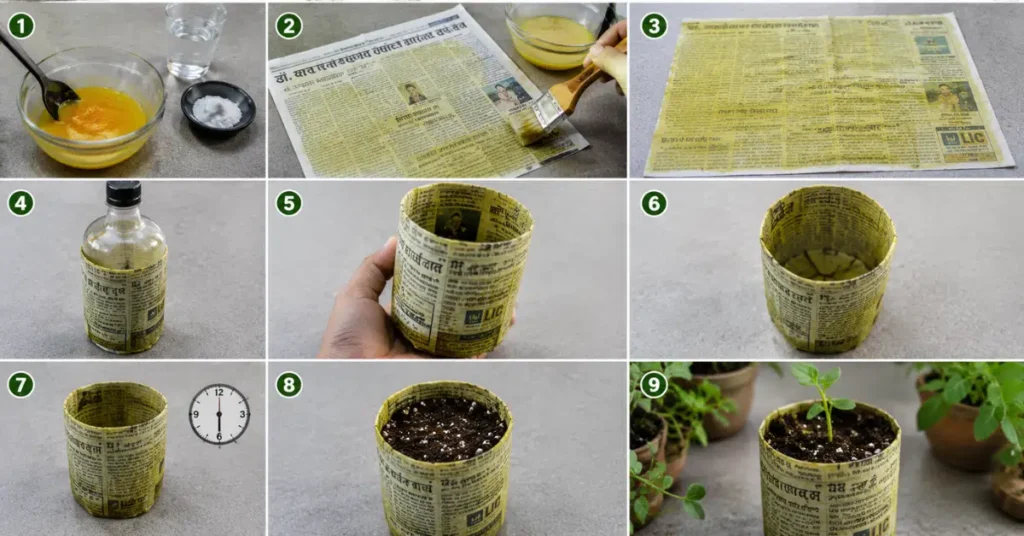
- Mix the turmeric and lime paste into the water until you get a thin, pale yellow wash — it should be watery, not pasty. If it’s too thick, it will make the paper soggy and weak instead of protected.
- Lay a full newspaper sheet flat and, using the brush, apply a thin, even coat of the turmeric-lime wash on one side only. Don’t drench it — a light film is enough. Drenching defeats the purpose because it adds excess moisture right at the start.
- Let the treated sheet air-dry for 15–20 minutes in a breezy spot, treated side facing up. It should feel dry to touch, not damp, before folding. This step is where most people rush and ruin the whole method — patience here is what separates a mold-resistant pot from a regular one.
- Once dry, fold the sheet around your bottle exactly as you would for a standard newspaper seed pot — six to eight layers wrapped around the base, with the treated side facing outward so it’s the barrier that meets ambient air and splashback, not the seedling’s root zone.
- Slide the folded pot off the bottle and press the base flat to seal the folds.
- Let the finished pot sit empty for another 30 minutes before filling with potting mix. This lets the folded layers “set” without trapped moisture between them — remember, that trapped microclimate between layers is exactly where mold starts.
- Fill with a well-draining seed-starting mix (I use 2 parts cocopeat, 1 part vermicompost, 1 part perlite or coarse sand) and sow as usual.
The Airflow Correction Most People Skip
Even a treated newspaper seed pot will mold eventually if you place it directly on a flat tray with no airflow underneath. Always rest your pots on a wire rack, a mesh tray, or upturned bottle caps so air can circulate under the base. In my own balcony setup in a humid month, pots placed flat on a plastic tray molded within 5 days even after turmeric-lime treatment, while identical pots on a wire rack stayed clean for the full 3-week germination-to-transplant window. Airflow underneath the pot matters as much as the treatment on the paper itself.
Watering Newspaper Seed Pots the Right Way in Humid Weather
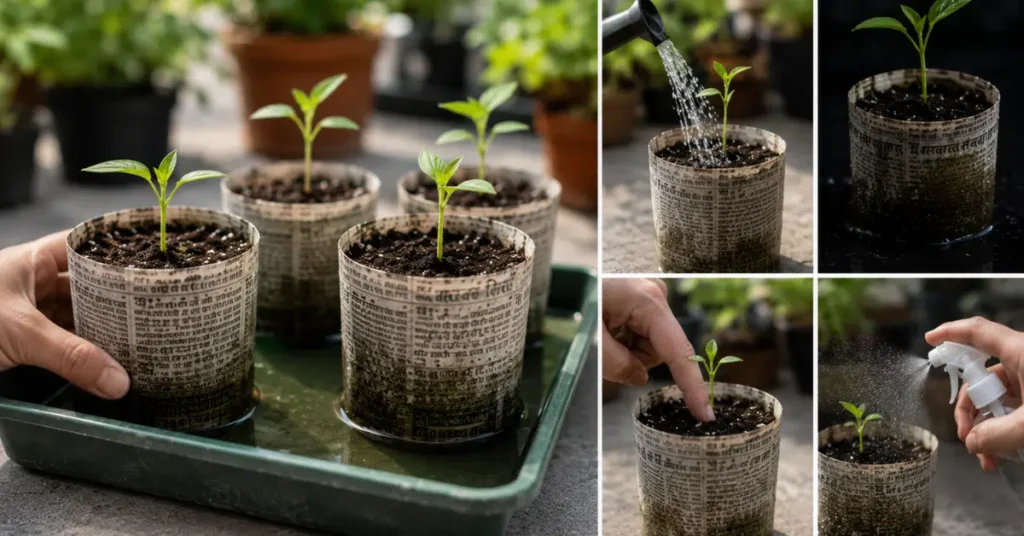
Once your newspaper seed pots are reinforced, watering technique still matters — but the rule is different from what you’ll read elsewhere.
- Water from below, not from above. Place the pot in a shallow tray with 1cm of water for 5–10 minutes, let it wick up, then remove it. Top-watering with a can constantly wets the outer paper surface, which is the exact trigger point for mold in newspaper seed pots.
- Water early morning only. Watering in the evening in humid regions means the pot stays damp through the night when temperatures drop and condensation increases — the worst possible combination for fungal growth.
- Check moisture with a finger, not a schedule. In 80%+ humidity, your newspaper seed pots may need water only every third day, not daily. Overriding the “daily watering habit” is often the single biggest improvement people report.
- Never mist the outer paper. Some guides suggest misting to “keep pots moist” — in Indian humidity, this is actively harmful advice and one of the fastest ways to trigger mold on newspaper seed pots.
How to Rescue Newspaper Seed Pots That Have Already Started Molding
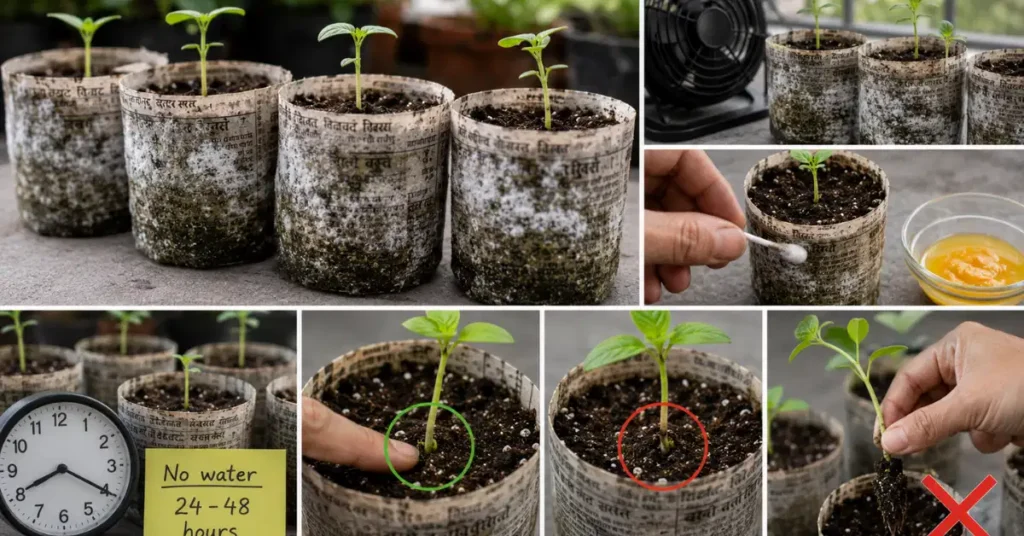
If you’ve caught it early — light white fuzz only on the outer surface, not yet touching the soil — you can usually save the batch. And if you’ve also noticed white fungus on your topsoil in nearby pots, the cause is the same monsoon humidity, just showing up on a different surface.
- Move the pots immediately to a spot with strong cross-ventilation, ideally near a fan on low speed (not pointed directly at the seedlings).
- Using a dry cotton bud, gently dab a very small amount of the turmeric-lime wash directly onto the moldy patch. Do not soak it.
- Stop bottom-watering for 24–48 hours and rely on the residual moisture already in the soil.
- Check the seedling’s stem where it meets the soil line (the “collar”) — if it’s still white/pale and hasn’t gone soft or brown, your seedling is fine and only the outer paper was affected.
- If mold has reached the soil surface or the stem collar has gone soft and dark, that seedling has likely developed damping-off and unfortunately won’t recover — remove it before spores spread to neighbouring pots.
If mold has reached the soil surface or the stem collar has gone soft and dark, that seedling has likely developed damping-off. This aligns with recommended damping-off prevention measures for nursery-stage crops, where affected seedlings rarely recover once the collar tissue softens.
Region-Specific Notes From an Indian Growing Calendar
Kerala, coastal Karnataka, Goa (June–September): This is peak-risk territory. I recommend skipping newspaper pots entirely during the heaviest monsoon weeks (typically late June to early August) and switching to reused plastic nursery bags or terracotta seed trays instead, resuming newspaper seed pots once humidity drops post-September.
Mumbai, Chennai, Kolkata: Reinforced newspaper seed pots work well here almost year-round if you’re consistent with the airflow-under-pot rule. The main risk window is July–August.
Bengaluru, Pune, Hyderabad: These cities have a more forgiving climate for newspaper seed pots, but sudden monsoon spells (especially Bengaluru’s unpredictable pre-monsoon showers) can catch growers off guard. Keep an eye on local humidity rather than the calendar date.
North Indian plains (Delhi, Lucknow, Jaipur, Chandigarh): Newspaper seed pots are genuinely low-risk for most of the year here except the humid July–August stretch. Basic folding without turmeric-lime treatment is usually adequate October through May.
Common Mistakes That Cause Newspaper Seed Pot Mold (Checklist)
Use this before your next sowing session:
- Using glossy or coloured supplement pages instead of plain newsprint
- Skipping the drying step after treating paper with any wash
- Placing pots flat on plastic trays with no airflow underneath
- Top-watering with a can instead of bottom-watering
- Watering in the evening instead of early morning
- Ignoring ambient humidity and watering on a fixed daily schedule
- Overcrowding pots so close together that air can’t move between them
- Using potting mix that’s too water-retentive (avoid pure cocopeat without perlite or sand)
- Leaving pots in a closed room with no fan or cross-ventilation
- Not checking pots daily during the first 5 days when mold risk is highest
A Practical 21-Day Care Routine for Newspaper Seed Pots
| Day | What to Do |
| Day 1 | Sow seeds in treated, dried newspaper pots. Place on wire rack. Bottom-water once. |
| Day 2–4 | Check daily for surface dampness. Bottom-water only if top layer of mix feels dry. |
| Day 5–7 | Inspect base folds closely — this is the most common mold starting point. Ensure airflow underneath is uninterrupted. |
| Day 8–12 | Germination typically visible. Increase morning sunlight exposure gradually. Continue bottom-watering every 2–3 days depending on humidity. |
| Day 13–18 | True leaves develop. Reduce watering frequency slightly as roots establish. Watch for any yellowing at the pot’s base fold, a sign of excess retained moisture. |
| Day 19–21 | Seedlings ready for transplanting. Plant the entire newspaper pot directly into soil — the paper breaks down naturally and won’t disturb roots. |
Final Thoughts
Newspaper seed pots are one of the most sustainable, zero-cost propagation methods available to Indian home gardeners, and it would be a shame to abandon them just because standard advice doesn’t account for our climate.
The mold problem isn’t a flaw in the method — it’s a gap in the instructions most guides give. Treat the paper before you fold it, give it airflow after you fill it, and water it the way our humidity actually demands, and newspaper seed pots will outperform plastic nursery bags in almost every way that matters, right down to how effortlessly they break down once you transplant.

FAQs
Does turmeric stain the potting soil or affect seedlings?
No. The quantity used in the wash is minimal and turmeric is biodegradable. It has no negative effect on germination rates in tomato, chilli, marigold, or tulsi seedlings, which is what I’ve tested it on most extensively.
Can I use neem oil instead of turmeric-lime wash?
Neem oil can be added in very small quantities (2–3 drops per 200ml) for extra pest resistance, but it shouldn’t replace the turmeric-lime wash entirely since neem oil doesn’t raise surface pH the way lime does, which is the part that actually deters fungal colonisation.
Why do my newspaper seed pots mold even though I water carefully?
If you’re in a high-humidity region and only adjusting watering, you’re addressing one of three causes and ignoring the other two — ambient air moisture and trapped microclimate between paper layers. Watering is rarely the sole cause once relative humidity crosses 75%.
How long do reinforced newspaper seed pots last before transplanting?
Typically 3 weeks, which matches the standard seedling-to-transplant window for most Indian vegetable and flower seedlings. The turmeric-lime treatment isn’t meant for long-term storage pots — it’s designed to protect the pot through germination and early growth only.
Is it safe to compost moldy newspaper seed pots?
Yes, but not directly into your active seedling area. Add them to a separate compost pile away from your nursery zone so spores don’t cross-contaminate new sowings.