
Blaming the heat? Wrong season. In India, July stalls almost always trace back to waterlogged roots and rain-washed nutrients, not sunlight. Here’s what’s actually happening below the soil line — and the exact drainage, feeding, and airflow fixes that get new leaves coming back within days.
Plants Stop Growing in July, the same complaint lands in my inbox from readers across Pune, Thane and Bangalore: “My plants were doing so well till last month, now everything has just stopped.” No new leaves. No flowers. Sometimes yellow patches creep in from the edges.
And the strange part — this isn’t a summer heat problem. It’s a July problem, which means it’s a monsoon problem. Most gardening advice online is written for American or European summers, where July means dry heat and drought stress.
In India, July means the opposite — waterlogged pots, oxygen-starved roots and a soil biology that has quietly gone sour. Once you understand what’s actually happening below the soil line, the fix takes about a weekend.
Why Plants Stop Growing in July (It’s Not the Heat)
Here’s what almost nobody tells Indian gardeners: the mid-summer stall is rarely about temperature.
By the time the first monsoon showers hit — usually the second or third week of June across most of western and southern India, a little later in the north — your plants go through three simultaneous shocks, and July is when you see the visible damage from all three stacking up.
Shock one: root zone oxygen crash. Roots don’t just drink water, they breathe. In a well-drained pot, air pockets between soil particles let roots respire. The moment monsoon rain saturates that pot and it can’t drain fast enough, those air pockets fill with water. Roots that were fine in May start suffocating by late June.
You won’t see it immediately — plants can survive on stored energy for two to three weeks even with partially drowned roots. That delay is exactly why the stall shows up in July, weeks after the actual damage began.
Shock two: nitrogen washout. Nitrogen in the nitrate form is highly soluble and moves with water. A single heavy monsoon downpour — the kind Mumbai or Kolkata regularly gets, 60-80mm in a few hours — can leach a large share of available nitrogen straight out of a pot’s drainage holes.
If you fed your plants in April or May and then trusted “the rain will keep them growing,” you actually fed the drainage tray, not the plant. By July, most containers are running on empty.
Shock three: light quality drop, not just light quantity. Cloud cover during monsoon doesn’t just dim sunlight, it shifts the light spectrum toward diffuse blue light and away from the direct red-orange wavelengths plants use most efficiently for flowering and fruiting.
Even plants getting six hours of “daylight” under a monsoon sky are photosynthesising at a fraction of their summer rate.
Combine that with waterlogged, nitrogen-starved roots, and you get exactly what readers describe: a plant that’s alive, green even, but frozen in place.
None of these three things are fixed by simply “waiting for the rains to pass.” Each has a specific, practical fix, and that’s what the rest of this guide covers.
First, Diagnose Correctly — Don’t Guess
Before fixing anything, spend five minutes actually reading your plant. Indian urban gardeners tend to reach for one of two default explanations — “it needs more water” or “it needs more sun” — and both are usually wrong in July. Use this quick diagnostic instead.
Check the soil surface. Push a finger 2 inches into the pot. If it’s soggy and smells faintly sour or like a marsh, you’re dealing with waterlogging and root suffocation, not thirst. A healthy monsoon pot should feel moist, never wet-squelchy.
Check leaf yellowing pattern. Older, lower leaves yellowing first and dropping usually points to nitrogen deficiency from leaching. New growth that’s stunted and pale, with the plant still holding onto old leaves, more often points to root damage restricting nutrient uptake altogether.
Check for a white or grey film on the soil surface. This is usually saprophytic fungus feeding on decaying organic matter in an oxygen-poor, overly wet growing medium — a clear sign your potting mix has gone anaerobic.
Check stem base for softness or dark discoloration. This is early-stage root rot or collar rot, extremely common in July on hibiscus, rose, and money plant grown in ordinary garden soil rather than a free-draining mix.
Look at pest activity, not just leaf damage. Aphids and mealybugs explode in humid, low-airflow conditions. If you see sticky residue (honeydew) or ants suddenly farming your plant, that’s a humidity-driven pest bloom, not a nutrient issue.
Once you know which of these is actually happening, apply the matching fix below rather than a blanket “more fertiliser, more water” approach, which in July usually makes things worse.
Fix 1: Solve the Drainage Problem Before Anything Else
If your diagnostic check showed soggy, sour-smelling soil, this is your starting point — nothing else you do will work until roots can breathe again.
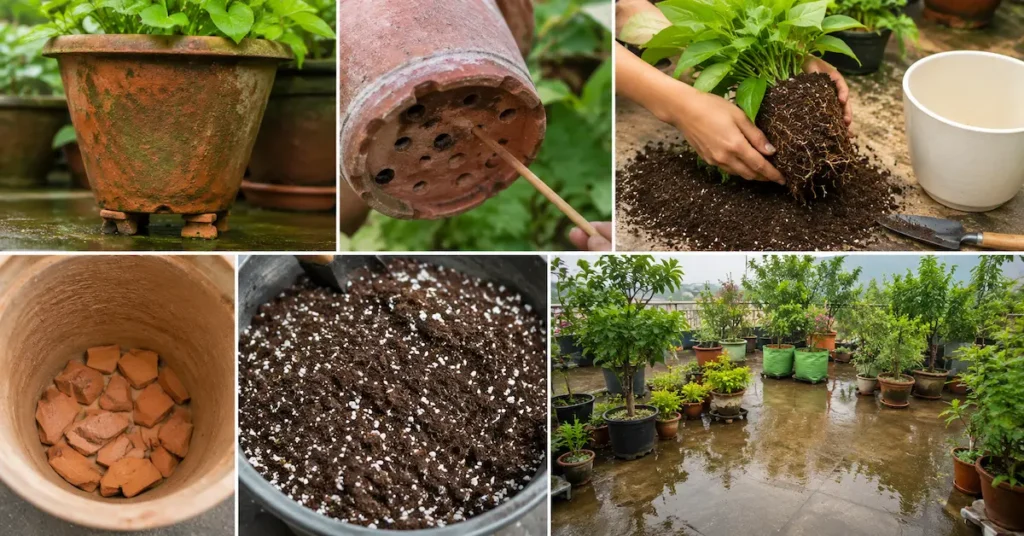
Elevate every single pot. This is the single highest-impact change you can make this week. Use pot feet, unglazed terracotta tile pieces, or even old bottle caps under each container, raising it just 1-2 inches off the tray or floor.
This lets excess water actually exit through the drainage holes instead of sitting in a puddle underneath, which is functionally the same as having no drainage holes at all. I’ve seen this one change alone reverse a stall within 10 days.
Check that drainage holes are actually open. Roots grow toward the holes over a season and physically plug them. Take a thin stick or old chopstick and clear every hole on pots that have been in place for more than one growing season.
Re-pot anything showing collar rot or sour soil into a fresh, chunky mix immediately — don’t wait for the monsoon to end. A reliable Indian-context potting mix for the rainy season is 40% cocopeat, 30% coarse river sand or perlite, 20% well-rotted compost, and 10% neem cake powder for both nutrition and mild pest protection. Avoid heavy black garden soil (kaali mitti) in containers during monsoon — it compacts and holds water far too long.
If you’ve already spotted a soft or blackened stem base, don’t stop at re-potting — check the roots themselves before deciding the plant’s savable. I’ve written a full breakdown of what early versus advanced root rot actually looks like, and when a plant is worth saving, in Root Rot in Monsoon: How to Identify, Treat, and Prevent It.
Add a drainage layer correctly. A 1-inch layer of broken terracotta shards (kadappa/matka pieces) or brick bats at the base of the pot, below the potting mix, genuinely improves drainage — but only if the pot’s own holes are clear. This layer is not a substitute for holes, it’s a supplement to them.
For terrace and rooftop gardens, check your floor drainage, not just your pots. A pot can drain perfectly and still sit in an inch of standing water on a terrace with poor slope toward the outlet. Walk your terrace 20 minutes after a heavy shower and see where water actually pools.
Fix 2: Rebuild the Nitrogen Your Rain Washed Away
If your leaves showed the classic bottom-up yellowing pattern, your plant is nitrogen-starved, and the fix is a change in how you feed, not just how much.
Switch to smaller, more frequent feeding instead of one large monthly dose. During monsoon, a heavy single feed gets partially washed out within days. Feeding at half-strength every 10-12 days keeps a more consistent nutrient level available without wasting fertiliser on runoff.
Use slow-release organic sources as your base. Neem cake powder (mix 1-2 tablespoons into the top inch of soil per medium pot) breaks down gradually and isn’t as vulnerable to leaching as water-soluble feeds.
Vermicompost worked into the top layer, roughly a handful for a 10-inch pot, does the same job while also improving soil structure.
Reserve liquid feeds for a quick correction, not a monsoon staple. A diluted jeevamrut or panchagavya drench (available ready-made in most Indian nurseries now, or easy to prepare at home) works well as a fast-acting top-up between solid feeds, especially for flowering plants like hibiscus and marigold that have stalled budding.
Time your feeding around the rain, not the calendar. Feed the day after a heavy shower has drained, never right before one, or you’re simply feeding the drain again.
Watch potassium too, not just nitrogen. Potassium deficiency shows up as browning leaf margins and weak stems, and it’s just as prone to monsoon leaching. Wood ash (a teaspoon scratched into the topsoil, from your kitchen chulha or tandoor ash if you have access) is a traditional and effective potassium source many Indian home gardeners still swear by.
Fix 3: Work With Monsoon Light, Not Against It
If drainage and feeding are fine but growth is still sluggish, the diffuse-light problem from Shock Three is likely your bottleneck.
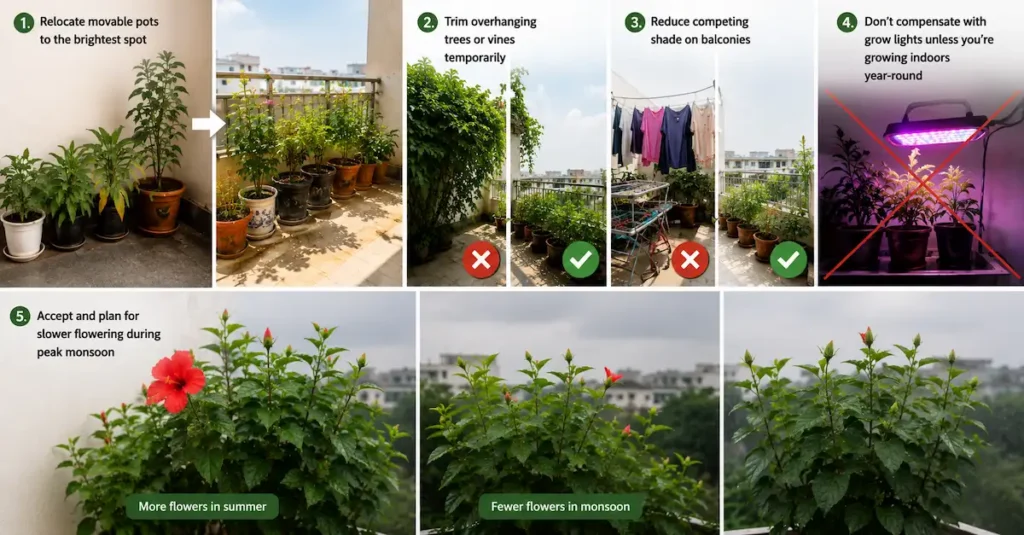
Relocate movable pots to the brightest available spot for this season specifically, even if that’s a different corner than where they thrived in summer. East and south-facing spots (adjust for your specific city’s monsoon sun angle) generally get the most usable light on overcast July days.
Trim overhanging trees or vines temporarily if they’re cutting the little bright light that is available. A gulmohar or neem tree canopy that gave welcome shade in April becomes a growth-limiting problem in cloudy July.
Reduce competing shade on balconies. Clotheslines, laundry stands, and stacked furniture routinely block a huge share of a balcony garden’s already-reduced monsoon light. A five-minute rearrangement often has more impact than any fertiliser.
Don’t compensate with grow lights unless you’re growing indoors year-round. For outdoor terrace and balcony setups, the fix is repositioning for maximum available daylight, not artificial lighting, which is rarely cost-effective for casual home gardens.
Accept and plan for slower flowering during peak monsoon. Hibiscus, rose, and most flowering ornamentals genuinely produce fewer blooms in July regardless of care quality — this is seasonal biology, not a mistake you’re making. Foliage plants, herbs and leafy vegetables are the better performers to focus your energy on through peak monsoon.
Fix 4: Get Ahead of Fungal Disease Before It Spreads
The white film, soft stems, and leaf-spot diseases that explode in July are a direct result of high humidity plus poor airflow. Prevention is far easier than cure here.
Improve airflow between pots immediately. Crowded balconies are the number one cause of fungal outbreaks I see in Indian urban gardens. Leave at least 4-6 inches of gap between containers so air can actually move and leaves can dry after rain.
Water at the base, never overhead, during monsoon. This matters more in July than any other month — wet foliage sitting in humid air for hours is exactly how fungal spores establish.
Remove yellowing or spotted leaves the moment you see them, don’t wait for a “bigger cleanup session.” Fungal spores spread fast in humidity, and one infected leaf left on the plant for a week can seed the whole pot.
Use a neem oil spray as your first line of defence, not a chemical fungicide. Mix 2 teaspoons neem oil with a few drops of any mild liquid soap in a litre of water, and spray in the early morning or evening, never in direct sun. Reapply every 7-10 days through peak monsoon.
For an active fungal spread, step up to a Trichoderma-based bio-fungicide, widely available through Indian agri-input stores and increasingly through online nurseries. It’s a beneficial fungus that out-competes the harmful ones and is safe for edible plants, which matters if you’re growing tomato, chilli or coriander on your balcony.
Avoid mulching directly against plant stems. Mulch is genuinely useful for temperature and moisture control, but piled against a stem in wet conditions, it becomes a direct pathway for collar rot. Keep a one-inch gap between mulch and stem.
Fix 5: Manage the Monsoon Pest Bloom Without Losing Your Beneficial Insects
Humidity-loving pests multiply fast in July, and the instinct to reach for a strong chemical spray usually backfires by also wiping out the natural predators that would otherwise keep things in check.
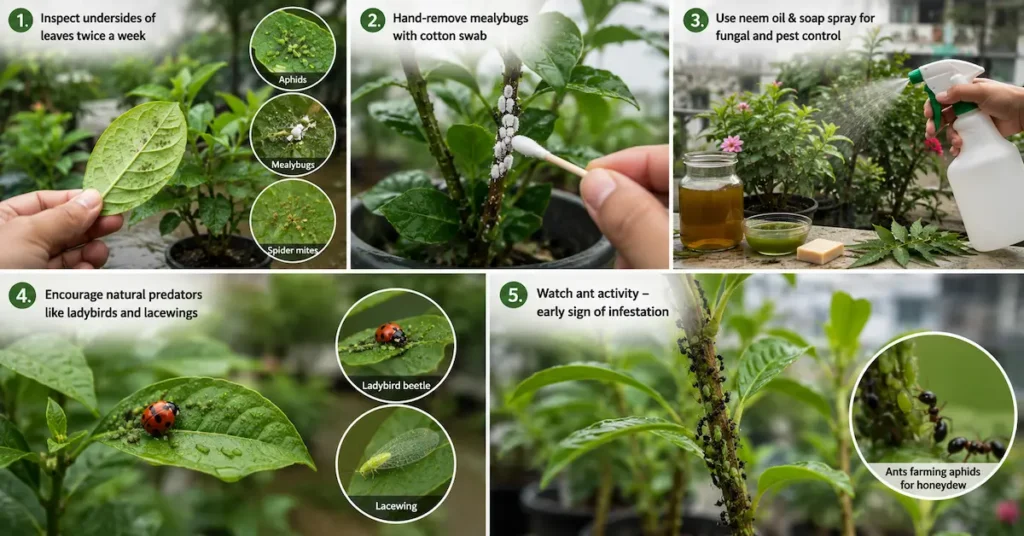
Inspect the undersides of leaves twice a week, not just the tops. Aphids, mealybugs and spider mites nearly always establish their first, out of sight.
Hand-remove visible mealybug colonies with a cotton swab dipped in diluted rubbing alcohol before reaching for any spray. For small-scale balcony infestations, this alone often solves the problem within a few days.
Use a neem oil and soap spray as your standard monsoon pest control, the same mix used for fungal prevention above does double duty against soft-bodied insects like aphids and mealybugs.
Encourage natural predators instead of eliminating everything. Ladybird beetles and lacewings are genuinely present in most Indian urban gardens if you avoid broad-spectrum chemical sprays. A garden with a small, tolerable aphid population that’s feeding ladybird larvae is healthier than one that’s been chemically sterilised.
Watch ant activity closely. Ants farming aphids or mealybugs for honeydew are a reliable early warning sign of an infestation you haven’t spotted yet. A sudden ant trail up a stem is worth investigating immediately.
Terrace and Balcony-Specific Monsoon Checklist
Urban Indian growing conditions — concrete surfaces, limited airflow, shared drainage — create a few problems container gardening guides written elsewhere never mention.
- Check your terrace waterproofing and slope early in the season. Standing water under pots accelerates every problem above.
- Group pots by water need, not by aesthetics, so you’re not overwatering drought-tolerant succulents just because they’re sitting next to thirsty foliage plants.
- Keep a physical barrier between pots and bare concrete — the concrete radiates retained heat and moisture unevenly, creating hot, damp micro-zones that stress roots.
- Clear roof or balcony drains of leaf litter weekly during peak monsoon — a blocked drain floods every pot sitting near it within hours of a heavy shower.
That same standing water sitting under your pots isn’t just drowning roots — it’s also the easiest mosquito breeding ground on your terrace. I’ve covered the exact saucer and drainage fixes for that separately in Your Balcony Pots Could Be Breeding Mosquitoes This Monsoon, worth a read alongside this one. - Bring particularly sensitive plants (succulents, cacti, and any Mediterranean herbs like rosemary or lavender) under a temporary clear plastic or fibre sheet cover during the heaviest weeks, since these specific plants simply cannot tolerate sustained monsoon wetness regardless of drainage quality.
Your July Garden Recovery Checklist
Use this as a working list, not a one-time task — most of these need repeating weekly through peak monsoon.
- Elevate every pot 1-2 inches off its tray or floor surface
- Clear all drainage holes with a thin stick or skewer
- Re-pot any plant showing collar rot or sour-smelling soil into a fresh, chunky mix
- Switch to half-strength feeding every 10-12 days instead of one monthly dose
- Work neem cake powder and vermicompost into the topsoil for slow-release nutrition
- Reposition movable pots to the brightest available monsoon-season spot
- Clear clutter and rearrange pots for at least 4-6 inches of airflow between them
- Water at soil level, never overhead, especially in the evening
- Remove any yellowing, spotted, or fungal-looking leaves the same day you spot them
- Apply a neem oil and mild soap spray every 7-10 days as standard monsoon care
- Inspect leaf undersides twice weekly for early pest activity
- Check terrace or balcony drains for blockages after every heavy shower
Common Mistakes Indian Gardeners Make in July
Having walked through this with hundreds of readers over the years, the same handful of mistakes come up again and again.
Assuming rain means you don’t need to water-check at all. Pots under a roof overhang, awning, or dense canopy often stay bone dry even during heavy monsoon, since the rain never actually reaches the soil. Check every pot individually rather than assuming “it rained, so everyone’s fine.”
Continuing summer fertiliser schedules unchanged. What worked in April, heavier and less frequent feeding, actively works against you in July’s leaching conditions.
Treating every yellow leaf as a nutrient problem and reaching straight for fertiliser. As covered above, yellowing from root suffocation looks similar at a glance but needs the opposite response, less water intervention and better drainage, not more feed.
Using chemical fungicide or pesticide as a first response. Beyond the ecological cost, broad-spectrum chemicals are often less effective against monsoon-specific fungal issues than targeted, repeated organic treatment, and they eliminate the natural pest control your garden could otherwise develop.
Giving up on flowering plants entirely. Reduced blooming in peak monsoon is normal biology, not a sign that hibiscus or rose has “failed.” Maintaining good root and airflow conditions through July sets these plants up for a strong flush the moment light quality improves in September.
What Recovery Actually Looks Like
Don’t expect an overnight transformation. Root systems that spent three weeks partially suffocated need time to regenerate the fine feeder roots responsible for nutrient uptake.
Realistically, once drainage is corrected and feeding is adjusted, most home gardeners in India see new leaf growth resume within 10-15 days, and a genuinely visible recovery in overall plant vigour by early-to-mid August, once monsoon intensity typically eases and light quality improves.
Flowering plants usually lag foliage plants by another few weeks, since bud formation is more light-dependent than basic leaf growth.
If a plant shows zero improvement after three weeks of correct care, particularly if the stem base remains soft or dark, it’s worth accepting the loss and taking a cutting or fresh start rather than continuing to invest effort in a root system that’s gone beyond recovery.
This isn’t a failure on your part; some plants, particularly succulents and certain herbs, simply aren’t suited to sustained Indian monsoon conditions in an exposed container.
Final Thought
July isn’t a bad month for your garden — it’s just an honest one. It shows you exactly which pots drain well, which ones don’t, and which habits you’ve been getting away with because summer was forgiving.
I’ve killed more hibiscus to standing water than to anything else, and every single time, the fix was boring: lift the pot, clear the hole, feed lighter and more often. Nothing here needs a fancy product or a weekend project.
Just attention, repeated weekly, for about six to eight weeks. By the time the rains ease off, you’ll have a garden that’s not just alive, but genuinely ready for its best growing stretch of the year. That’s the real reward of getting through July right.
