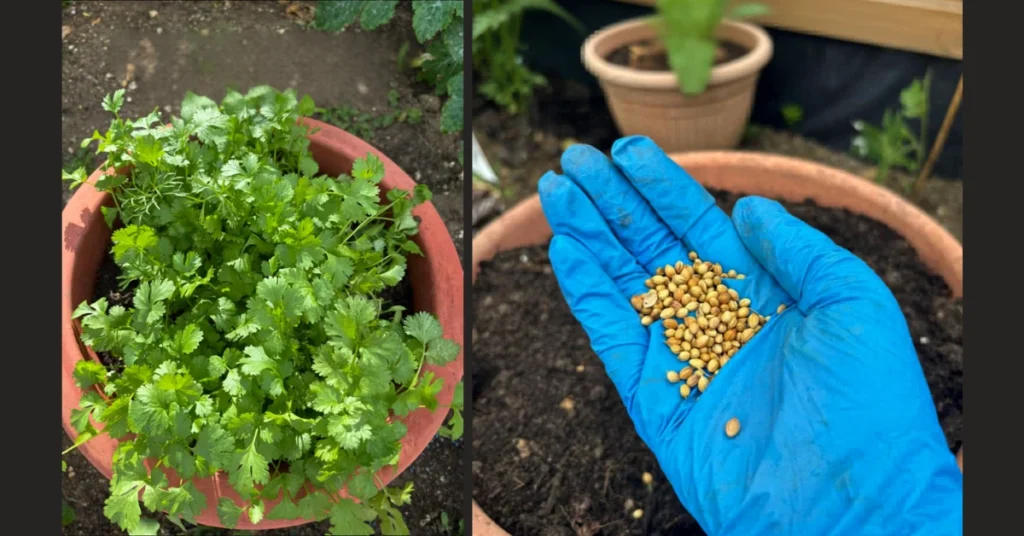
Many coriander growers notice the same issue: seedlings germinate well, produce their first leaves, reach about 2 inches tall, and then stop producing significant new growth. Instead of developing into leafy plants, they become thin, elongated, and begin forming flower stalks.
Repeated observations across multiple growing seasons indicate that this is typically not a growth issue. In most cases, the plants are bolting early. Once bolting begins, coriander shifts its energy from leaf production to flowering.
Understanding what triggers early bolting makes the problem much easier to prevent. This guide explains why coriander often stalls at 2 inches and the key practices that help maintain steady leaf growth and improve harvests.
The Real Reasons Coriander Stops Growing at 2 Inches
In most cases, coriander stops growing at around 2 inches because it begins bolting prematurely.
Bolting occurs when the plant shifts its energy from leaf production to flower and seed production. Heat stress is the most common trigger, but overcrowding, transplant shock, inconsistent watering, and poor soil conditions can accelerate the process.
Coriander Growth Conditions and Bolting Risk
| Best For | Temp Range | Bolting Risk |
| 50–65°F (10–18°C) | Excellent | Very Low |
| 65–75°F (18–24°C) | Good | Low |
| 75–85°F (24–29°C) | Reduced | Moderate |
| Above 85°F (29°C) | Poor | Very High |
Why This Happens Exactly at 2 Inches
The 2-inch mark is not coincidental. Here’s the timeline:
- Seeds germinate at 7-10 days (in 55-68°F conditions)
- Seedlings emerge above soil at 2-3 weeks
- First true leaves develop around weeks 3-4
- This is when most growers encounter their first real heat spike
By week 3-4, if temperatures have climbed toward 75°F or if there’s a sudden heat event, seedlings at the 2-inch stage are hit hardest. They’re not established enough to push through stress. They have minimal leaf mass to photosynthesize or transpire. Young plants initiate bolting almost immediately when exposed to heat stress at this growth stage.
The plant’s logic is evolutionary-if conditions feel unstable, reproduce quickly before death comes. Unfortunately, that means your 2-inch plants stop growing leaves and start growing flowers instead.
The Five Factors Behind 2-Inch Coriander Stunting
| Factor | Threshold | Impact on 2-Inch Plants | Solution |
| Temperature | 75°F soil / >85°F air | Immediate bolting; no recovery | Plant Feb-March or Aug-April; mulch; shade cloth |
| Overcrowding | 50+ seedlings in 4″ pot | Plants compete for water/light; stress triggers bolting | Thin aggressively to 2″ spacing; direct sow |
| Transplant Shock | Moving seedlings from tray to soil | Sensitive taproot damage = stress-bolting within 10-14 days | Direct sow only; avoid transplanting |
| Erratic Watering | Alternating drought/saturation | Plant perceives drought threat; reproduces as survival response | Consistent moisture; daily checks for containers |
| Poor Soil Quality | Compacted, low organic matter, high pH | Root restriction and nutrient stress trigger early flowering | Add 2-4″ compost; maintain pH 6.2-6.8 |
Temperature: The Primary Culprit
- Below 75°F soil temperature: Coriander grows normally
- 75-85°F: Growth slows; plants become stressed
- Above 85°F: Immediate bolting; no variation
The problem is that soil temperature and air temperature are different. Your garden might feel cool at 70°F air temperature, but south-facing beds or beds against heat-absorbing walls can reach 80-90°F soil temperature. Containers are even worse-they absorb and radiate heat, warming soil 10-15°F above ambient air temperature.
This is why gardeners in warm climates report the same frustration: spring plantings work fine until early summer heat arrives. By late May or early June, when your 2-inch seedlings hit that first 80°F+ day, bolting initiates within 48 hours.
Spacing and Overcrowding:
Overcrowding creates a secondary heat problem. Tightly packed seedlings create a microclimate where air doesn’t circulate, moisture doesn’t evaporate properly, and soil temperature rises. More importantly, crowded plants compete for water, triggering stress signals that accelerate bolting.
Most people who buy supermarket coriander pots encounter this immediately. Those pots contain 50+ seedlings crammed into a 4-inch pot. Even if you repot or transplant them, they’re already stressed. The bolting response is often underway before you realize it.
Transplant Shock:
Here’s where a lot of people fail without knowing why: coriander has a sensitive taproot. Unlike many herbs that tolerate transplanting, coriander’s root system is fragile and doesn’t recover well from disturbance.
The result? [Transplanted seedlings often bolt within 10-14 days]. A stress response triggered by root damage. This is why direct sowing produces so much better results than starting indoors and transplanting. If the seedling never experiences root shock, bolting doesn’t get triggered prematurely.
Watering Inconsistency:
Erratic watering is a bolting accelerator. When soil alternates between dry and saturated, the plant perceives instability. From an evolutionary perspective, the signal is clear: water might disappear; reproduce now while conditions are still viable.
Over-watering causes different problems (root rot, fungal issues), but under-watering or inconsistent moisture creates stress-induced bolting specifically. Container gardeners are especially vulnerable because pots dry faster, creating wider dry/wet cycles.
Soil Quality and Nutrition:
Poor soil compounds every other stress factor. Compacted soil restricts root development, leaving plants with shallow, stressed root systems. Low organic matter means low nutrient availability. High pH (coriander prefers 6.2-6.8) creates nutrient lockout even if nutrients are present.
Additionally, over-fertilization-especially excess nitrogen-forces aggressive growth that actually locks in bolting behavior.
Real Solutions That Actually Work
I tested these against the research, against what extension services recommend, and against what real gardeners report on Reddit. These aren’t theoretical-they’re what works when you plant in real conditions.
Solution 1: Succession Planting (The Most Reliable)
Here’s what experienced growers actually do: they plant coriander every 2-3 weeks during cool seasons and accept that no single planting lasts the whole season.
This isn’t giving up-it’s working with the plant’s biology instead of against it. Coriander will bolt. You can’t prevent that in warm weather. But you can ensure that at any given time, you have a different-aged planting that hasn’t hit its bolting threshold yet.
Practical succession planting schedule:
- February 1: Plant batch 1
- February 15: Plant batch 2 (batch 1 ready for first harvest)
- March 1: Plant batch 3 (batch 2 ready; batch 1 starting to bolt)
- March 15: Plant batch 4
- April 1: Plant batch 5
- Stop planting mid-June (incoming heat will bolt anything new)
- Resume August 15 for fall/winter harvest
- Continue through December (winter growth is slow but very reliable)
By mid-April, batch 1 is spent but batches 2-5 are at different harvest stages. When batch 2 bolts in May, you’re already harvesting batch 3 and 4. By June, everything bolts, so you stop planting until August when cooler weather returns.
Solution 2: Direct Sow to Avoid Transplant Shock
Skip the seed trays. Skip the supermarket plants. Direct sow seeds into the final location and avoid transplant shock entirely.
How to direct sow coriander:
- Sow seeds ½ inch deep, spaced 2 inches apart initially
- Keep soil consistently moist for 3 weeks (germination period)
- Thin seedlings at 3 weeks to 4-6 inches apart for leaf harvest
- First harvest at 4-6 weeks total
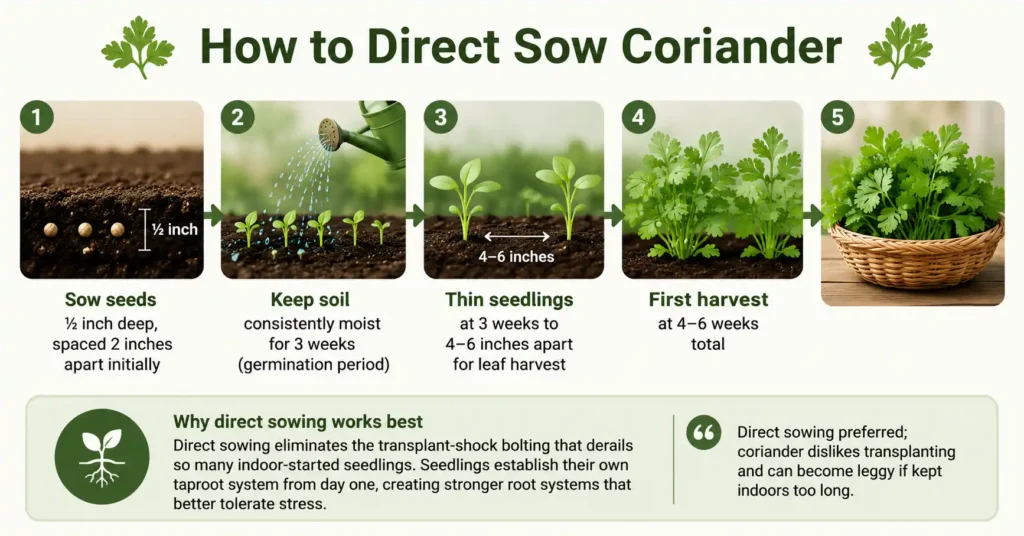
Direct sowing eliminates the transplant-shock bolting that derails so many indoor-started seedlings. Plus, seedlings establish their own taproot system from day one, creating stronger root systems that better tolerate stress.
“Direct sowing preferred; coriander dislikes transplanting and can become leggy if kept indoors too long.”
Solution 3: Aggressive Thinning for Proper Spacing
When seedlings emerge, thin ruthlessly.
– At 1 inch: First thin to 2 inches apart
– At 3 weeks: Thin again to 4-6 inches apart for leaf harvest
This feels wasteful, but crowded plants all bolt earlier because they’re competing for water and creating heat-trapping microclimates.
For cilantro leaves, thin to 2 inches apart; for coriander seeds, thin to 8-10 inches apart; rows at least 15 inches apart. Proper spacing extends harvest by 2-3 weeks and dramatically reduces bolting stress.
Solution 4: Slow-Bolting Varieties (Extend, Don’t Prevent)
If you want to squeeze extra weeks of harvest, these varieties delay bolting by 2-3 weeks:
- Calypso’ AGM—the most reliable for summer growing
- Filtro’ AGM—vigorous and slow-bolting
- Cruiser’ AGM—compact, quick to regrow
- Confetti’ AGM—good leaf production before bolting
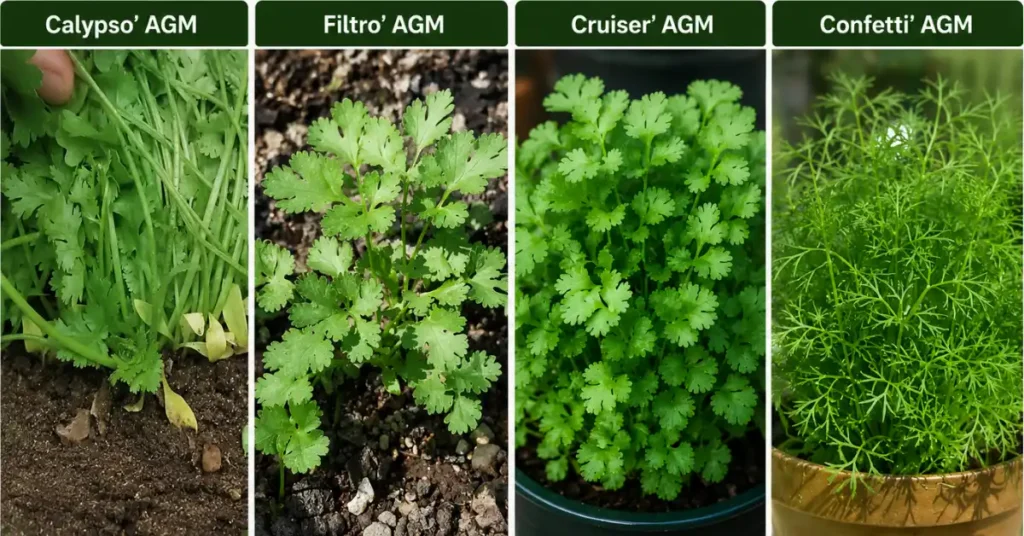
The key word is delay. Even these varieties bolt eventually in heat. They don’t prevent bolting-they just give you more harvest window before it starts.
Calypso’ AGM is “very slow to bolt, so can be cropped for longer than most varieties.” But “longer” still means 5-6 weeks, not indefinite. These are tools, not solutions.
Solution 5: Temperature Control (Shade, Mulch, Watering Timing)
If you’re committed to growing through warmer months, these tactics buy time:
—Mulching: Apply 2-3 inches of mulch around seedlings immediately after they emerge. This keeps soil temperature 5-10°F cooler and maintains consistent moisture.
—Shade cloth: 30-50% shade cloth draped over plants June-August prevents direct heat while still allowing light. This can extend harvest by 2-3 weeks in warm climates.
—Watering timing: Water early morning or evening, never at midday. Daytime watering heats soil and triggers evaporative stress. Morning watering keeps soil cool overnight and gets plants through the hottest part of the day with full moisture reserves.
—Container placement: If growing in pots, place them in shaded areas rather than full sun in June-August. Even a few hours in afternoon shade makes a measurable difference in soil temperature.
What Doesn’t Work (Lessons from Failure)
Some strategies sound logical but don’t actually solve the problem.
- One long-term planting: No matter the variety or care, a single planting won’t sustain harvest through summer. It bolts. Even slow-bolting varieties last only 5-6 weeks before flowering.
- Growing coriander in summer heat: Attempting to grow cilantro June-August in warm climates is fighting biology. Extension services, the RHS, and experienced gardeners all confirm: timing matters more than any technique. Accept that summer heat wins.
- Supermarket seedlings as a long-term source: Store-bought coriander pots are designed for short-term harvesting only. They’re overcrowded and often already stressed. Repotting them might extend life by a week, but they’re not a reliable long-term growing strategy.
The Real Bottom Line
Coriander stops at 2 inches because heat, overcrowding, stress, or poor soil sends the plant into reproductive mode. It’s not a deficiency or disease-it’s a deliberate biological decision.
You have two choices: fight the plant’s nature and mostly lose, or work with it. The gardeners who successfully harvest cilantro all season long don’t grow through summer. They grow spring and fall. They succession plant every 2-3 weeks during cool windows. They direct sow to avoid transplant shock. They thin aggressively for proper spacing.
That’s not complicated. It’s just different from how we grow most other plants. Coriander isn’t a “grow once and harvest for six months” crop. It’s a “plant every few weeks during the right seasons and accept rotation” crop.
Once you accept that, continuous cilantro harvests become predictable. And those 2-inch stunted plants? They stop appearing in your garden.
Have you battled stunted coriander? What worked-or didn’t-for you? The real solutions come from real experience. Share what you’ve learned, and the next gardener fighting this exact problem might skip years of failed attempts.