
A sunflower plant can look healthy, grow tall, and produce plenty of leaves, but never bloom. This is a common problem for balcony gardeners. Unlike garden-grown sunflowers, potted plants often struggle with limited sunlight, restricted root space, nutrient imbalances, or unsuitable varieties. The good news is that flowering failures usually have specific, identifiable causes.
In this guide, you’ll learn the most common reasons balcony sunflowers don’t bloom and the exact steps to get them flowering again.
1. Your Sunflowers May Not Be Receiving Enough Direct Sunlight
Insufficient sunlight is the most common reason balcony sunflowers fail to bloom. Many gardeners assume that a bright balcony provides enough light, but brightness alone is not enough for flower production.
Sunflowers are full-sun plants that typically need at least 6–8 hours of direct sunlight every day. Larger varieties often perform better with 8–10 hours. On many balconies, nearby buildings, railings, shade nets, trees, or walls reduce actual sun exposure, even when the space appears bright throughout the day.
When a sunflower does not receive enough direct sunlight, it focuses its energy on producing leaves and stems rather than flowers. The plant may continue growing taller and look healthy, but bud formation is delayed or may not happen at all. If your sunflower is not blooming, checking its daily direct sun exposure should be your first step.
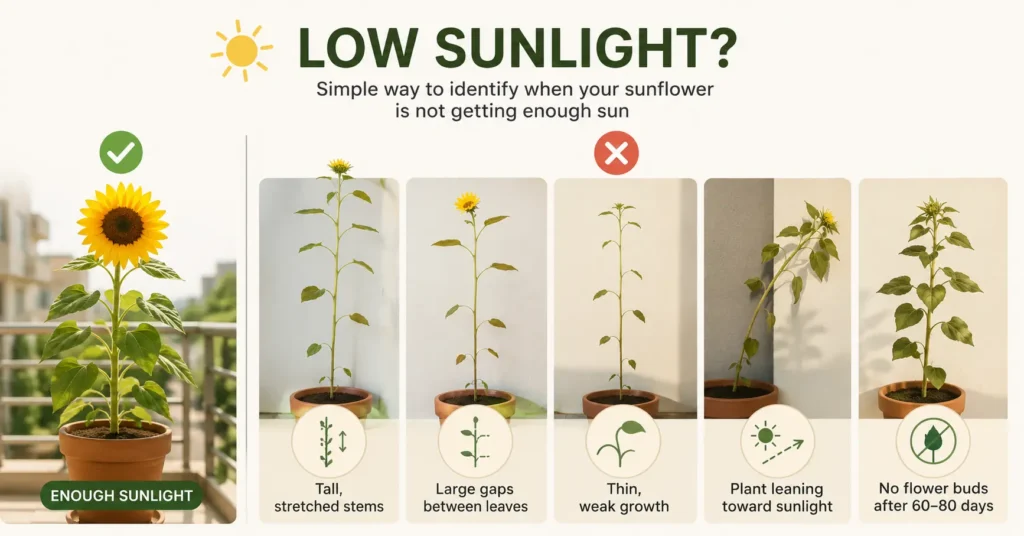
Simple Way to Identify Low Sunlight:
- Tall, stretched stems
- Large gaps between leaves
- Thin weak growth
- Plant leaning toward sunlight
- No flower buds after 60–80 days
Practical Solutions That Work For Me:
One of the most important things is to track sunlight on your balcony for one full day. Do not estimate. Observe exactly how many hours of direct sunlight hit the plant.
If sunlight is less than 6 hours:
- Move pots to the sunniest corner.
- Shift plants to terrace areas whenever possible.
- Use movable plant stands.
- Avoid placing sunflowers behind taller plants.
2. Check Whether You’re Using the Right Soil Type
The garden soil is too dense. It holds water like concrete. After a few weeks, the roots have no oxygen, and they rot. Commercial potting mixes sold in Indian garden shops are often too alkaline (pH 7.8-8.5), which locks up essential nutrients like iron and zinc even when they’re physically present in the soil.
The real problem shows up as pale yellow leaves with green veins-iron deficiency chlorosis. The plant looks starved despite being fertilized. That’s because the pH is wrong.
Pro Tip: Small herbs like coriander often struggle with the same soil issues as sunflowers. If your kitchen garden is lagging, check out our guide: Coriander Stuck at 2 Inches? Here’s Why and How to Fix It.
The fix is simple: make your own potting mix.
Here’s the recipe that works for Indian sunflowers:
- 30% coco peat (washed, quality brands like Coco Natural or Sustee)
- 25% perlite or coarse sand (₹300-400 per bag)
- 20% well-aged compost or manure (3+ months old)
- 15% neem cake powder (₹200-300 per kg)
- 10% biochar or coarse charcoal
Mix these by volume in a bucket and you’ve got 5-6 liters of proper growing medium for ₹80-150. You can buy all ingredients at any nursery or farm supply shop. It’s cheaper than premium commercial mixes and dramatically better. This single change has fixed more sunflower failures than anything else.
If you’ve already used commercial mix and the plants are looking pale, don’t repot them. Instead, spray chelated iron (₹300-600 per bottle, brands: Growth Promoter Iron, Chelated Iron) on the foliage every 7 days for three applications. The plant should green up in 10-14 days.
3. You Chose the Wrong Sunflower Variety for Balcony Growing
Many gardeners buy sunflower seeds without checking the variety. However, not all sunflowers are suitable for container growing.
Giant varieties can reach 8–12 feet tall and need deep soil, large root systems, and heavy feeding. When confined to balcony pots, they often become stressed, resulting in poor growth and delayed or no flowering.
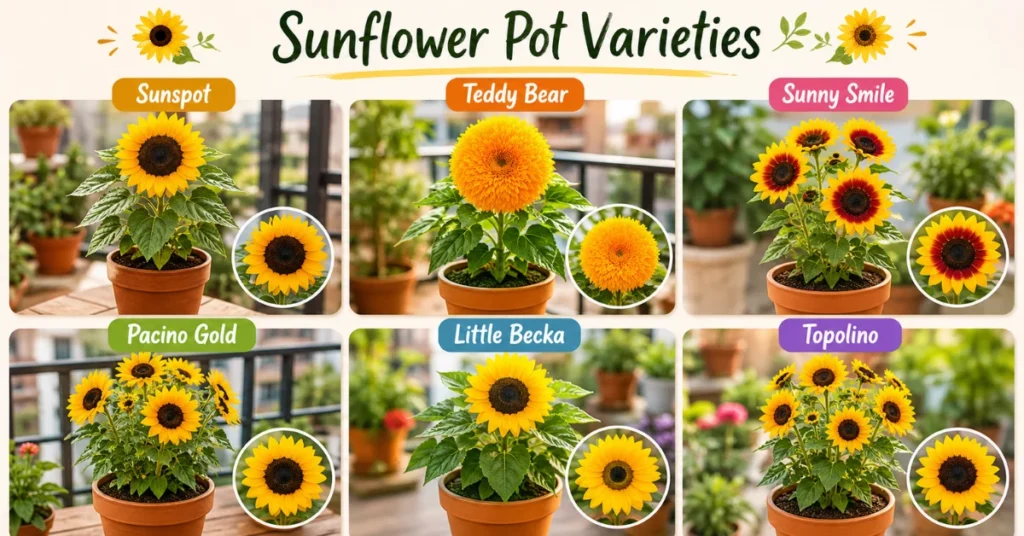
Better Choices for Indian Balconies:
- Sunspot
- Teddy Bear
- Sunny Smile
- Pacino Gold
- Little Becka
- Topolino
These varieties are specifically suited for containers and small spaces.
What Happens with Giant Varieties?
A giant sunflower grown in a 10-inch pot may grow slowly, produce small leaves, delay flowering, or fail to bloom altogether due to restricted root space.
Always check the plant’s mature height before buying seeds. For balcony gardening, dwarf and compact varieties under 3 feet usually perform best.
4. You’re Watering Wrong
This might be the most confusing mistake because sunflowers need consistent moisture, but Indian weather makes consistency nearly impossible. In March, your balcony is a furnace and the soil dries in hours. By June, the monsoon arrives and the soil stays waterlogged for days.
Most gardeners water on a fixed schedule. Every day, or every two days. That’s the wrong approach. It works in temperate climates with stable weather, but not in India.
Instead, check your soil. Stick your finger an inch into the soil. If it feels dry or cool, water. If it feels moist, skip watering. If it feels wet, absolutely do not water. Let it dry for 1-2 days. This one habit will fix more problems than anything else.
During March-May heat (pre-monsoon), you might water daily. By June-August (monsoon), you’ll water every 3-4 days because rain and humidity keep the soil damp. In October-November, it drops to every 2-3 days. Winter (December-January) might be every 3-5 days.
If you can’t tell by feel, buy a moisture meter (₹300-800, brands: Dr.Meter, Rapitest). Stick the probe in, read the number, and you have a clear signal. Takes the guesswork out entirely.
Also: your pots must have drainage holes. If they don’t, drill three 1/2-inch holes in the bottom right now. Decorative pots without drainage are the silent killers of balcony plants. If you can’t drill into a specific pot, use the double-pot method: keep the sunflower in a draining pot inside the decorative one.
5. Check If You’re Using Too Much Nitrogen Fertilizer
Excessive nitrogen feeding is a common reason sunflowers produce plenty of foliage but fail to flower. This creates the classic “all leaves, no flowers” problem.
Many gardeners regularly apply cow dung manure, vermicompost, kitchen compost, or nitrogen-rich liquid fertilizers. While these inputs support vigorous growth, they can also push the plant to focus on leaves and stems instead of flower buds.
As a result, the sunflower appears healthy, with dense green foliage and strong growth. However, excess nitrogen signals the plant to continue vegetative growth, which can significantly delay or even
Signs Your Sunflowers Are Getting Too Much Nitrogen:
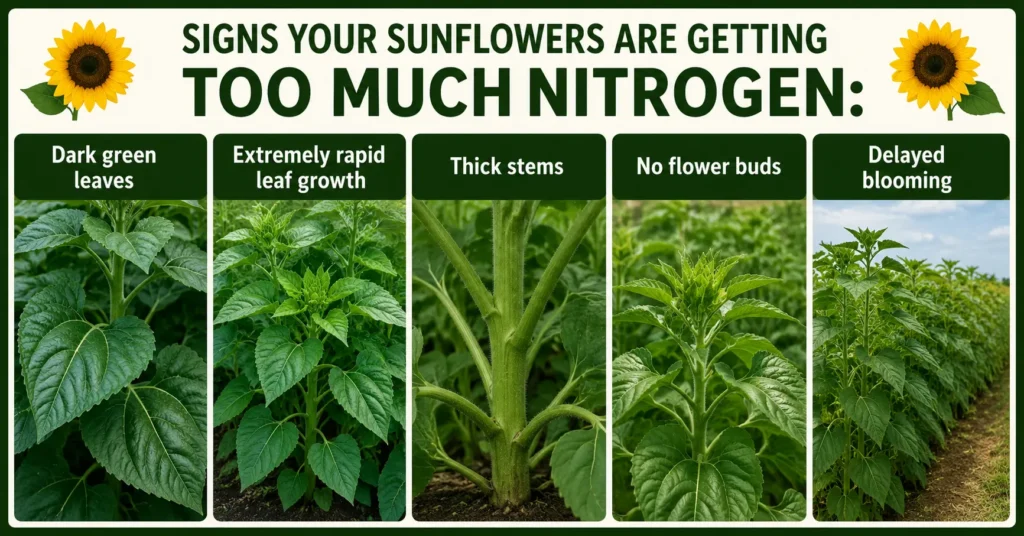
-Dark green leaves
-Extremely rapid leaf growth
-Thick stems
-No flower buds
-Delayed blooming
How to Fix Excess Nitrogen in Sunflowers:
| Problem | Fix |
| Too much nitrogen | Reduce nitrogen fertilizer. |
| Half-grown plants | Switch to high P & K fertilizers. |
| Need phosphorus | Use bone meal or rock phosphate. |
| Need potassium | Use banana peel fertilizer. |
| Poor flowering | Use flowering plant fertilizer. |
| Small or no buds | Use a balanced NPK ratio. |
6. Check Whether Your Pot Is Large Enough
A small pot restricts root growth, causing stress that delays or prevents flowering. Sunflowers develop extensive root systems and require adequate container space to produce blooms reliably.
My Recommended Pot Sizes:
| Sunflower Type | Recommended Pot Size |
| Dwarf varieties | 12-inch pot (10–15 L soil) |
| Medium varieties | 14–16-inch pot (20 L soil) |
| Tall varieties | 18-inch pot or larger |
Signs Your Sunflowers May Be Root-Bound:
- Slow growth
- Yellowing lower leaves
- Frequent wilting despite watering
- Stunted plants
- Absence of flower buds
The presence of roots coming out of the drainage holes indicates that the plant is root-bound. Early repotting will significantly increase the number of flowers produced.
7. Check the Quality of Your Seeds
This one is blunt but necessary. Street vendor seed packets have germination rates of 40-60%. They’re often old, contaminated, or misidentified. Buy from reputable seed companies instead.
Mahyco (an Indian company) sells Teddy Bear F1 and Moulin Rouge F1 seeds at ₹80-150 per packet from most nurseries. Germination rate: 95%+.
Syngenta sells Sunburst and Autumn Beauty at ₹100-200 per packet. Germination: 95%+.
Imported seeds (Burpee, Johnny’s) cost ₹300-400 per packet online but have 98%+ germination.
The upfront cost is slightly higher. But if your germination rate jumps from 40% to 95%, you’re getting more viable plants from one packet. You save money overall.
Store seeds in a sealed container in the fridge (₹0, use your existing fridge). Don’t buy in bulk and hoard old seeds. Buy fresh seeds annually. Refresh your calendar every January or February: buy seeds, check dates, make notes.
8. Watch for Fungal Diseases During the Monsoon Season
By July, Indian humidity hits 70-90%. Balconies with plants crowded together and stagnant air become disease incubators. Powdery mildew is the most common-white powder on leaves. Bud rot follows-buds darken and don’t open.
These diseases are preventable. Start fungicide sprays in late June, before visible disease. Use sulfur dust (₹250-400 per kg, mix to 2-3% concentration spray) or neem oil (₹300-600 per 500ml) every 7 days. Spray early morning or evening, coating both leaf surfaces.
But don’t just spray. Space your pots 18-24 inches apart. Move laundry, storage, and other items off the balcony. Prune nearby branches. Open railings for wind flow. Run a small oscillating fan (₹400-1000) on low, 4-6 hours daily, to keep air moving through the foliage.
If buds start to show brown spots, remove them immediately. Use clean scissors and disinfect the blades with bleach between cuts. Dispose of infected material in the trash, not the compost.
Conclusion:
Growing sunflowers on a balcony is a rewarding challenge that turns a small space into a vibrant sanctuary. While it can be frustrating when your plants refuse to bloom, remember that nature usually just needs a simple adjustment. By prioritizing direct sunlight, choosing dwarf varieties, and balancing your NPK nutrients, you provide the perfect environment for buds to thrive.
Don’t let a leafy plant discourage you. Use these troubleshooting tips to fine-tune your gardening routine. With the right pot size and consistent care, your balcony will be glowing with golden blooms in no time!