
Growing high-yield vegetables in a crowded city space is nothing like backyard gardening, and most “small space” guides don’t seem to know the difference. They hand you the same crops every blog recommends, leaving you to water plants for weeks that give back almost nothing. After three years of trial and error across three different terraces, I finally narrowed down the vegetables that actually pull their weight in containers — and I’ve got the harvest numbers to back it up.
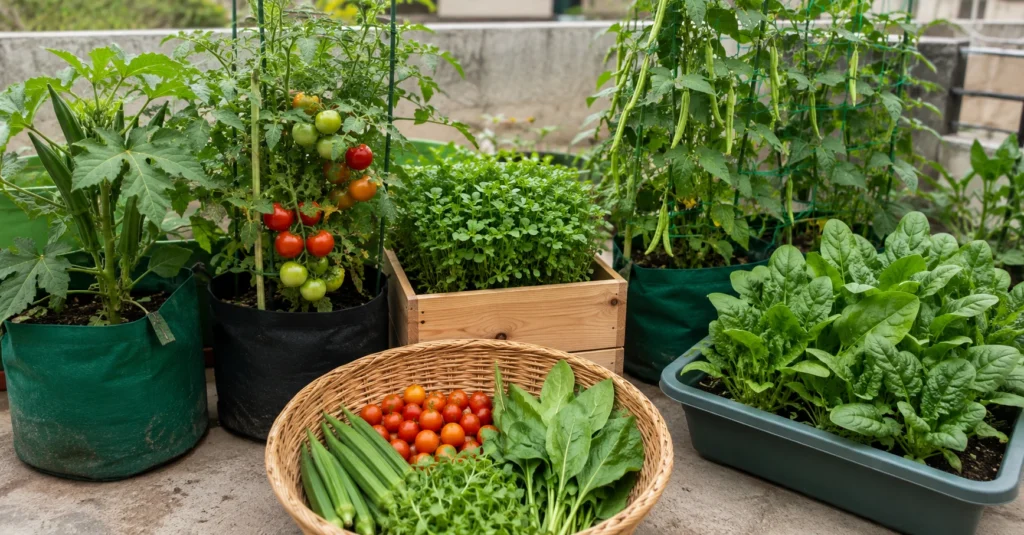
Three years ago, I started my terrace garden the way most people do: I grew whatever the gardening blogs told me to grow. Pumpkin vines that needed 15 feet I didn’t have. Tomato varieties bred for open fields, not 12-inch pots.
By the second season, half my terrace was producing almost nothing, and I was watering plants that gave back less than they took.
I began to keep track: every container, every harvest, every failure. I was surprised, though, to find that the vegetables that “everyone” tells you to grow in small spaces were not the highest producers for me, and some crops that most blogs seem to ignore entirely ended up being my best producers, year after year.
This is not a list of vegetables that grow well in India. This is a list of vegetables that grow well in containers, on terraces, with the water and heat and space constraints that most of us actually have to contend with.
Five crops, tested over three years and three terraces, with real numbers attached, not theoretical yields pulled from an agricultural data sheet.
If you’re working with a terrace, a balcony, or even a sunny windowsill, this is where I’d start.
Why Yield Per Square Foot Matters More in Indian Cities Than Almost Anywhere Else
Most gardening content is written assuming you have a backyard. In Mumbai, Bangalore, Delhi, or Pune, you probably don’t. You have a terrace shared with water tanks and drying clothes, or a balcony where every grow bag is fighting for railing space.
That completely flips how you plan your garden. What works in a farm setting (15-20 feet of sprawl for a pumpkin, for example) is a catastrophe on a 100 sq ft terrace, while something like cluster beans (Gawar Phali), which most gardening blogs don’t even mention, has become one of my best performers because it grows vertically, takes heat that kills other legumes, and continues for 10-12 weeks from one sowing.
So the real question isn’t “which vegetables yield well. It’s which vegetables yield well per container, in our climate, with our water quality, in the space we actually have. That is how I chose every single crop on this list.
5 High-Yield Vegetables That Actually Earned Their Place in My Garden
1. Bhindi (Okra) — The Terrace Workhorse
If I had to keep growing only three vegetables for the rest of my life, bhindi would be one of them, no question.
I grow it in 15-inch grow bags, one plant per bag, and from a single bag I’ve consistently harvested 25-35 pods across a 10-week picking window once the plant starts producing — usually 45-50 days after sowing in good summer heat.
The trick most people miss: bhindi sulks badly below 24°C soil temperature, so sowing too early in cold North Indian springs gives you stunted plants. Wait until late March in Delhi, or skip straight to the June-July monsoon sowing if you missed it.
The real yield secret is picking discipline. Pods left on the plant past 4-5 days turn fibrous and the plant slows down production trying to mature seeds instead of pushing new flowers. Harvest every alternate day without fail, even if the pods look slightly small.
2. Cherry Tomatoes — Higher Returns Than Regular Tomatoes, Genuinely
I switched from regular tomatoes to cherry varieties (Pusa Cherry Tomato 1, specifically) two seasons ago and the difference in container performance was honestly dramatic.
A single cherry tomato plant in a 12-inch pot, staked properly, has given me 1.5-2 kg of fruit across its lifecycle — spread over 8-10 weeks of continuous picking.
Regular beefsteak tomatoes in the same pot size gave me maybe 600-800g total because the plant puts so much energy into fewer, bigger fruits and is far more prone to blossom end rot in our hard, calcium-poor municipal water.
If your water is hard (most of North India), cherry tomatoes are the more forgiving and frankly more productive choice for containers. Don’t let anyone tell you cherry tomatoes are just a “fun” crop — per square foot, they outperform standard tomatoes in my experience by a wide margin.
3. Methi (Fenugreek) — The Fastest Return on Space You’ll Get
Methi is the vegetable I recommend to every beginner who tells me they’re impatient, because it’s ready to start harvesting in just 20-25 days, and you can do a cut-and-regrow harvest 2-3 times from the same sowing before it bolts.
I broadcast-sow methi seeds thickly in a 2×1 foot wooden crate filled with 4 inches of soil — no need for deep containers since you’re harvesting leaves, not roots. One crate gives roughly 400-500 grams of fresh methi leaves per cutting, and I get three cuttings before the plants go to seed. That’s nearly 1.2-1.5 kg from a space smaller than a doormat, in under six weeks.
I lost an entire season’s harvest to a simple mistake: sowing too thin, thinking each plant needs space to grow. Methi for leaves wants to be crowded — it actually self-supports better and produces more total leaf mass when sown dense.
4. Cluster Beans (Gawar) — The Crop Nobody Talks About But Should
This is genuinely the underrated star of my terrace, and almost no Indian gardening blog covers it properly because it’s seen as a “field crop.” That’s exactly why it belongs on a micro-niche blog like this.
Gawar climbs a trellis or even just a jute net tied to my terrace railing, tolerates the harshest May-June heat that kills my beans and peas outright, and from two plants in a single large tub (18 inches), I harvested over 2 kg of tender pods across a 10-week season.
It needs almost no babysitting once established — far less aphid trouble than French beans in my experience, and it shrugs off irregular watering on days I travel for work.
If you’ve struggled with beans dying in peak summer heat, Gawar Phali is your answer.
5. Spinach (Palak) — Best Grown in Shallow Wide Trays, Not Deep Pots
Most people make the same mistake with palak that they make with methi: using deep pots when shallow, wide containers actually give better yield because palak’s root system is fibrous and spreads sideways, not down.
I use a 3×1.5 foot shallow plastic tray, 5 inches deep, and get consistent cut-and-regrow harvests every 12-15 days through the cooler months (November to February in Delhi). Across a single winter season, one tray has given me close to 3 kg of leaves over five to six cuttings.
The yield killer here is bolting from heat — palak gives up the moment day temperatures cross 28-30°C consistently, so this is strictly a winter and early spring crop in most of India, not a year-round one.
Quick Comparison: What My Measurements Actually Showed
Here’s the honest data from my own terrace, not theoretical numbers pulled from agricultural yield tables.
| Vegetable | Container Used | Approx. Yield Per Container | Harvest Window | Best Season (North India) |
| Bhindi (Okra) | 15-inch grow bag | 25-35 pods | 8-10 weeks | March-June, June-Sept |
| Cherry Tomato | 12-inch pot, staked | 1.5-2 kg | 8-10 weeks | Oct-Feb sowing |
| Methi (Fenugreek) | 2×1 ft crate, 4″ soil | 1.2-1.5 kg (3 cuttings) | 5-6 weeks total | Oct-March |
| Cluster Beans (Gawar) | 18-inch tub, trellised | 2+ kg (2 plants) | 8-10 weeks | April-July |
| Palak (Spinach) | 3×1.5 ft shallow tray | 2.5-3 kg (5-6 cuttings) | 10-12 weeks | Nov-Feb |
These numbers will shift depending on your sunlight hours, soil mix, and how consistent your watering is — but the relative ranking holds true across the three terraces I’ve personally managed (mine, and two friends’ terraces I helped set up using the same method).
What Really Determines Yield — And What Most Gardening Blogs Overlook
After three seasons, I’ve stopped believing that variety selection alone determines yield. Three things matter more than people assume:
Container depth matched to root type. Leafy crops are shallow and wide. Fruiting crops like tomato and okra want depth — anything under 12 inches and you’ll see stunted plants regardless of variety.
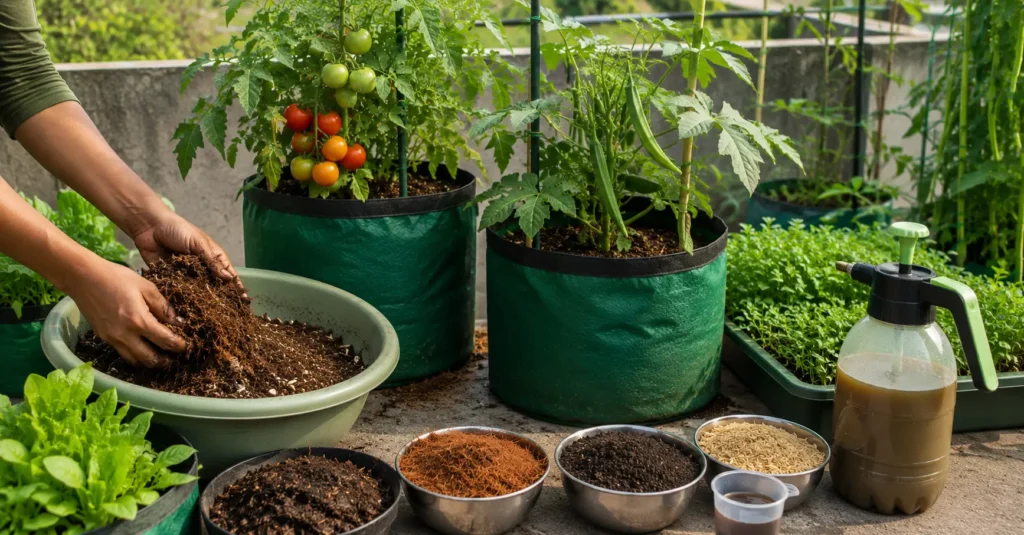
Potting mix that doesn’t compact. Indian garden soil alone compacts hard in containers within weeks, choking roots. My standard mix is 40% cocopeat, 30% compost (I make my own from kitchen waste — here’s exactly how I do it), 20% garden soil, and 10% coarse sand or rice husk for drainage. This single change increased my yields more than switching varieties ever did.
Feeding on a schedule, not on a whim. I feed every container crop with diluted liquid fertilizer (cow dung slurry or a balanced NPK liquid feed) every 10-12 days once flowering starts. Skipping this is the single biggest reason people see healthy-looking plants that produce disappointingly little.
A Practical Starting Plan for New Gardeners
Don’t try to grow all five at once in your first season — that’s how most people burn out by month two. Start with methi and palak together since they’re forgiving and fast, giving you confidence and actual harvests within three weeks.
Once you’ve got that rhythm, add bhindi or cherry tomato as your “main season” crop, and bring in cluster beans only once you’ve experienced one Indian summer with your setup, because it genuinely shines in conditions that defeat other vegetables.
Small terraces don’t need to compete with farmland. They need the right five or six crops, grown properly, picked on schedule. That’s the entire system — no secret fertilizer, no exotic seeds, just matching the right vegetable to the right container and actually showing up to harvest on time.
If you’re starting your own terrace setup this season, I’d genuinely love to know what you’re working with — space, sunlight hours, and city — because the advice does shift depending on whether you’re dealing with Delhi’s dry heat, Mumbai’s humidity, or Bangalore’s far gentler climate. Drop it in the comments and I’ll point you toward what’s actually worked for gardeners in similar conditions.
Conclusion
Three years in, my terrace still isn’t huge, and it never will be. But it doesn’t need to be. What changed everything wasn’t more space — it was finally growing the right Indian vegetables for containers, instead of whatever a generic gardening list told me to try.
Bhindi, cherry tomatoes, methi, gawar, and palak aren’t glamorous choices. They’re just the ones that consistently paid me back for the space, water, and effort I gave them.
If you’re starting your own terrace garden this season, don’t try to copy a farm. Copy what actually survives and produces in a pot, on Indian heat, with Indian water.
Start small, track your harvests, and let the numbers — not the internet — tell you what deserves a permanent spot on your terrace.
FAQs
Which vegetable gives the fastest harvest in a small terrace garden?
Methi, hands down. You’ll get your first cutting in 20-25 days, and you can harvest it 2-3 times from the same sowing before it bolts. If you want quick wins to stay motivated, start here.
Can I grow these vegetables on a balcony that gets only 4-5 hours of sun?
Bhindi and cherry tomatoes will struggle with less than 6 hours of direct sun — they’ll survive, but yields drop sharply. Palak and methi are far more forgiving and still produce well in 4-5 hours.
Why do my container vegetables grow but barely give any harvest?
This is almost always a feeding problem, not a variety problem. Once flowering starts, container plants exhaust nutrients fast. Feed every 10-12 days, and don’t wait until the plant looks weak to start.
Is gawar (cluster beans) really worth growing if I’ve never seen it on other gardening blogs?
That’s exactly why I grow it. It tolerates summer heat that kills beans and peas, climbs vertically so it barely uses floor space, and keeps producing for 10-12 weeks. It’s underrated, not unsuitable.
How big a container do I actually need for tomatoes and okra?
Don’t go below 12 inches depth for either. I tried smaller pots in my first season — the plants survived but stayed stunted and gave a fraction of the harvest compared to proper depth.