There’s a specific kind of embarrassment that comes from realizing your “green” habit isn’t actually that green.
I remember standing in my small balcony garden one Sunday morning, coffee in hand, feeling genuinely proud of myself. I had tomatoes climbing a trellis, herbs in neat little rows, and a tray of baby spinach that was about two weeks away from a salad. I was growing my own food. I was reducing my carbon footprint. I was doing the right thing.
And then I looked down.
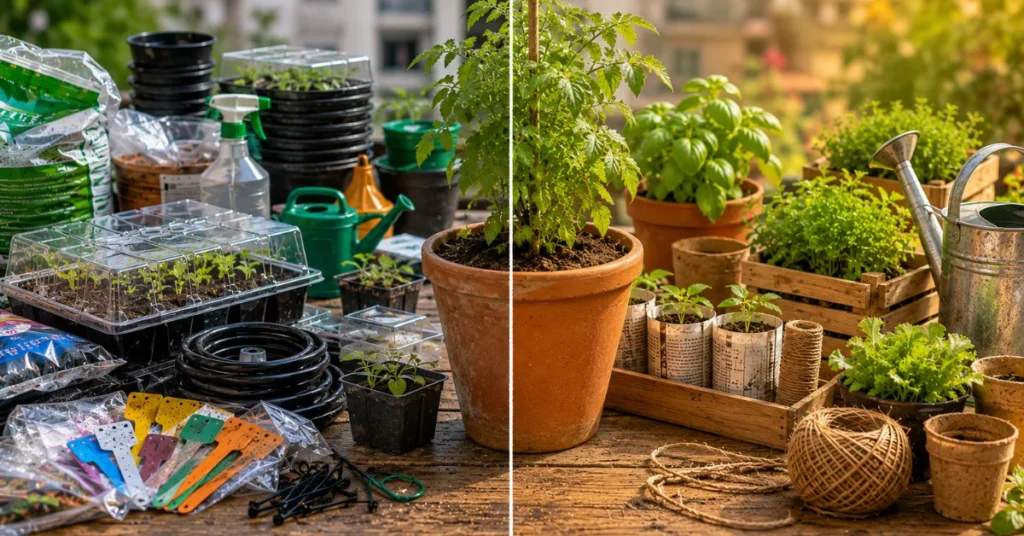
Plastic seed trays. Plastic pots. Plastic plant labels. A plastic watering can. Bags of compost sealed in thick plastic film. Fertilizer bottles made of — you guessed it — plastic. Twist ties, zip ties, drip irrigation tubing, nursery containers I’d been “saving to reuse.”
I did a rough count that morning. My tiny, supposedly eco-friendly urban garden had over 40 individual pieces of plastic in it.
That was the moment I realized I had a problem.
Why Urban Gardening Has a Quiet Plastic Crisis
Let’s be honest about something: the gardening industry is not a zero-waste industry. It never has been.
Walk into any garden center and you’ll see thousands of plants crammed into black plastic nursery pots. You’ll find seed packets lined with foil-plastic laminate. You’ll see grow bags, raised bed liners, mulch films, and drip irrigation systems — all made from plastic that’s designed to be durable, meaning it won’t break down for decades, maybe centuries.
The irony is brutal. We turn to urban gardening because we want to live more sustainably. We want to know where our food comes from. We want to reduce the environmental cost of what we eat. And yet the infrastructure we use to grow that food is quietly undermining those exact goals.
According to research from the Royal Horticultural Society (RHS), the UK alone generates over 500 million plastic plant pots per year — and most of them are not recycled because they’re made from black polypropylene, which most recycling facilities can’t process. The numbers in India and other rapidly urbanizing countries are growing fast, with no clear systems to handle the waste.
And here’s the part that stings: most of this plastic is unnecessary. We’ve just been conditioned to think it’s normal.
The Plastics You Don’t Even Notice
When I started auditing my garden, I didn’t just count the obvious stuff — the pots and trays. I started tracking every single plastic item that passed through my gardening routine. Here’s what I found, and I’d bet most urban gardeners would find the same:
Seed starting: Plastic seed trays, plastic dome lids, plastic plug trays, plastic seed packets (many have a plastic inner layer even when they look paper-based).
Growing containers: Nursery pots from store-bought seedlings, decorative plastic planters, grow bags (even fabric grow bags often contain synthetic fibers that shed microplastics), window box liners.
Soil and amendments: Bags of potting mix, compost, perlite, coco coir — almost universally sold in single-use plastic bags. Some are thick enough to reuse, but most aren’t.
Watering: Plastic watering cans, plastic hose fittings, drip irrigation tubing and emitters, self-watering pot reservoirs.
Plant support: Plastic-coated wire ties, plastic plant clips, plastic stakes, zip ties, synthetic netting and trellises.
Pest and disease management: Spray bottles, pesticide and fertilizer containers, copper tape with plastic backing, sticky traps.
Labels and organization: Plastic plant labels, plastic plant markers, laminated seed packets you’ve kept “for reference.”
By the time I finished my list, I felt less like an eco-warrior and more like someone who’d been quietly collecting a landfill.
The Microplastic Problem Nobody Mentions
Here’s where it gets worse — and this is the part that genuinely changed how seriously I took this issue.
Even if you’re not directly throwing plastic into the landfill, plastic in your garden degrades. UV radiation, heat, and freeze-thaw cycles cause plastic to break down into microplastics. These tiny particles — often smaller than 5 mm — work their way into your soil. And then into your plant roots. And then, potentially, into the food you eat.
A 2020 study published in Environmental Science & Technology found that microplastics were detectable in lettuce, wheat, and carrots grown in plastic-contaminated soil. Researchers in Germany found that microplastics moved from soil into plant tissue, particularly in leafy greens — the exact crops most urban gardeners grow in abundance.
You planted spinach to avoid eating chemicals. And yet the plastic pot holding it might be leaching them back in.
This is not meant to scare you out of gardening. Urban gardening is still far better for your health and the environment than relying entirely on industrially farmed supermarket produce. But the plastic issue deserves to be taken seriously — not dismissed as a niche eco-anxiety.
What I Actually Changed (And How You Can Too)
Here’s the good news: going plastic-free in your garden is not only possible, it’s often cheaper. Many plastic-free alternatives are more durable, more beautiful, and come with the added satisfaction of knowing your garden is genuinely sustainable, not just surface-level green.
I didn’t overhaul everything overnight. I replaced things gradually, as they wore out or as I found better alternatives. Here’s the system I now use, and that I’d recommend to anyone starting from where I was.
1. Swap Plastic Pots for Natural Containers
This is the biggest visual change and, honestly, the most satisfying one.
Terracotta pots are the obvious choice. They’re made from fired clay, fully biodegradable at end of life, and they actually benefit your plants — the porous walls allow air circulation to the roots and prevent overwatering. Yes, they’re heavier and can crack in frost, but for balcony and indoor gardening in warm climates like much of India, they’re close to perfect. Look for locally made terracotta; it’s often cheaper than imported decorative pots and has a fraction of the carbon footprint.
Wooden crates and boxes work brilliantly for herbs and shallow-rooted vegetables. You can line them with burlap or hessian (natural fibers, fully biodegradable) to hold the soil. Old wooden crates from vegetable markets are often free or near-free.
Coconut shell bowls and coir pots are fantastic for seedlings and small herbs — they’re abundant in India, compostable, and look genuinely beautiful. Coir pots can be planted directly into the ground or a larger container; the roots grow straight through the walls.
Upcycled containers deserve more credit than they get. Old clay cookware, tin cans with drainage holes drilled in, bamboo containers, ceramic mugs — these aren’t just quirky Instagram aesthetics. They’re legitimate, long-lasting planters that cost nothing and keep objects out of the waste stream.
2. Fix the Seed-Starting Problem
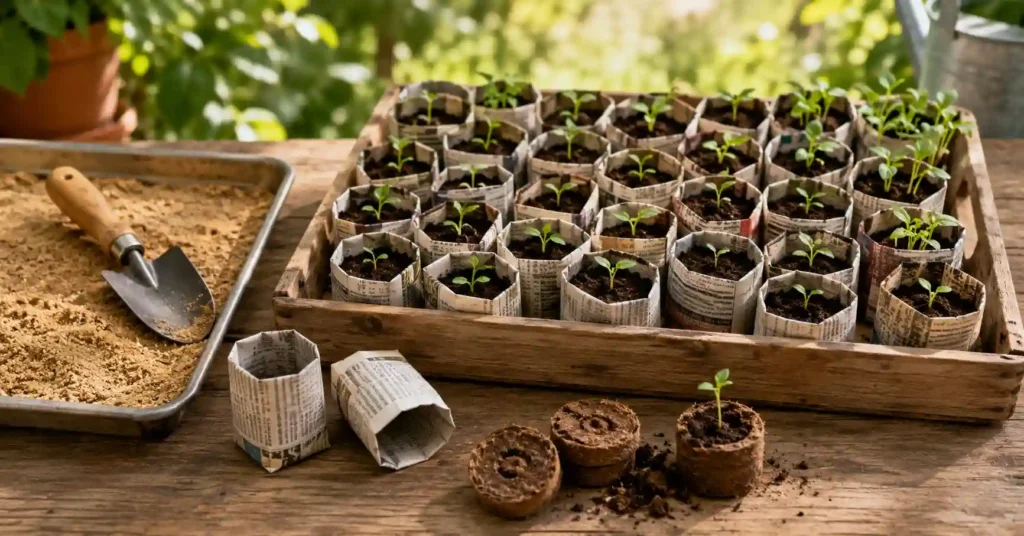
Plastic seed trays are one of the biggest sources of garden plastic, especially for people who start a lot of plants from seed.
The solution I settled on: newspaper pots. You can fold them in about 30 seconds each; there are countless tutorials online. They decompose in the soil when you transplant, so there’s zero transplant shock and zero waste. I now start all my seedlings in newspaper pots set inside a wooden tray. Works perfectly.
Coir pellets are another option — compressed discs of coconut fiber that expand when you add water. Drop a seed in, water it, and when it’s time to transplant, the whole thing goes into the soil. Completely compostable.
For a growing tray, a simple wooden flat with a thin layer of sand at the bottom works. I found an old baking tray at a secondhand shop. It’s been in my garden for three years.
3. Rethink How You Buy Soil and Compost
This is the hardest one to solve completely, because soil amendments are almost universally sold in plastic bags. Here are the practical workarounds I’ve found:
Buy in bulk when possible. Some garden centers and municipal composting facilities sell compost by the kilogram if you bring your own container. A cloth bag, a jute sack, or even a large clay pot works. It takes a phone call to check, but it’s worth it.
Make your own compost. I know, everyone says this, and it sounds like a lot of effort. But a small clay pot composter or a simple wooden compost bin on your balcony can handle kitchen scraps — vegetable peels, fruit rinds, coffee grounds, tea leaves — and produce rich compost in 6–8 weeks. This eliminates the need to buy bagged compost entirely for most of your garden’s needs.
Reuse soil bags as storage. If you must buy bagged compost, use the bags for other storage until they genuinely can’t be used anymore. Squeeze every use out of them before they become waste.
Also Read: How to Solarize Garden Soil Naturally to Control Weeds and Pests
4. Replace Plastic Labels with Natural Alternatives
This one’s easy and kind of fun.
Wooden ice cream sticks (the kind sold in bulk for craft projects) make perfect seed labels. Write on them with a pencil — not pen, which fades — and they last a full growing season.
Flat stones from a garden or roadside work brilliantly as plant markers. Write on them with a paint marker or chalk.
Bamboo skewers cut to size and written on with pencil are another option.
None of these will last forever, but neither do plastic labels — they get brittle and snap in the sun. Natural alternatives actually perform comparably over a season.
5. Fix Your Watering Setup
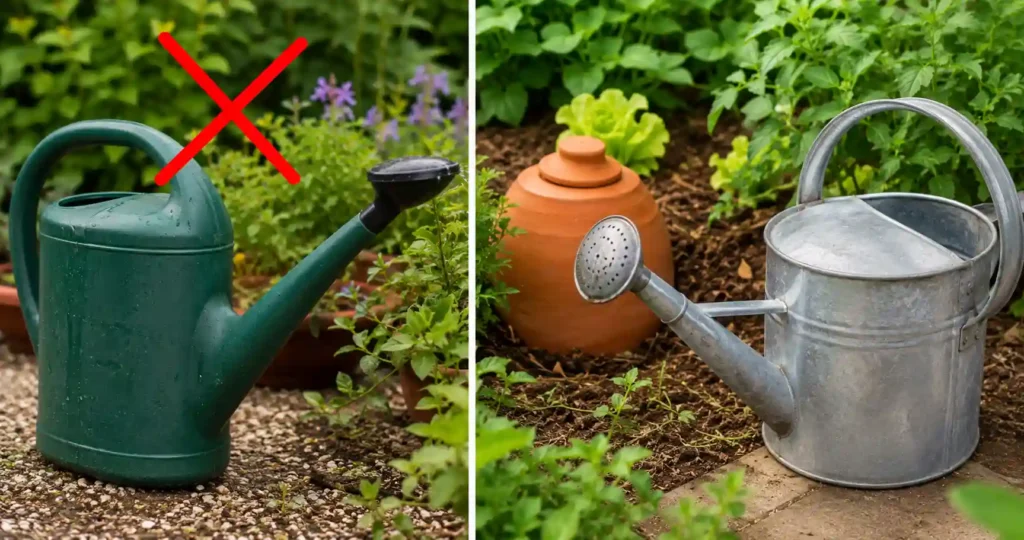
Plastic watering cans last for years, so if you already have one, don’t throw it away — that’s also wasteful. But when it’s time to replace it, go for galvanized steel or copper. They’re more expensive upfront but last decades. Mine is a simple galvanized steel can I bought at a local hardware store for less than the price of a plastic one from a garden brand.
For drip irrigation, clay pot irrigation (ollas) is a traditional technique that’s wildly effective. Bury an unglazed clay pot near your plants, fill it with water, and it slowly seeps moisture directly to the root zone — no tubing, no pumps, no plastic. It’s been used for thousands of years across dry climates, and it’s genuinely better than most modern drip systems for water efficiency.
6. Use Natural Twine and Plant Ties
Jute twine and cotton string are inexpensive, strong, and fully compostable. They work just as well as plastic twist ties for most plant-tying tasks. You can buy a large roll of jute twine for the price of a bag of plastic ties, and it’ll last years.
For heavier support — tying tomatoes to stakes, training climbers — strips of old cotton fabric (torn from worn-out T-shirts) work better than plastic ties because they’re soft and won’t cut into stems.
A Word on Perfection
I want to be honest here: my garden is not 100% plastic-free. I have a drip irrigation timer that’s plastic. My water butt has a plastic tap. There are a few grow bags made from synthetic fabric that I haven’t replaced yet.
And that’s okay.
The goal isn’t purity. The goal is improvement. Every plastic pot you replace with terracotta, every newspaper seed tray you use instead of a plastic one, every kilogram of compost you make instead of buying in a bag — it adds up. Over the years, it adds up significantly.
The average urban gardener who actively replaces plastic over two to three growing seasons can reduce their garden plastic consumption by 80–90%. That’s real. That matters.
The Bottom Line
Urban gardening is still one of the most genuinely sustainable things a city dweller can do. Growing your own food reduces food miles, builds connection with the natural world, improves mental health, and puts you in control of what goes into your body.
But sustainable gardening means looking honestly at the whole picture — including the materials we use to grow.
The plastic problem in urban gardening is real, it’s underreported, and it’s largely unnecessary. The alternatives exist, they work, and many of them are cheaper than their plastic equivalents.
You don’t have to overhaul your garden tomorrow. Start with the next thing that needs replacing. Choose terracotta over plastic. Fold a few newspaper pots. Buy a roll of jute twine.
That Sunday morning when I counted 40 pieces of plastic on my balcony, I felt embarrassed. Now, three years later, I feel something closer to pride — not because my garden is perfect, but because it’s genuinely trying to be what I always thought it was.
Eco-friendly. For real this time.
FAQs
Have you audited your garden for plastic? Share what you found — and what you’ve switched to — in the comments below.