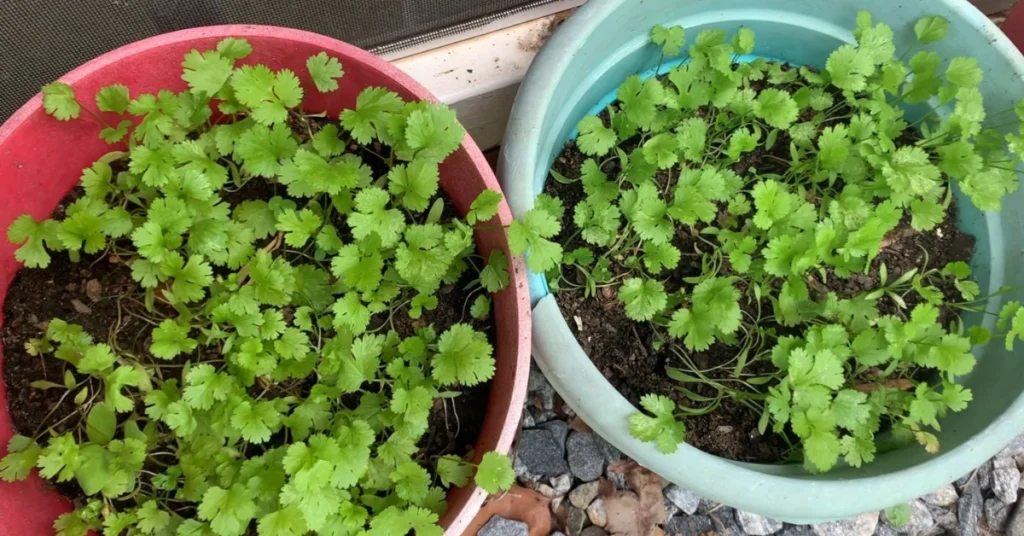
If you’ve grown coriander at home even once, you already know the frustration: you sow the seeds, water them carefully, the plant sprouts beautifully — and then, almost before you get a chance to snip a single sprig, it bolts.
The stems shoot upward, feathery flowers appear, and the leaves you wanted turn sparse and bitter. What went wrong?
Almost always, the answer is timing. You planted in the wrong season.
Coriander (Coriandrum sativum) is one of the most temperature-sensitive herbs you can grow. It doesn’t respond to care the way most plants do — more water and more fertilizer won’t compensate for planting in the wrong window.
This guide breaks down exactly when to sow coriander, why the season matters so profoundly, how to read your local climate rather than a generic calendar, and the practical steps that separate a productive coriander patch from a plant that bolts in two weeks.
Why Coriander Bolts — and Why Most Gardeners Get This Wrong
Before getting into seasons, it helps to understand what bolting actually is and why coriander is so prone to it.
Bolting is the plant’s survival mechanism. When coriander senses that conditions are becoming hostile — rising temperatures, lengthening days, or any kind of stress — it shifts its energy from leaf production to seed production.
The plant is essentially deciding: the environment is becoming unfavourable, I need to reproduce before I die.
The threshold temperature at which coriander begins bolting is around 27–29°C (80–84°F). Once ambient temperatures consistently cross this range, especially at night, no amount of shade cloth or extra watering will stop the plant from flowering. It’s a biological response, not a water or nutrient problem.
This is the core mistake most home gardeners make: they treat bolting as a care problem when it’s actually a timing problem. They try to fix it with more shade or more water. The real fix happens before you ever put a seed in the soil.
There’s a second factor that most guides don’t mention clearly: day length. Coriander is a long-day plant, meaning it’s also triggered to flower when daylight hours exceed roughly 12–13 hours.
In tropical and subtropical climates, this means late spring and summer planting creates a double bolting trigger — both high temperatures and long days are working against you simultaneously.
The Two Best Windows for Growing Coriander at Home
Window 1: The Cool Season (Primary Window)
This is the golden period for coriander — the window where your plant is most likely to stay leafy for 6 to 10 weeks before flowering.
For subtropical and tropical climates (India, Southeast Asia, parts of the Middle East, northern Australia): Sow from late September through November and again from February through early March.
The post-monsoon months give you falling temperatures and shortening days — both work in your favour. In north Indian cities like Delhi, Lucknow, or Jaipur, October–November sowings are particularly productive because winters are dry and cool without being freezing.
For temperate climates (UK, northern Europe, Pacific Northwest USA, New Zealand’s South Island): Sow from late March through May for your primary spring window, and again from late August through September for an autumn flush before frosts arrive. Both windows catch coriander in the sweet spot where temperatures hover between 15°C and 24°C.
For Mediterranean and mild coastal climates (coastal California, southern Spain, South Africa’s Western Cape): You have the most flexibility.
Sow from October through February for a long cool-season growing period. Avoid summer entirely — even with coastal cooling, July and August temperatures typically push plants into bolt mode.
Window 2: Succession Sowing Within the Cool Season
One of the most effective strategies experienced coriander growers use is not sowing all their seeds at once, but staggering plantings every 2–3 weeks within the cool season window. Sow a small batch on October 1st, another on October 20th, another on November 10th.
This creates a rolling harvest — as one batch begins to flower, the next is just hitting peak leaf production.
This single habit — succession sowing — will give you more coriander than any other technique, because it sidesteps the all-or-nothing problem of having one batch bolt just when you need herbs most.
When NOT to Sow Coriander (The Seasons That Will Waste Your Seeds)
Avoid: Peak Summer
In most climates, sowing coriander between May and August (or November–February in the southern hemisphere) is a near-certain path to rapid bolting.
Even if you get germination and early growth, plants sown into warming soil with lengthening days will begin flowering within 3–5 weeks, often before you can harvest meaningfully.
The exception is if you’re in a genuinely cool-summer mountain or highland climate where temperatures stay below 22°C consistently. In that case, summer sowing can work — but you’re the exception, not the rule.
Avoid: The Run-Up to Long Days
Even within the cool season, sowing too late as days are lengthening can cause premature bolting. In northern hemisphere subtropical gardens, a February sowing that starts well can still bolt rapidly in late March as day length pushes past 12 hours. Know your last viable sowing date and stop 6 weeks before consistently hot weather arrives.
How to Read Your Local Climate (Not a Calendar)
Generic planting calendars are a starting point, not a rulebook. Your specific microclimate — your balcony aspect, your city’s urban heat island effect, your local humidity — all affect when coriander will bolt.
Here’s how to calibrate for your actual location:
Track your last-cool-night date. Note the date when your overnight temperatures consistently stay above 20°C. Count back 8 weeks. That’s your last viable sow date for the warm season.
Watch for extended cloud cover and rain. Coriander grown under consistently overcast conditions tolerates slightly higher temperatures because evaporative cooling and diffused light reduce heat stress.
A monsoon break or an overcast autumn can extend your harvest window by 1–2 weeks.
Test soil temperature, not air temperature. Coriander germinates best in soil between 15°C and 21°C. Soil in a container on a west-facing balcony can be 5–8°C warmer than the ambient air temperature. Use a cheap soil thermometer — it’s one of the most useful tools for any container gardener.
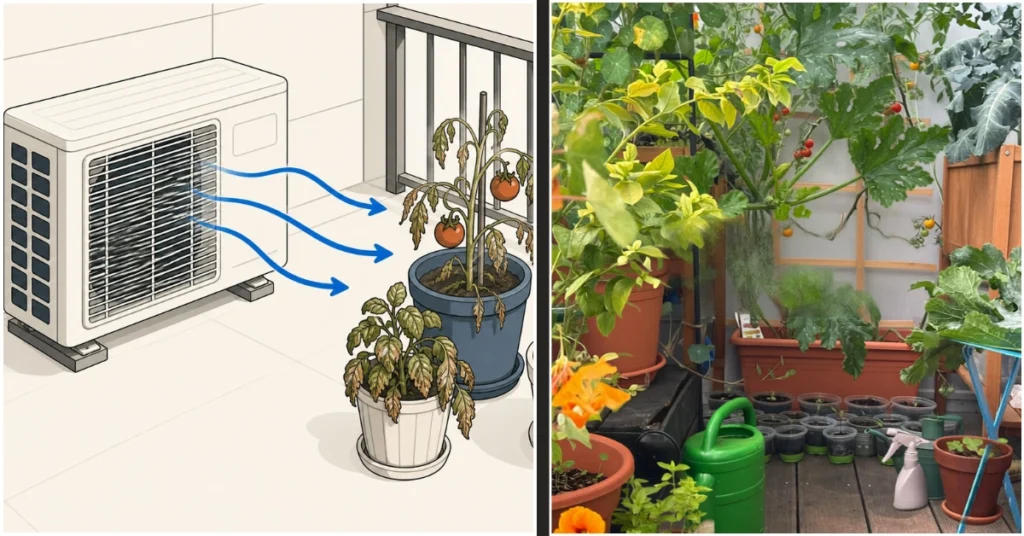
Account for urban heat. If you’re gardening in a city apartment, particularly above the 5th floor with reflected heat from surrounding buildings, your effective growing season is shorter than what regional guides suggest.
Add shade netting or move containers to north-facing spots during the latter half of the cool season.
Soil, Container, and Setup Decisions That Extend Your Harvest Window
Getting the season right is essential, but your setup can meaningfully extend or shorten how long your plants stay productive.
Container Depth Matters More Than Width
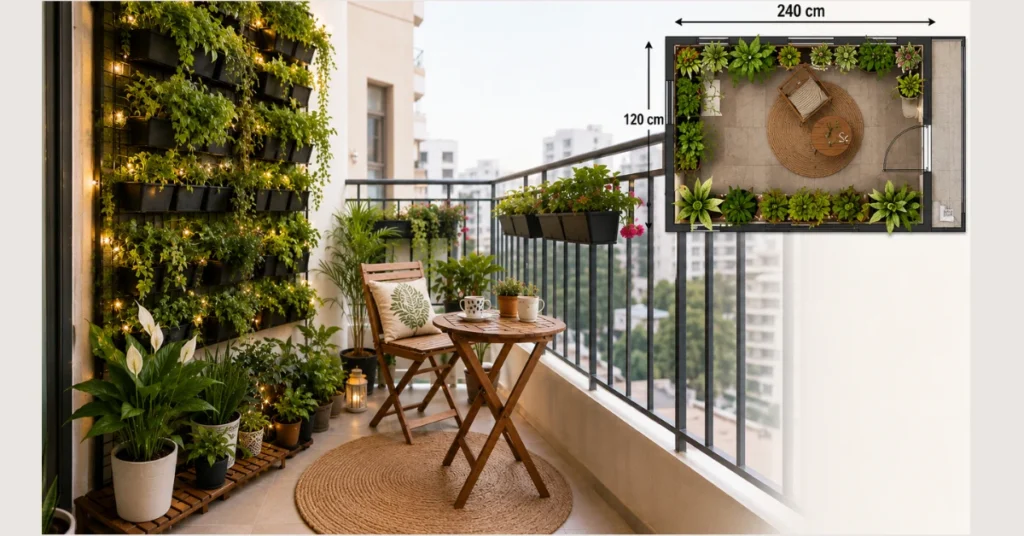
Most people grow coriander in shallow trays. This is a mistake. Coriander has a taproot, and shallow containers cause root-bound stress, which triggers bolting. Use containers that are at least 20–25 cm (8–10 inches) deep. You don’t need wide pots — a deep rectangular planter is ideal for balcony growing.
Avoid Terracotta in Hot Climates
Terracotta is beautiful but it wicks moisture and heat rapidly. In warm climates, terracotta containers will push soil temperatures up significantly compared to plastic or glazed ceramic. In hot weather that’s a bolt accelerant.
Switch to light-coloured plastic or double-wall containers that insulate roots from temperature swings.
Soil Mix for Coriander
Coriander doesn’t want rich, heavy soil. A well-draining mix is critical — waterlogging causes root rot and plant stress that accelerates bolting.
Use a ratio of roughly 60% quality potting mix, 30% coarse sand or perlite, and 10% compost. Avoid nitrogen-heavy fertilisers once the plant is established — excess nitrogen promotes lush, fast growth that actually makes bolting happen sooner, not later.
Direct Sow Only — No Transplanting
This is non-negotiable. Coriander has a taproot that does not tolerate transplanting. Any root disturbance — even minor — is interpreted by the plant as stress and triggers bolting within days. Always sow seeds directly into the final container. Never start in seed trays and transplant.
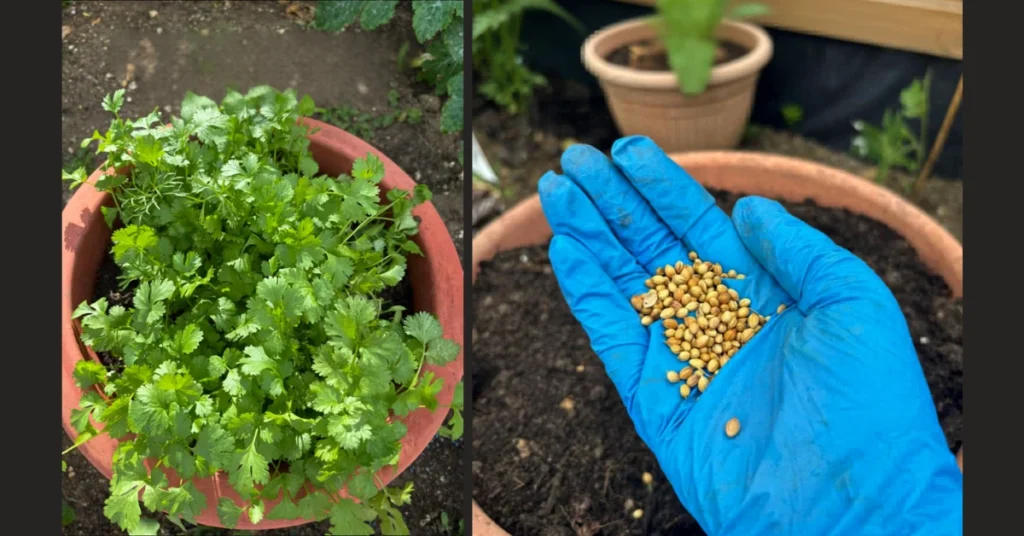
Crush the seeds slightly before sowing (each coriander “seed” is actually two seeds fused together) to improve germination rate. Sow 1 cm deep, thin to one plant every 5–6 cm once seedlings have their first true leaves.
Watering Strategy to Slow Bolting
Once your plants are growing, how you water has a measurable effect on how long they stay leafy.
Water in the morning, not evening. Morning watering allows foliage to dry during the day, reducing fungal problems. More importantly, it means plants go into the cooler night period with well-hydrated roots, which reduces the temperature stress that triggers bolting.
Water deeply and infrequently, not shallowly and daily. Light, frequent surface watering encourages the taproot to stay near the surface where soil is warmest and dries fastest. Deep, thorough watering 2–3 times weekly pushes roots downward into cooler, more stable soil layers.
Mulch the soil surface. Even in containers, a thin layer of coir or dry leaves on the soil surface reduces soil temperature by 3–5°C and cuts moisture loss significantly. In subtropical gardens, this alone can extend your coriander harvest by 1–2 weeks.
Harvesting Techniques That Extend Leaf Production
How you harvest directly affects how long the plant stays productive.
Never pull entire stems from the base. This removes growth nodes and shortens plant life. Instead, snip stems leaving at least 5 cm of growth above the soil. New branching will occur from remaining nodes.
Harvest the outer stems first. The outermost, oldest growth is closest to bolting anyway. Harvesting it directs the plant’s energy toward newer, inner growth.
Pinch flower buds the moment they appear. This won’t stop bolting permanently, but it buys you 1–2 extra weeks of leaf production. The moment you see the central stem begin to elongate and the leaf shape change from broad to feathery, pinch that central shoot off immediately.
Harvest in the morning. Coriander’s volatile oils — the compounds responsible for its flavour — are most concentrated in the early morning before heat causes them to dissipate. Morning-harvested coriander is noticeably more aromatic than afternoon-harvested.
What to Do When Coriander Bolts Anyway
Even with perfect timing and care, coriander will eventually bolt. This isn’t failure — it’s biology. Here’s how to make the most of it:
Let it flowe r for pollinators. Coriander flowers are excellent nectar sources for small pollinators including hoverflies and parasitic wasps. If you have other food plants in your garden or balcony, letting one coriander plant go to flower actively supports the ecosystem around your vegetables.
Harvest coriander seeds. Once the plant flowers and sets seed, you get coriander seeds — an entirely different culinary ingredient.
Allow seeds to turn from green to pale brown on the plant, then cut the entire stem and dry it upside down over paper. The dried seeds store for 18 months and work beautifully in Indian curries, spice rubs, and pickling brines.
Collect seeds for replanting. Home-saved coriander seed from plants that were particularly slow to bolt is a form of passive selection.
Over seasons, you develop a seed stock that’s better adapted to your specific microclimate and marginally more bolt-resistant than commercial varieties.
Variety Selection: Does It Matter?
Most home gardeners buy generic coriander seed from the grocery store or local nursery without paying attention to variety. For serious home growing, variety selection is worth the effort.
Slow-bolt varieties to look for:
- Leisure — bred specifically for slow bolting, widely available in the UK and Europe
- Santo — a popular slow-bolt variety available in North America and India, produces 20–30% more leaf before flowering compared to standard varieties
- Calypso — compact, very slow to bolt, well-suited to container growing
- Lemon Coriander (Eryngium foetidum in some regions) — technically a different species but bolt-proof, grows as a perennial in USDA zones 9–11
In India, most packaged seeds are simply labelled “dhaniya” without a variety name. If you can source from seed suppliers rather than spice markets, ask specifically for slow-bolt or late-flowering varieties — they exist in the Indian seed market under various regional names.
A Practical Monthly Guide for North Indian Home Gardeners
Since north India represents one of the most challenging climates for coriander — hot summers, cold winters, distinct monsoon — here’s a month-by-month guide:
- January–February: Active growing season. Plants sown in October–November are at peak production. Sow another batch in mid-February for a late cool-season flush, but expect bolting by late March.
- March: Last chance to sow. Plants will bolt quickly as temperatures rise toward 30°C. Harvest aggressively.
- April–September: Do not sow. Even shade won’t prevent rapid bolting during Delhi and other Indian cities’ summers. Focus on other herbs.
- October: Best sowing month of the year. Temperatures drop post-monsoon, days shorten, humidity falls. Plants sown now will thrive through November and December.
- November–December: Excellent growing conditions. Harvest generously. Sow succession batches every 3 weeks.
Final Thoughts: Timing Is the Skill
After a decade of growing coriander in containers, in ground beds, on rooftops, and on narrow balconies, the single most honest piece of advice I can offer is this: you cannot outgarden bad timing.
The gardeners who always have fresh coriander on hand aren’t necessarily doing anything more complicated than you.
They’re just planting at the right time, succession sowing every few weeks, and letting the rest happen naturally. They’ve stopped fighting the seasons and started working with them.
Get the timing right, use deep containers, don’t transplant, sow in succession — and coriander becomes one of the easiest, most rewarding herbs you’ll ever grow at home.