
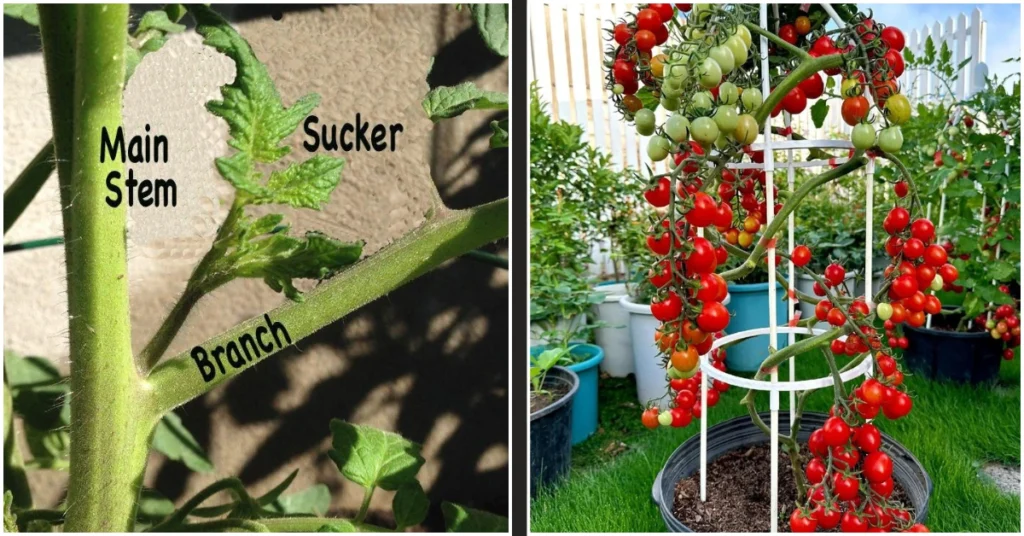
Most gardeners are told to remove tomato suckers to improve production. In my experience growing tomatoes in limited urban spaces, that advice is often outdated. Every sucker is a potential fruiting stem, and removing them automatically can reduce a plant’s overall yield.
When a healthy sucker is allowed to mature, it develops flower clusters and sets fruit just like the main stem. On indeterminate varieties, these additional stems can dramatically increase the number of tomatoes harvested from a single plant.
The key is not aggressive pruning but smart management. I remove only suckers that crowd the center of the plant, restrict airflow, or compete for valuable space. Healthy, well-positioned suckers remain.
Over the years, I’ve consistently seen higher yields from plants that keep most of their productive side growth. For home and urban gardeners, maximizing fruit-bearing stems usually delivers better results than following rigid pruning rules.
First, What Exactly Is a Tomato Sucker?
A tomato sucker is a second stem that grows out from the place where the leaf stem meets the main stem. It is widely accepted practice among many gardeners to trim these off the moment they come up.
The assumption behind this is that the suckers use up some of the energy needed for producing fruit. Although this may seem like an obvious explanation, it overlooks the nature of tomatoes and how they develop.
The mature sucker is no longer a useless side stem. The sucker becomes another productive stem which can hold leaves, flowers, and eventually fruit. This is yet another way by which the tomato plant increases its ability to absorb energy from sunlight.
All things considered, the mature sucker is not using up anything. On the contrary, it creates more ways by which the tomato plant produces fruit.
Why I Started Questioning Traditional Advice
Many guidelines for growing tomatoes are made through controlled methods, where spacing, weather conditions, and maintenance are carefully regulated. However, when cultivating tomatoes in my garden, these conditions rarely apply. This is why I’ve never accepted traditional guidelines at face value without conducting my own experiments first.
For many planting seasons, I’ve observed one trend that defied the traditional guideline on removing suckers. The plants that had undergone the greatest amount of pruning tended to look tidier, yet they did not tend to be more productive than other varieties.
On the other hand, the plants that received less maintenance often grew to great heights full of blossoms and tomatoes. They seemed wild but were often highly productive compared to other types of plants.
This contradiction led me to conclude that I needed to move away from gardening theory and focus on the results of each plant. Rather than pruning all the suckers I could see, I started analyzing their productivity.
The More Stems I Kept, the More Flowers My Tomatoes Produced
The most critical lesson I learned was very straightforward. The greater the number of healthy stems, the more flower trusses that were formed, and as a result, there were more chances to form fruits. When I started looking at the suckers not as unwanted growth but as sources of productivity, everything changed.
With each new sucker becoming a productive stem, which can bear several flower trusses per year, I realized how many chances were lost by removing those vigorous suckers at an earlier stage.
Observing the difference between the heavily pruned and selectively pruned plants made it obvious that the latter had greater flower formation, better fruit set, and larger yields.
I Learned That a Fuller Tomato Plant Creates Its Own Shade
A frequently mentioned reason why tomato suckers need to be removed is that they increase foliage and lead to overcrowding. Although bad air circulation can sometimes occur because of this, there is one advantage of having extra vegetation that often goes unnoticed.
With more stems and, therefore, more leaves, a protective canopy is formed. In the case of extreme heat during the summer time, it can help protect the developing fruit from being exposed to too much sunlight and avoid stressing the plant.
It was noted that heavily pruned plants kept tomatoes under the direct sun all day long, making them susceptible to sunscald, which can affect the quality of fruits by creating pale and leather-like spots on the surface.
Therefore, plants with sufficient foliage took care of themselves by protecting their future harvest and preventing any harmful effects of increased temperatures due to excess sun exposure.
Related Blog: Why Your Balcony Sunflowers Are Not Blooming: 7 Common Mistakes Indian Gardeners Make
Less Heat Stress Meant More Tomatoes on the Vine
In spite of the fact that there have been many cases of tomato plants failing because of improper watering or fertilizing techniques, excessive heat should be taken into account too. Under conditions of long periods of high temperatures, tomato plants usually shed their blossoms, which leads to their non-fruiting.
From my experience, I can say that tomato plants having higher foliage retention rates cope with heat stress much better in comparison to those with very low foliage retention due to intensive pruning.
Thus, the reason is that additional foliage provides shade for flowers and protects them from drying up due to direct sunlight and wind exposure.
Every Healthy Leaf Helps Support a Bigger Harvest
Perhaps one of the most stubborn fallacies concerning tomatoes is the idea that foliage and stems fight the fruits for nutrition. Instead, it’s the well-developed greenery that enables plants to bear fruit.
Each leaf serves as a kind of collector of sunlight necessary for energy production. The larger the leaf area of a plant, the more chances the plant will have for providing abundant yields.
By cutting down numerous suckers, one does not limit the number of stems alone – one limits the future number of leaves as well. Although the development of new shoots consumes nutrients, at the same time it adds to the number of areas capable of producing energy through photosynthesis.
That is why I no longer treat leaf growth in my tomatoes as an enemy. The task is not pruning for pruning’s sake; it’s making sure the plant receives enough greenery for good flowering, bearing fruit, and yield throughout the whole season.
My Watering Routine Became Easier
The one aspect which is often overlooked is the impact that extra foliage has on the soil conditions. The extra foliage means that the tomatoes will create shade for the root area, keeping the soil cool and preventing any loss of moisture caused by direct sunlight exposure.
In a case when temperatures soar in the middle of the summer months, this can be particularly helpful as it allows the roots to remain moist despite the high air temperatures. The stability of moisture conditions meant that the plants did not have as much stress to overcome.
I Stopped Spending Hours Pruning
Let’s be honest: pruning tomato suckers is as much about workload as technique. Once you move beyond a few plants, it quickly becomes a constant maintenance cycle.
With larger plantings, new suckers appear every week, and each round of removal requires repeated inspection. Instead of observation, tomato growing turns into routine management.
When I stopped removing suckers aggressively, the workload dropped immediately. I spent less time controlling growth and more time focusing on plant health and harvest timing. The system became simpler, and results often improved rather than declined.
Instead of spending hours pinching off shoots, I focused on tasks that delivered greater returns:
-Deep watering
-Mulching
-Disease monitoring
-Fertilization
-Harvesting
The Difference Between Determinate and Indeterminate Tomatoes
One of the most important distinctions in tomato growing is that plant behavior depends heavily on the variety. Treating all tomatoes the same leads to unnecessary yield loss.
Determinate tomatoes grow to a fixed size and set most of their fruit in a concentrated window. In these plants, suckers often contribute directly to the main crop load, and removing them can reduce total yield rather than improve it.
Indeterminate tomatoes behave differently. They continue growing and producing fruit throughout the season, which means unchecked suckers can quickly turn a single plant into an unmanageable mass of vegetation.
For indeterminate types, I use selective control instead of routine removal. I allow many suckers to develop while only managing overall size when the plant begins to overwhelm space or airflow. This approach keeps productivity high without sacrificing structure or control.
I Still Remove Tomato Suckers, But Only in a Few Cases
- Extremely Crowded Plants- If stems become overly dense and airflow is severely restricted, selective thinning can help reduce disease pressure. The objective is not to remove every sucker, but to maintain adequate air circulation throughout the plant.
- Small Growing Spaces- Gardeners growing tomatoes in containers, raised beds, or small gardens often need stricter size control. Because space is limited, some growth may need to be sacrificed to keep plants manageable and productive within the available area.
- Severe Disease Problems- In regions with persistent fungal diseases, strategic pruning can improve airflow and reduce moisture retention within the canopy. Moderation is important; only the necessary growth should be removed to maintain plant health while reducing disease risk.
- Early Season Training- Occasionally, a few lower suckers are removed early in the season to establish a strong plant framework, with additional growth allowed later. This approach builds structure while maintaining overall productivity.
So What Actually Happened to Disease?
One of the main arguments for sucker removal is disease prevention, and this concern is valid. Dense plants can trap humidity, but disease management involves far more than pruning alone.
Several factors had a much greater impact:
- Proper spacing
- Mulching
- Watering at soil level
- Good soil health
- Crop rotation
- Removing diseased foliage
Under the good management of basic growth factors, there was no incidence of diseases associated with the presence of suckers.
Some of my best tomato seasons were recorded during the periods when I grew more compared to what is recommended by pruning practices.
The Harvest Numbers That Made Me Rethink Everything
What convinced me the most was not a theory, but rather the harvest baskets. Opinions can be easily formed about the garden, but the yield cannot be.
Each year, I would find that my suckered plant would outweigh the one that I heavily pruned. This was a pattern that did not take a long time to notice since the distinction could be seen during harvest.
Sure, there were cases when the fruits were smaller, but there was an increase in the number of tomatoes. In a backyard, this is what counts more than perfection in the size of fruit.
In any case, I care more about getting a lot than about getting perfectly big tomatoes because a kitchen requires quantity and not perfection in size.
The Biggest Mistake New Gardeners Make
New gardeners often treat tomato-growing advice as fixed law. I used to do the same, assuming that established rules applied universally across every garden.
In practice, gardening outcomes are shaped by context. Climate, soil composition, tomato variety, and even micro-environment conditions all influence how a plant responds to pruning or growth management.
A method that performs well in one setting can easily underperform in another. That’s especially true with sucker removal, where plant vigor and spacing can change the outcome completely.
The most reliable approach I’ve found is controlled experimentation. Leave some suckers, remove others, and observe the differences over a full season. The garden itself will always provide more accurate feedback than any one-size-fits-all rule.
Tomato Growing Strategy: Before vs After
BEFORE: Heavy Pruning Approach
- I removed most suckers aggressively
- I tried to force a strict plant shape
- Support was minimal or inconsistent
- Watering was less structured
- Fertilizing was irregular or reactive
- I constantly intervened in plant growth
Result: Plants were often stressed, required more attention, and didn’t always produce consistent yields despite the effort.
AFTER: Low-Stress, Health-Focused Approach
- I allow most suckers to grow
- I focus on overall plant health, not strict shaping
- I use strong cages, stakes, or trellises
- I mulch heavily to protect soil health
- I water deeply and consistently
- I fertilize on a steady, simple schedule
- I prune only when there’s a real problem
Result: Stronger plants, fewer interventions, and more reliable, abundant harvests year after year.

Pingback: Grow Water Apple in Containers: Easy Harvest Guide