Buy or grow? With tomato prices spiking every monsoon, more Delhi-NCR families are skipping the mandi altogether. Is a balcony garden really worth the effort? (Hint: yes — if you know what to grow.) Here’s the full story, plus a beginner’s guide to starting your own this season.

Buy or grow? With tomato prices spiking every monsoon, more Delhi-NCR families are skipping the mandi altogether. Is a balcony garden really worth the effort? (Hint: yes — if you know what to grow.) Here’s the full story, plus a beginner’s guide to starting your own this season.
There is a particular kind of frustration that hits every July in Delhi-NCR. The clouds roll in, the temperature finally drops from unbearable to merely uncomfortable, and then the sabzi mandi delivers its annual gut-punch: tomatoes that cost twenty rupees a kilo in May are suddenly commanding eighty, ninety, sometimes well over a hundred. Onions climb. Chillies vanish from the cheap end of the vegetable cart. Heavy rain across growing belts in Uttar Pradesh, Haryana, and the hill states damages standing crops and disrupts the supply chain into the capital, and every household in the region ends up paying for it, one overpriced sabzi ki thaili at a time.
This year, though, something different is happening alongside the usual complaining. Walk through almost any mid-rise apartment complex in Gurugram’s Sector 50s, the DLF pockets of Noida, Dwarka’s residential blocks, or the older colonies of South Delhi, and you’ll start noticing something on the balconies that wasn’t there three monsoons ago: grow bags. Broken buckets repurposed as planters. PVC pipes turned into vertical towers. Cherry tomato vines climbing up bamboo stakes tied to grill railings. Coriander and methi sprouting out of old paint tins.
It isn’t a coordinated campaign. Nobody sent out a circular. But talk to enough Resident Welfare Association members, enough terrace-garden hobbyists, and enough nursery owners in the region, and a pattern becomes obvious: Delhi-NCR’s apartment dwellers are quietly building their own food supply, one balcony at a time, and the trigger is almost always the same conversation that happens in every kitchen this time of year — “did you see what tomatoes cost today?”
This piece looks at why the trend is accelerating right now, what’s actually driving it beyond just vegetable prices, and — because knowing a trend exists is useless without knowing how to act on it — a complete, practical guide to starting your own balcony or terrace kitchen garden in Delhi-NCR’s climate, written for people who have never grown anything before.
Why This Monsoon Is Different
Vegetable price spikes during the monsoon aren’t new. Anyone who has lived in North India for more than a couple of years knows the rhythm: prices ease through winter and spring, climb through the pre-monsoon heat as supply tightens, and then spike hard once the rains start damaging crops in the growing regions that feed Delhi’s mandis. Tomatoes are usually the first and worst-hit, because they’re delicate, perishable, and grown in large volumes in areas that get hit by exactly the kind of heavy, erratic rainfall that has become the monsoon’s new normal.
What’s changed isn’t the price cycle itself — it’s how people are choosing to respond to it. According to agricultural inflation studies published by erratic monsoon patterns and extreme weather events are causing unprecedented volatility in North India’s food supply chains. A few key factors have converged this year to accelerate home-growing across urban households.
What’s changed isn’t the price cycle itself — it’s how people are choosing to respond to it. A few things have converged this year.
First, balcony gardening content has genuinely gone mainstream on Indian social media. Reels and short videos of people harvesting their own tomatoes, chillies, and greens from repurposed containers get shared constantly in neighbourhood WhatsApp groups, not just gardening forums. It’s no longer a niche hobby associated with retired uncles and aunties with green thumbs — it’s showing up in the feeds of thirty-somethings who’ve never touched soil.
Second, RWAs across NCR have started organising informal terrace and common-area composting and gardening initiatives, partly driven by municipal pushes on solid waste segregation. Once a society sets up a composting pit for wet kitchen waste, the natural next step for many residents is: why not use this compost to actually grow something?
Third — and this is the part that doesn’t get talked about enough — apartment dwellers have realised that growing your own isn’t really about saving money on tomatoes. A grow bag, some potting mix, and a packet of seeds will not make your household self-sufficient. What it does is take four or five of the vegetables and herbs you use constantly — coriander, mint, curry leaves, green chillies, methi — completely off your monthly shopping list, permanently, for the cost of a one-time setup. Those are exactly the items where mandi prices swing the hardest and where a small amount of home production makes a genuinely noticeable dent in your kitchen budget.
Fourth, this monsoon’s price behaviour has been particularly erratic even by North Indian standards, with heavy, patchy rainfall damaging crops across supply regions and causing sharp week-to-week swings at the mandi level — the kind of volatility that makes people want a supply chain they control themselves, even a tiny one.
Put those four things together and you get a real, observable behavioural shift: more first-time gardeners, more balconies in active use, and more people treating a hobby that used to be optional as something closer to a household utility.
Who’s Actually Doing This
The profile of the new NCR balcony gardener doesn’t match the old stereotype. It isn’t dominated by retirees with time on their hands. Nursery owners across Gurugram and Noida report that a large share of their monsoon-season customers are working professionals in their late twenties to mid-forties — people who commute two hours a day, who are buying their first grow bags on a Sunday evening after scrolling gardening content the whole week, and who want something low-maintenance enough to survive their own inconsistent attention.
There’s also a strong second cluster: parents of young children who’ve started gardening projects specifically as a way to get kids off screens and involved in something tactile — planting seeds, watching sprouts, harvesting a handful of cherry tomatoes as a small, satisfying reward. Several housing societies in the region have started running weekend “kitchen garden corners” in common areas specifically pitched at families, combining the RWA’s waste-segregation push with a genuinely popular activity.
And then there’s a smaller but growing group doing this at real scale: residents converting entire terraces — not just balcony railings — into structured kitchen gardens with drip irrigation, raised beds, and enough production to genuinely supplement, not just supplement symbolically, their household vegetable needs through the growing season.
None of these groups started out as “gardeners.” Almost all of them started out annoyed about a vegetable bill.
The Real Economics: Is Balcony Gardening Actually Worth It?
It’s worth being honest about the math here, because a lot of gardening content oversells the savings.
A single tomato plant in a good-sized grow bag, well cared for, can realistically produce somewhere between two and four kilograms of tomatoes over a full growing cycle — not overnight, and not without effort, but achievable for a beginner. At monsoon-spike prices, that’s a meaningful amount of money for a plant that costs next to nothing to raise from seed and a bag of potting mix that costs a few hundred rupees and can be reused, refreshed, and used again for years.
But the plant most people should actually grow if they care about the economics isn’t tomato — it’s the herbs and greens. Coriander, mint, curry leaves, and methi are used almost daily in North Indian cooking, sold in small, overpriced bunches, and are also among the easiest, fastest-growing things you can put in a container. A single curry leaf plant, once established, will supply a household’s needs indefinitely and never needs replanting. A mint container, once it takes, becomes almost impossible to kill and produces more than most households can use.
The honest verdict: balcony gardening will not replace your vegetable shopping. It will meaningfully reduce it for a specific set of high-frequency, high-markup items, it will insulate you from the worst of the monsoon price spikes for those items specifically, and — for most people who actually stick with it — the bigger payoff ends up being less about money and more about having fresh, pesticide-free produce and a genuinely calming daily routine. That’s not a marketing line; it’s what shows up consistently when you talk to people who’ve been doing this for more than one season.
A Complete Beginner’s Guide to Starting a Balcony Kitchen Garden in Delhi-NCR
If the trend has you curious, here is a practical, climate-specific guide — written for Delhi-NCR’s conditions specifically, not generic advice copied from a temperate-climate gardening site.
Step 1: Assess Your Balcony’s Sunlight First, Not Last
This is the single most common mistake first-time gardeners in NCR apartments make. They buy plants, then figure out the light situation, and then wonder why nothing grows. Do it the other way around.
Watch your balcony for a full day if you can. Most fruiting vegetables — tomato, chilli, brinjal, okra — need a genuine minimum of five to six hours of direct sun to produce well. If your balcony is east-facing, you’ll get gentler morning sun, which is actually ideal in Delhi’s harsh climate because it avoids the brutal afternoon heat that can scorch pots. West and south-facing balconies get intense sun that’s great for fruiting vegetables but means your containers will dry out faster and need more frequent watering, especially before the monsoon fully sets in.
If your balcony gets less than three to four hours of direct light, don’t force fruiting vegetables. Grow leafy greens and herbs instead — coriander, mint, spinach, and lettuce tolerate partial shade far better than tomatoes or chillies ever will.
Step 2: Choose the Right Containers
You do not need to buy expensive ceramic planters to start. In fact, most experienced balcony gardeners in NCR will tell you to avoid spending money on decorative pots until you know what actually survives on your specific balcony.
Grow bags are the standard recommendation for a reason: they’re cheap, they drain well (critical during monsoon, when overwatering and root rot are the biggest plant killers), they’re lightweight, and they last several seasons if you buy the thicker, UV-stabilised fabric ones rather than the flimsiest available option.
Repurposed containers work just as well and cost nothing — old paint buckets, large plastic drums cut in half, five-litre cooking oil cans, broken sturdy buckets. The only non-negotiable requirement is drainage holes. Without holes at the bottom, monsoon rain will waterlog the soil and rot the roots within days, no matter how good the plant otherwise is.
A rough sizing guide: herbs and small greens can go in containers as shallow as six to eight inches deep. Tomatoes, chillies, and brinjal need at least twelve to fifteen inches of depth and a container that holds a decent volume of soil, because these are heavier feeders with more extensive root systems.
Step 3: Get the Soil Mix Right for Container Growing
Garden soil dug straight from the ground is a mistake in containers — it compacts, drains poorly, and often carries pests or disease. The standard, reliable mix that works well in Delhi-NCR’s climate is roughly:
- 40% good quality garden soil or cocopeat
- 30% compost (well-rotted kitchen compost or cow dung manure)
- 20% coarse sand or perlite for drainage
- 10% rice husk or neem cake for pest resistance and aeration
If that sounds like too much sourcing for a first attempt, most local nurseries in NCR now sell pre-mixed potting soil specifically formulated for container vegetable gardening, and it’s a perfectly reasonable place to start while you learn.
Step 4: What to Actually Grow This Monsoon Season
Not everything grows well during North India’s monsoon. Excess humidity and waterlogging kill more monsoon-season plants than anything else, so choosing monsoon-tolerant vegetables matters more than most beginner guides mention.
Best choices for a Delhi-NCR monsoon balcony garden:
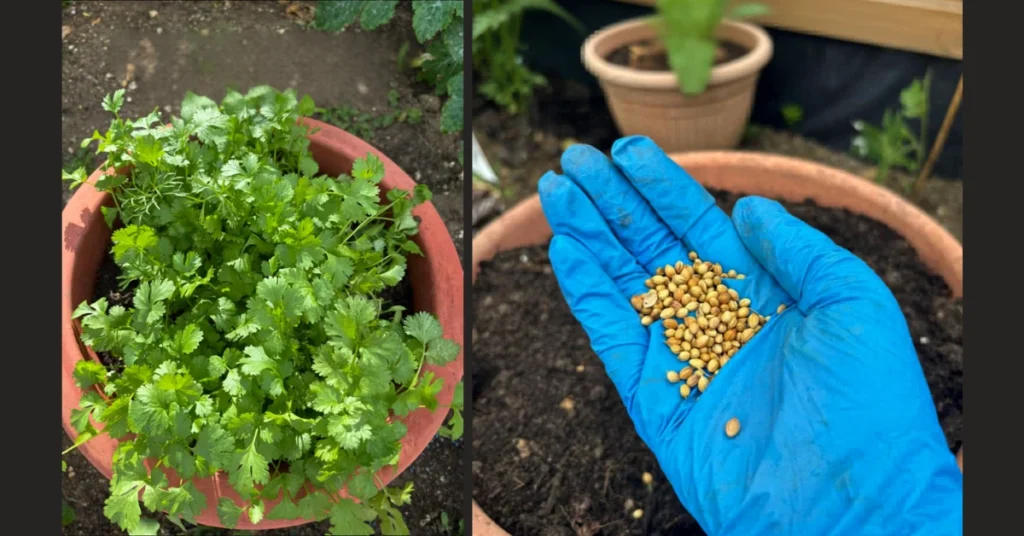
- Coriander (dhania): Fast-growing, tolerates humidity well, ready to harvest in three to four weeks. Sow seeds directly, don’t transplant.
- Mint (pudina): Extremely hardy, spreads aggressively once established, thrives in humid conditions. Grow it in its own container — it will take over anything it shares space with.
- Curry leaves (kadi patta): A one-time investment as a sapling that keeps producing for years. Slow to establish but low-maintenance once mature.
- Okra (bhindi): Genuinely thrives in Delhi’s warm, humid monsoon weather and is one of the more forgiving fruiting vegetables for beginners.
- Ridge gourd and bottle gourd (turai, lauki): Vigorous monsoon growers if you have vertical space — a trellis, a railing, or a wall to train them along.
- Green chillies: Tolerant of monsoon conditions once past the seedling stage, though seedlings need protection from waterlogging.
- Brinjal (baingan): Does reasonably well but needs more consistent care and pest watching than okra.
What to avoid or delay until post-monsoon:
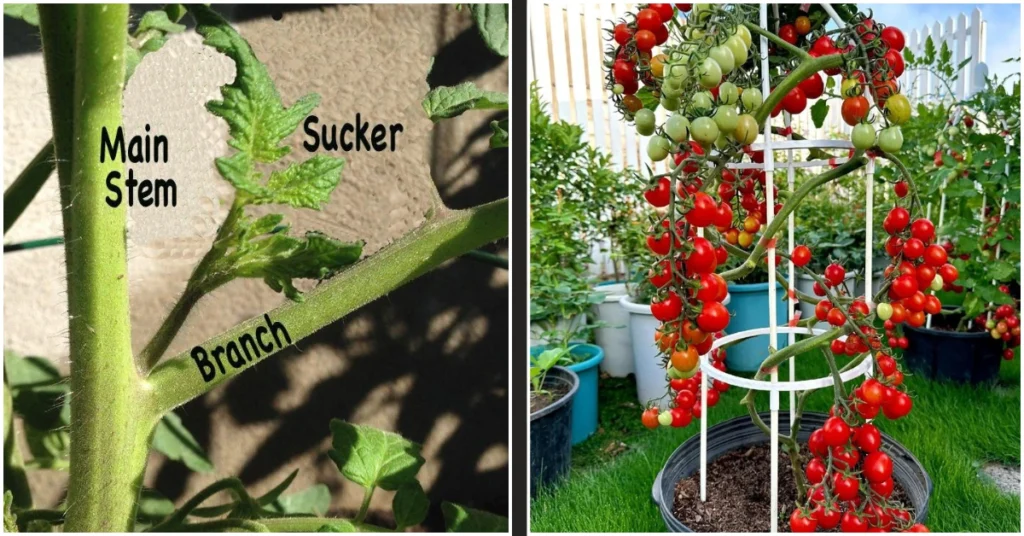
- Tomatoes are genuinely difficult during peak monsoon because excess moisture encourages fungal disease and fruit cracking. Many experienced NCR growers plant tomatoes in August as the rains start easing, rather than in the thick of July’s heaviest downpours, for a much easier growing experience.
- Root vegetables like carrots and radish generally do better sown post-monsoon, once waterlogging risk drops.
- Leafy greens like spinach and lettuce can bolt or rot in excess humidity if containers don’t drain fast enough — manageable, but they need closer attention during the wettest weeks.
Step 5: Watering — The Monsoon Paradox
Counterintuitively, the biggest killer of container plants during Delhi-NCR’s monsoon isn’t underwatering, it’s overwatering, or more precisely, poor drainage combined with rain the gardener didn’t account for. People used to watering daily in the dry heat keep doing it out of habit once the rains start, and the combination of rainfall plus manual watering drowns the roots.
Keeping an eye on localized weather forecasts makes container watering far easier. Following the India Meteorological Department’s monsoon rainfall updates helps balcony gardeners anticipate heavy downpours ahead of time, ensuring pots can be shielded from waterlogging before root damage sets in.
The fix is simple but requires a mindset shift: check the soil with your finger before watering, rather than watering on a fixed schedule. If the top inch is still damp from the last rain, skip it. Make sure every container has proper drainage holes and, ideally, sits slightly elevated on bricks or pot feet so water doesn’t pool underneath and seep back up. During particularly heavy rain spells, it’s worth temporarily moving pots under an overhang or covered part of the balcony if your plants are showing yellowing leaves — a classic sign of waterlogged roots.
Step 6: Composting — Closing the Loop
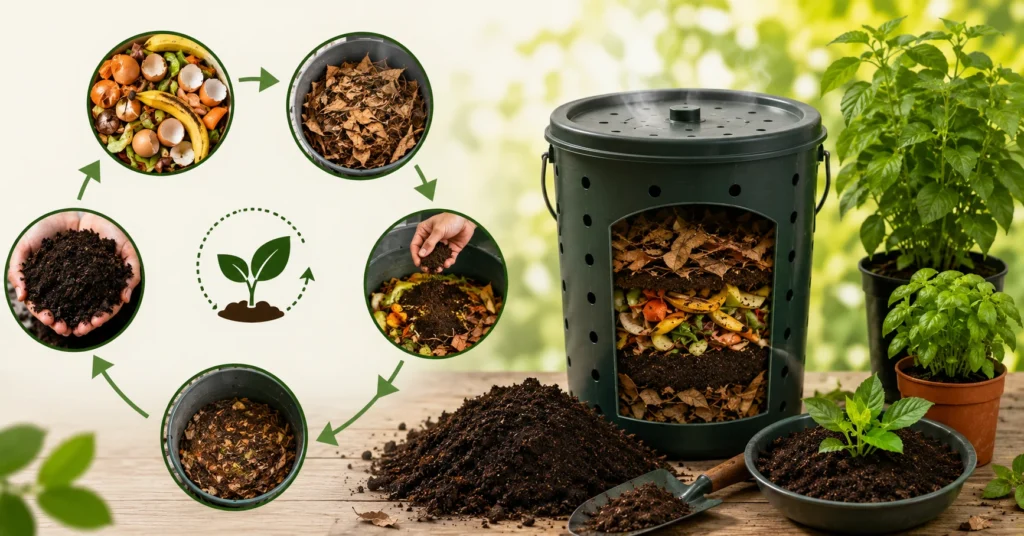
A meaningful share of NCR’s new balcony gardeners got there through composting first, not the other way around. If your society has a wet-waste segregation programme, kitchen scraps — vegetable peels, tea leaves, eggshells, fruit waste — can go into a small balcony compost bin instead of the general bin, and come back a few weeks later as free, high-quality fertiliser for your containers.
A basic balcony composting setup needs only two stacked containers with holes drilled for aeration and drainage, alternating layers of “green” waste (kitchen scraps) and “brown” waste (dry leaves, shredded newspaper, cardboard) in roughly equal proportion, and an occasional turn with a trowel to keep it aerated and speed up decomposition. It will smell faintly earthy if done right, and unpleasant if it’s too wet or too green-heavy — a sign to add more dry brown material and turn it more often.
For a household growing five or six containers, home compost alone can often cover most of the season’s fertiliser needs, which is where a chunk of the real cost savings in balcony gardening actually comes from — not the vegetables themselves, but not having to buy fertiliser or, indirectly, waste collection reduces too.
Step 7: Managing Pests Without Chemicals
Balcony gardens attract far fewer pests than open ground, but monsoon humidity does bring some regulars: aphids on new growth, whiteflies on the undersides of leaves, and fungal issues on anything overwatered.
Most experienced organic growers in the region rely on a short list of home remedies rather than commercial pesticides, which matters both for cost and because most people growing their own food specifically want to avoid the chemicals they’re trying to escape by growing it themselves in the first place:
- A diluted neem oil spray (a teaspoon of neem oil, a few drops of dish soap as an emulsifier, mixed into a litre of water) handles most soft-bodied pests like aphids and whiteflies when sprayed every five to seven days.
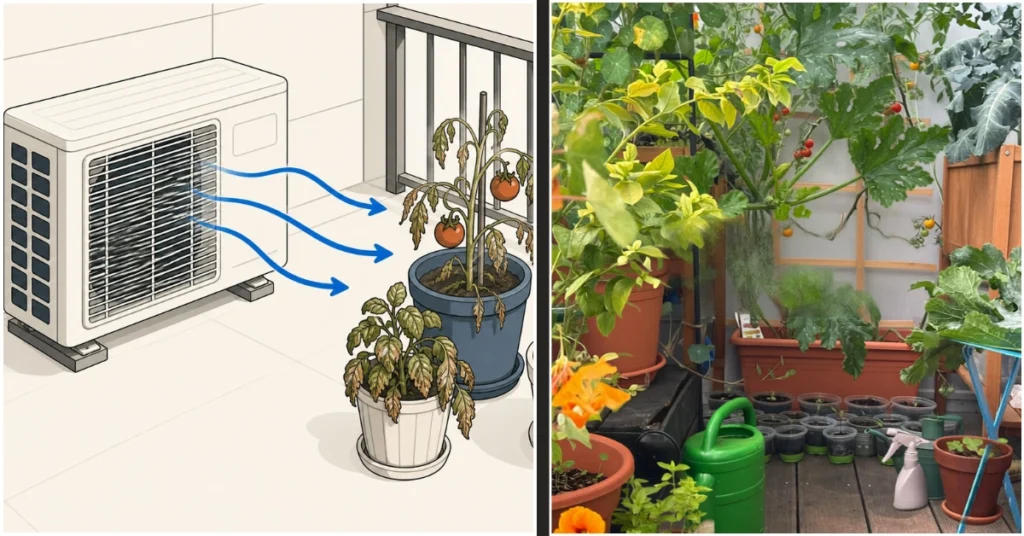
- Good airflow between containers — not cramming pots too close together — reduces fungal issues significantly, since stagnant humid air around leaves is what invites disease in the first place.
- Removing yellowing or diseased leaves promptly, rather than leaving them on the plant, stops fungal problems from spreading to healthy growth.
Step 8: Vertical Space Is Your Best Friend in an Apartment
Balcony space in NCR apartments is almost always the limiting factor, not sunlight or motivation. The gardeners who get the most out of small spaces almost universally use vertical growing rather than trying to cram more pots along the floor.
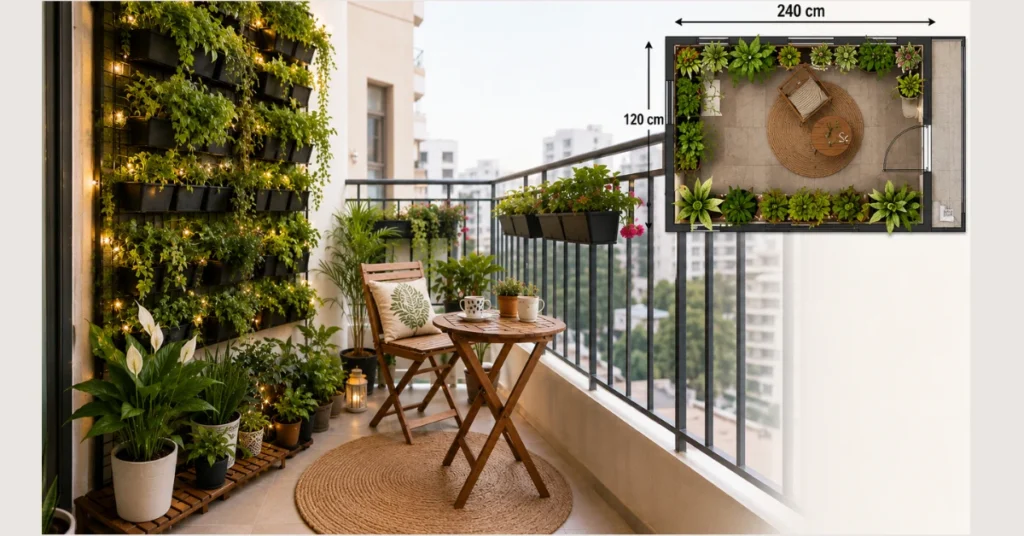
Railing planters add growing space without taking up floor area at all. A simple trellis or a few lengths of jute twine strung from railing to ceiling gives climbing plants like gourds, beans, and even some tomato varieties somewhere to go besides sideways. Tiered plant stands stack multiple small containers into a single footprint, which is particularly useful for herb collections where each plant doesn’t need much room individually.
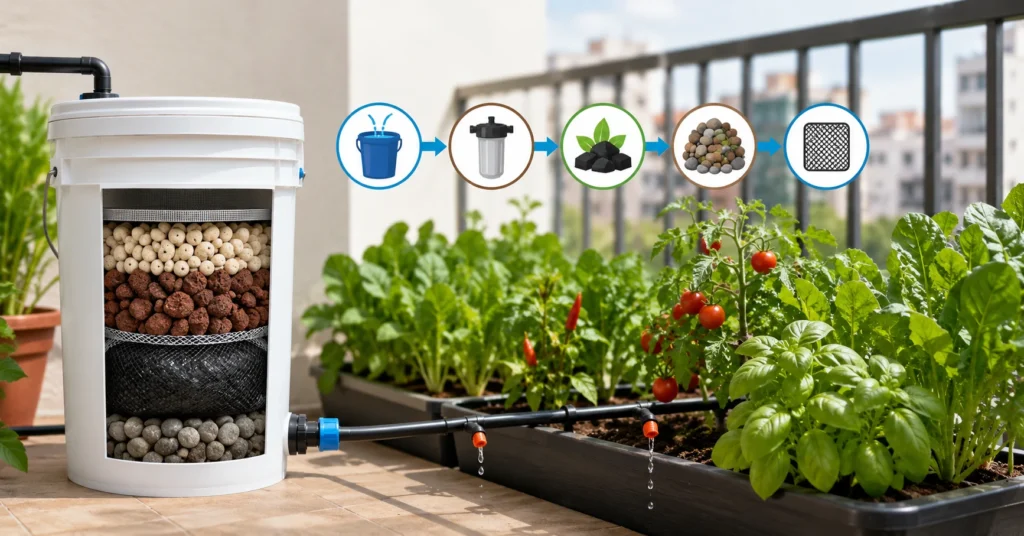
If you decide to expand your setup or scale up to a full terrace garden, managing your daily watering schedule becomes crucial during peak summer and dry spells. Consider building a DIY balcony drip irrigation system to keep your plants consistently hydrated without clogging your emitters or stripping essential minerals from the soil.
Balcony vs. Terrace: Choosing the Right Scale
Not every apartment in NCR has the same amount of usable outdoor space, and the right approach genuinely differs depending on what you’re working with.
If you have a standard apartment balcony — the six-by-four or eight-by-four foot space most flats in Gurugram, Noida, and Dwarka come with — the realistic ceiling is somewhere around eight to twelve containers, mixing a couple of fruiting vegetables with a larger cluster of herbs and greens. This is enough to notice a real difference in your kitchen without the garden taking over your ability to actually use the balcony for anything else.
If you have terrace access, either a private terrace or shared access through your society, the scale changes completely. Raised beds become viable instead of just containers, which hold moisture and nutrients far better and let root systems develop properly. Several NCR societies have started converting underused terrace space into shared kitchen gardens split among interested residents, with a rotating watering and harvesting schedule managed through the RWA. This model tends to produce noticeably more food per household than individual balcony efforts, simply because shared terrace space is larger and the collective effort spreads the workload.
If you have neither — a north-facing balcony with almost no direct light, or no outdoor space at all — a compact indoor setup near a bright window can still support herbs like mint and coriander, though fruiting vegetables are genuinely difficult without direct sun. In these cases, many residents redirect their effort toward composting alone, contributing kitchen waste to a society-level composting programme even without growing anything themselves.
What You’ll Actually Spend: A Realistic Starter Budget
Gardening content online tends to either wildly oversell the savings or wildly overstate the setup cost. Here’s a more grounded breakdown for a first-time NCR balcony gardener working with roughly six to eight containers:
- Grow bags or containers (6–8 units): This is typically the single biggest line item, though it’s a one-time cost since good quality fabric grow bags last three to four growing seasons with reasonable care.
- Potting mix: A modest recurring cost for the first setup, reduced significantly in future seasons once you’re generating your own compost.
- Seeds and saplings: Seed packets for coriander, methi, and greens are inexpensive and go a long way, while established saplings for curry leaves or chillies cost more upfront but save weeks of germination time.
- Basic tools: A hand trowel, a small watering can, and a pair of pruning scissors cover almost everything a balcony garden needs — no need for anything more elaborate at this scale.
- Neem oil for pest control: A small bottle lasts an entire season and covers most common pest issues without needing anything else.
Total first-season setup for a modest six-to-eight-container garden generally lands in a range most households wouldn’t think twice about spending on a single restaurant meal out — and a meaningful share of that is a one-time cost, not a recurring one. From the second season onward, with reusable containers and home compost in place, the ongoing cost drops close to just the price of seeds.
A Rough Monsoon-to-Winter Planting Calendar for NCR
For readers who want a sense of what to plant and when, here’s a general timeline suited to Delhi-NCR’s climate:
- Mid-to-late July (current monsoon peak): Coriander, mint, methi, okra, ridge gourd, bottle gourd, green chillies (as established seedlings, not from seed, to avoid monsoon rot at the delicate seedling stage).
- Late August into September (rains easing): Tomatoes, brinjal, capsicum — this is genuinely the easier window for these crops compared to peak monsoon.
- October into November (post-monsoon, cooler weather setting in): Carrots, radish, spinach, lettuce, peas, and the classic North Indian winter vegetable lineup, which thrives in Delhi’s cooler, drier winter air far more easily than in the humidity of the monsoon months.
Timing matters more than most first-time gardeners expect. Planting the right crop in the wrong season is the single most common reason beginners in NCR give up after one disappointing attempt, when the real issue was never a lack of a green thumb — it was fighting the climate instead of working with it.
The Bigger Picture: What This Trend Says About Urban India
It’s tempting to file this under “hobby trend” and move on, but there’s a more interesting story underneath it. Delhi-NCR’s balcony farming boom is a small, local example of something happening in cities across India — a generation of urban residents who grew up completely disconnected from where their food comes from, actively choosing to reconnect with it, not out of ideology but out of a very practical mix of rising costs, waste-management pressure from their own housing societies, and a genuine, almost surprising enjoyment of the process once they try it.
It’s not going to change how Delhi-NCR is fed. The scale is far too small, and it will always be a supplement, never a replacement, for the mandi system that feeds a region of this size. But at the household level, for the people doing it, it’s changing something real: a slightly smaller grocery bill during the worst weeks of the price cycle, noticeably fresher herbs and greens on the plate, a genuinely calming daily routine of checking on a handful of plants, and — for the families doing it with children — a small, tangible lesson in where food actually comes from, growing quietly on a balcony railing in Gurugram, Noida, or South Delhi, one grow bag at a time.
FAQs
Is balcony gardening actually worth it during Delhi’s monsoon, or should I wait until winter?
Monsoon is actually a strong season to start, provided you choose monsoon-tolerant crops like coriander, mint, okra, and gourds rather than fighting the season with tomatoes and root vegetables, which do better once the heaviest rains ease off in late August and September.
How much does it cost to set up a basic balcony kitchen garden in NCR?
A modest starter setup — five to six grow bags, potting mix, and a mix of seeds and one or two nursery saplings — typically costs a few hundred to around a thousand rupees depending on scale, most of which is a one-time cost since grow bags and containers are reusable across multiple growing seasons.
Do I need direct sunlight for a balcony garden to work?
Fruiting vegetables genuinely need five to six hours of direct sun, but if your balcony gets less than that, you can still grow a productive herb and leafy green garden — coriander, mint, and spinach all tolerate partial shade reasonably well.
What’s the easiest vegetable for a complete beginner to grow in a Delhi-NCR apartment?
Coriander and mint are the most forgiving starting points — fast-growing, hard to kill, and genuinely useful in daily North Indian cooking, which makes them a satisfying first success before moving on to fruiting vegetables like chillies or okra.
Can balcony gardening really reduce my monthly grocery bill?
It won’t replace your main vegetable shopping, but it can meaningfully reduce spending on high-frequency items like coriander, mint, curry leaves, and green chillies, which are exactly the items where mandi prices swing hardest during the monsoon.